Artwork
A Bearded Man and a Man in Profile [verso]
![A Bearded Man and a Man in Profile [verso], by Paul Gauguin, graphite, 1886](https://artifactworldgallery.com/img/paul-gauguin--a-bearded-man-and-a-man-in-profile-verso--321a620089eb3c34-w1024.webp)
A Bearded Man and a Man in Profile [verso] is a graphite drawing by the Impressionist artist Paul Gauguin. It dates from 1886 and is held in the collection of the National Gallery of Art. Created in 1886, A Bearded Man and a Man in Profile is a drawing on wove paper executed with graphite and crayon.
- Inscription
- Inscribed:notations overall
About this work
The painting is called A Bearded Man and a Man in Profile. It was created by Paul Gauguin between 1884 and 1888. The work is held at the National Gallery of Art, Washington, and is classified as a portrait, which might suggest Gauguin's interest in people and their stories. To learn more about the style and period of this work, look up Impressionism.
Overview
The work measures a modest size and presents two male figures, one bearded and one shown in profile, rendered in a restrained monochrome palette.
Created in 1886, A Bearded Man and a Man in Profile is a drawing on wove paper executed with graphite and crayon. The work measures a modest size and presents two male figures, one bearded and one shown in profile, rendered in a restrained monochrome palette. It resides in the collection of the National Gallery of Art in Washington, D.C., and is catalogued as a portrait within Gauguin’s early graphic oeuvre.
Subject & Meaning
The composition juxtaposes a bearded sitter with a second figure rendered in profile, suggesting a study of character and interpersonal contrast. While no narrative is supplied, the pairing invites contemplation of identity and the social roles of men in the late‑19th‑century milieu that preoccupied Gauguin.
Technique & Style
Gauguin employed a combination of graphite for line work and crayon for tonal shading, allowing subtle variations of texture on the wove paper support. The drawing exhibits a departure from the fleeting brushwork of Impressionism, favoring more deliberate contours and a simplified, expressive handling of form that anticipates his later Symbolist concerns.
History & Provenance
The piece belongs to the period when Gauguin was expanding his practice beyond painting to include drawing, printmaking, and sculpture. It reflects his early graphic production before the development of his mature Synthetist style. The work entered the National Gallery of Art’s collection through acquisition in the mid‑20th century, though earlier ownership details remain sparse.
Context
During the mid‑1880s Gauguin was increasingly dissatisfied with the conventions of French Impressionism, seeking a more structured visual language. This drawing aligns with his broader search for symbolic content and a heightened emotional resonance, traits that would later define his contributions to Post‑Impressionism and Symbolism.
![Crouching Monkey and Man's Head; Bones and Muscles [verso]](https://artifactworldgallery.com/img/paul-gauguin--crouching-monkey-and-man-s-head-bones-and-muscles-verso--6ce66c8fb6bba7c2-w320.webp)
Own this work as a print
Artist & collection
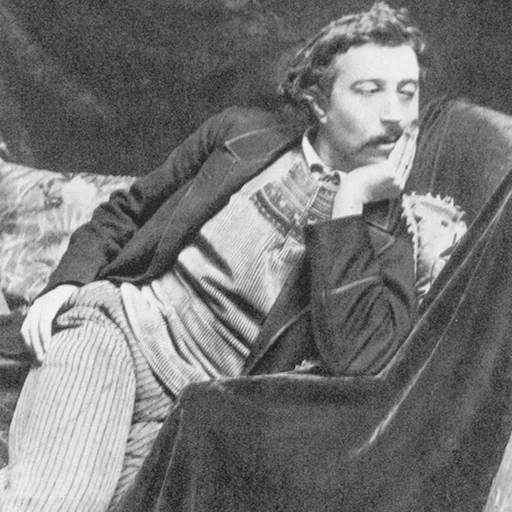
Artist
Eugène Henri Paul Gauguin (; French:; 7 June 1848 – 8 May 1903) was a French painter, sculptor, printmaker, ceramist, and writer, whose work has been primarily associated with the Post-Impressionist and Symbolist movements.

![Heads of a Boy and a Man (Self-Portrait?) [verso], by Paul Gauguin](https://artifactworldgallery.com/img/paul-gauguin--heads-of-a-boy-and-a-man-self-portrait-verso--92a4d2aa3cb26bf0-w320.webp) Heads of a Boy and a Man (Self-Portrait?) [verso]
Heads of a Boy and a Man (Self-Portrait?) [verso]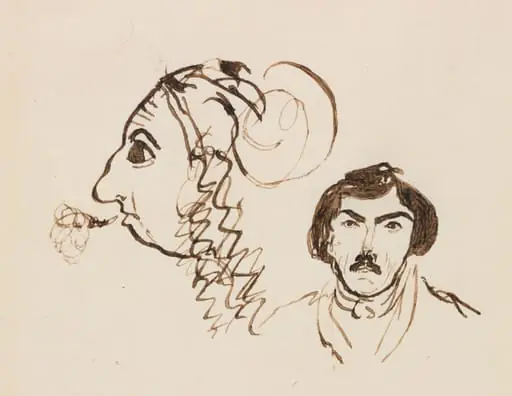 Self-Portrait with Portrait of Delacroix
![Two Figures and a Bench; Three Studies of Men's Heads and One of a Hand [recto], by Paul Gauguin](https://artifactworldgallery.com/img/paul-gauguin--two-figures-and-a-bench-three-studies-of-men-s-heads-and-one--b308c9e6d9f9cfa9-w320.webp) Two Figures and a Bench; Three Studies of Men's Heads and One of a Hand [recto]
Two Figures and a Bench; Three Studies of Men's Heads and One of a Hand [recto]![A Caricature and Five Forms; A Man in Profile, a Winged Creature and a Boy [verso], by Paul Gauguin](https://artifactworldgallery.com/img/paul-gauguin--a-caricature-and-five-forms-a-man-in-profile-a-winged-creatu--ba33d39de90d54d7-w320.webp) A Caricature and Five Forms; A Man in Profile, a Winged Creature and a Boy [verso]
A Caricature and Five Forms; A Man in Profile, a Winged Creature and a Boy [verso]![Four Studies of Breton Women; Shapes and Vases [verso], by Paul Gauguin](https://artifactworldgallery.com/img/paul-gauguin--four-studies-of-breton-women-shapes-and-vases-verso--9d4d602e9c3e8bff-w320.webp) Four Studies of Breton Women; Shapes and Vases [verso]
Four Studies of Breton Women; Shapes and Vases [verso]![A Person Holding an Umbrella and a Seated Man with a Hat and a Glass [verso], by Paul Gauguin](https://artifactworldgallery.com/img/paul-gauguin--a-person-holding-an-umbrella-and-a-seated-man-with-a-hat-and--8307c4522b7d6e38-w320.webp) A Person Holding an Umbrella and a Seated Man with a Hat and a Glass [verso]
A Person Holding an Umbrella and a Seated Man with a Hat and a Glass [verso]![A Profile and Four Shapes; Sketch of a Man's Head [recto], by Paul Gauguin](https://artifactworldgallery.com/img/paul-gauguin--a-profile-and-four-shapes-sketch-of-a-man-s-head-recto--5fde9bfd1a02c6cf-w320.webp) A Profile and Four Shapes; Sketch of a Man's Head [recto]
A Profile and Four Shapes; Sketch of a Man's Head [recto]![Five Sheep; Four Head Studies [verso], by Paul Gauguin](https://artifactworldgallery.com/img/paul-gauguin--five-sheep-four-head-studies-verso--c7b13148bfdbb0ae-w320.webp) Five Sheep; Four Head Studies [verso]
Five Sheep; Four Head Studies [verso]![Landscape and Head of Man; Head of Monkey Inside a Square [recto], by Paul Gauguin](https://artifactworldgallery.com/img/paul-gauguin--landscape-and-head-of-man-head-of-monkey-inside-a-square-rec--9db8c3f222a674c1-w320.webp) Landscape and Head of Man; Head of Monkey Inside a Square [recto]
Landscape and Head of Man; Head of Monkey Inside a Square [recto]![Three Studies of a Man Wearing a Hat [recto], by Paul Gauguin](https://artifactworldgallery.com/img/paul-gauguin--three-studies-of-a-man-wearing-a-hat-recto--1337f9984d88798b-w320.webp) Three Studies of a Man Wearing a Hat [recto]
Three Studies of a Man Wearing a Hat [recto]