Artwork
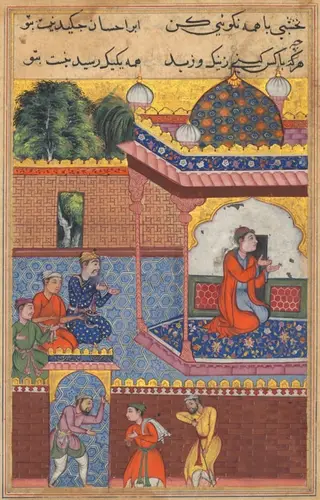
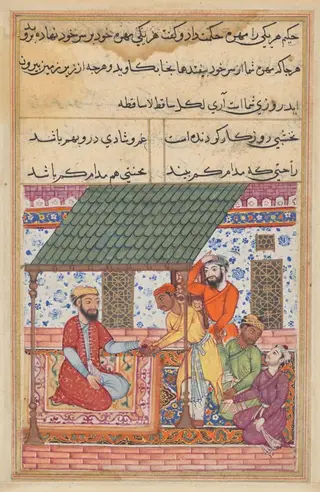
Kaiwan, Latif, and Sharif arrive at a house of worship, where they seek help from Khurshid who has become a mystical healer, from a Tuti-Nama (Tales of a Parrot): Thirty-second Night
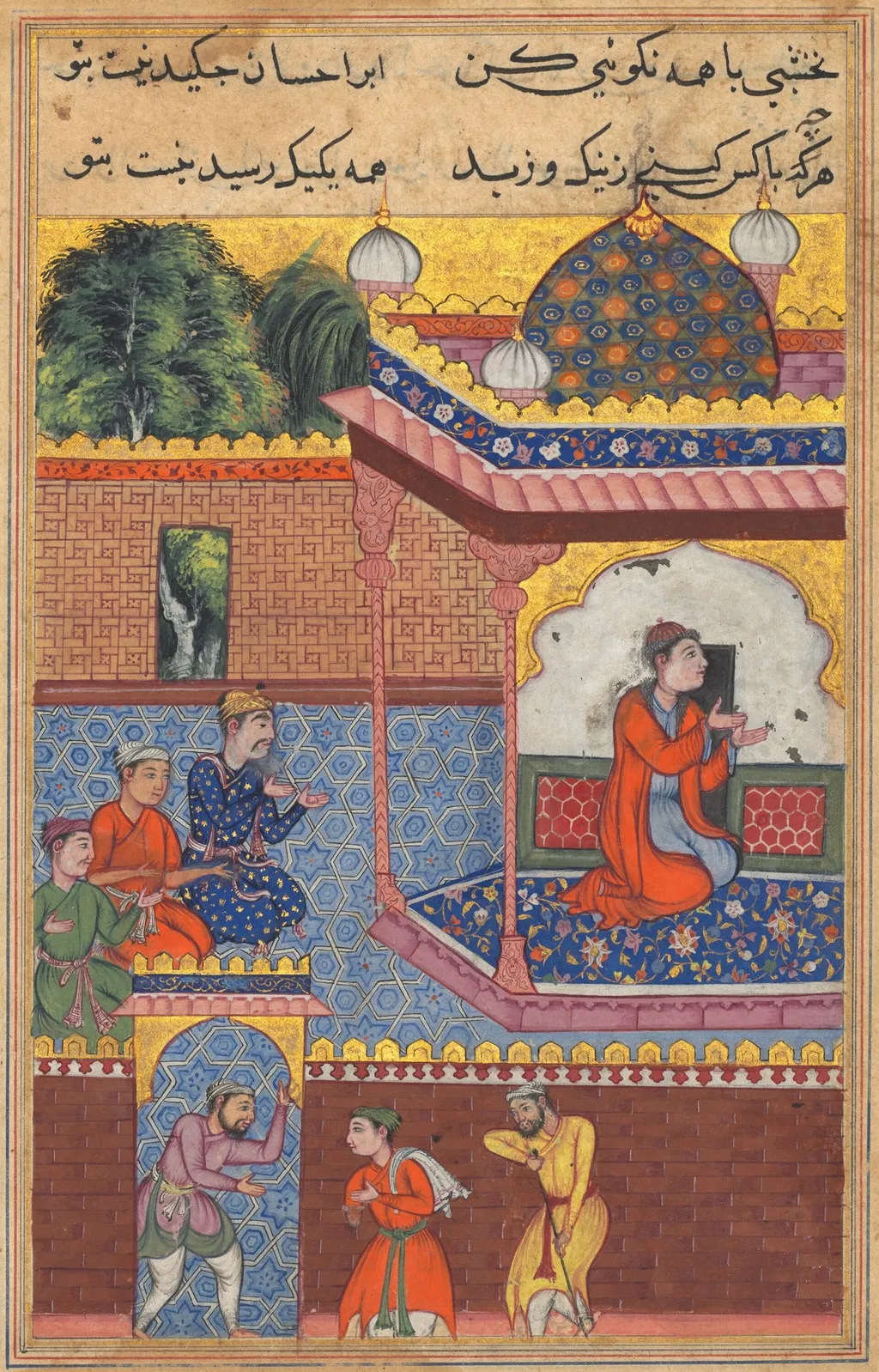
Kaiwan, Latif, and Sharif arrive at a house of worship, where they seek help from Khurshid who has become a mystical healer, from a Tuti-Nama (Tales of a Parrot): Thirty-second Night is an unspecified painting. It dates from 1560 and is held in the collection of the Cleveland Museum of Art. The work is a multi‑panel painting that divides a narrative scene into four distinct registers.
About this work
Subject & Meaning
Within the narrative context of this Mughal manuscript, Khurshid is portrayed as having transformed into a mystical healer who provides aid to the protagonists.
The painting illustrates a specific episode from the Thirty-second Night of the Tuti-Nama, or Tales of a Parrot. The scene depicts the characters Kaiwan, Latif, and Sharif arriving at a house of worship to seek assistance from Khurshid. Within the narrative context of this Mughal manuscript, Khurshid is portrayed as having transformed into a mystical healer who provides aid to the protagonists. This visual narrative captures a moment of spiritual intervention and divine healing central to the story's progression.
Technique & Style
The scene illustrates a narrative moment from the Tuti-Nama manuscript painted in 1560 during the Mughal period. Executed as a miniature on paper, the work employs fine brushwork and natural pigments typical of courtly Persianate illustration. Figures are rendered with delicate outlines and flat areas of color, emphasizing flattened spatial depth and ornamental patterning.
The composition balances narrative clarity with stylized elegance, reflecting contemporary manuscript conventions. The support is paper, handled with care to preserve its fragile surface, and the condition remains stable with only minor pigment fading.
History & Provenance
The painting was created circa 1560 in the Mughal Empire, aligning with the early imperial atelier context where the Tuti-Nama manuscript was produced under Mughal patronage.
Its ownership history is documented beginning with its inclusion in the Cleveland Museum of Art’s collection, where it is cataloged as object 1962.279.213.b. The museum acquired the work in 1962, integrating it into a broader collection of Mughal-era manuscripts and paintings.
The painting is held in the collection of the Cleveland Museum of Art, which holds it under the inventory designation 1962.279.213.b. It was produced in 1560 within the Mughal Empire and entered the museum's holdings as part of the Tuti-Nama manuscript cycle. No further exhibition history is documented in the available sources.
Legacy
The painting has shaped later Persian manuscript illustration by establishing a visual grammar for mystical encounters, a motif that recurs in 17th century works such as the Safavid Shahnameh and later Mughal album paintings. Its role as an early example of narrative sequencing within a single frame informed the compositional strategies of later Indian miniatures, where figures converge at sacred sites to seek spiritual aid. The work's inclusion in the Cleveland Museum of Art collection has kept it accessible to scholars studying the diffusion of Sufi iconography across Persianate courts, reinforcing its reputation as a prototype for later depictions of mystic healers.
Overview
The work is a multi‑panel painting that divides a narrative scene into four distinct registers. A golden dome and foliage appear behind a red brick façade at the top, while the lower registers depict three figures in vivid blue, orange and green robes interacting near a doorway, accompanied by additional characters in secondary actions.
Context
Set against a backdrop of Persian literary culture, the scene aligns with the 16th‑18th century practice of illustrating epic and romantic tales for elite audiences. The use of Persian script at the top reinforces the work’s function as a visual accompaniment to the written narrative, bridging text and image.
Artist & collection

- Kaiwan, Latif, and Sharif arrive at a house of worship, where they seek help from Khurshid who has become a mystical healer, from a Tuti-Nama (Tales of a Parrot): Thirty-second Night
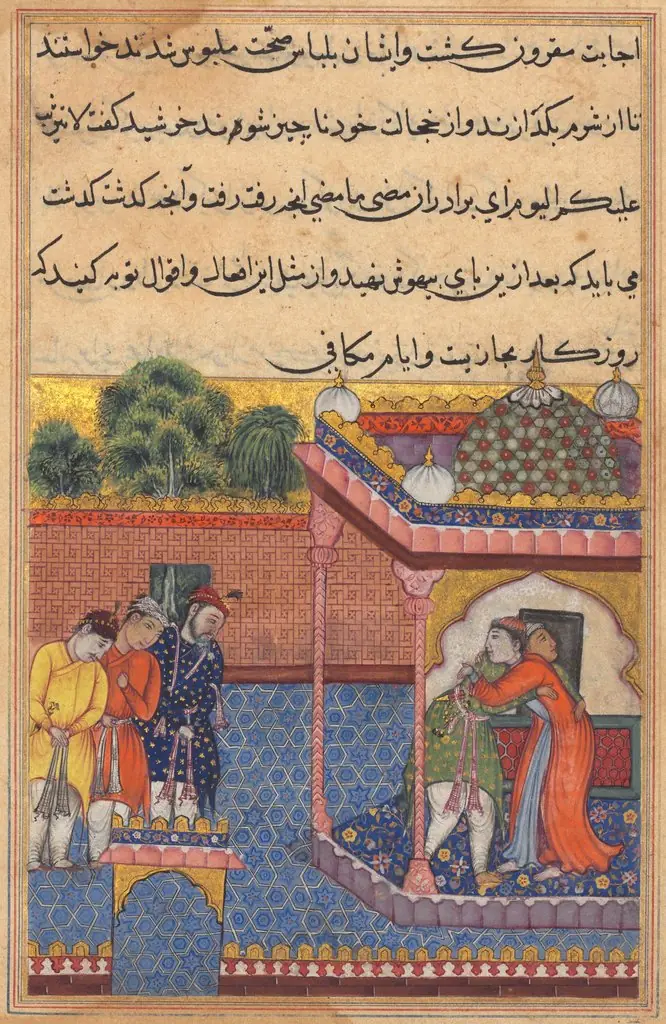 Khurshid reunited with her husband Utarid, from a Tuti-nama (Tales of a Parrot): Thirty-second Night
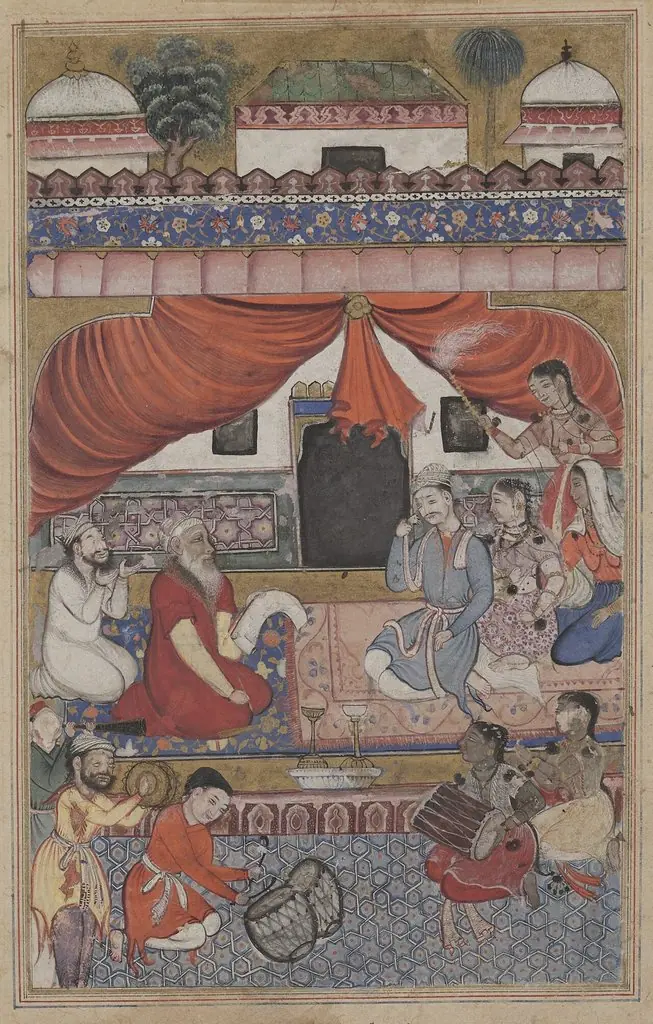 Preparation for the marriage of Mahmuda to the Young Vizier, from a Tuti-nama (Tales of a Parrot): Thirty-third Night
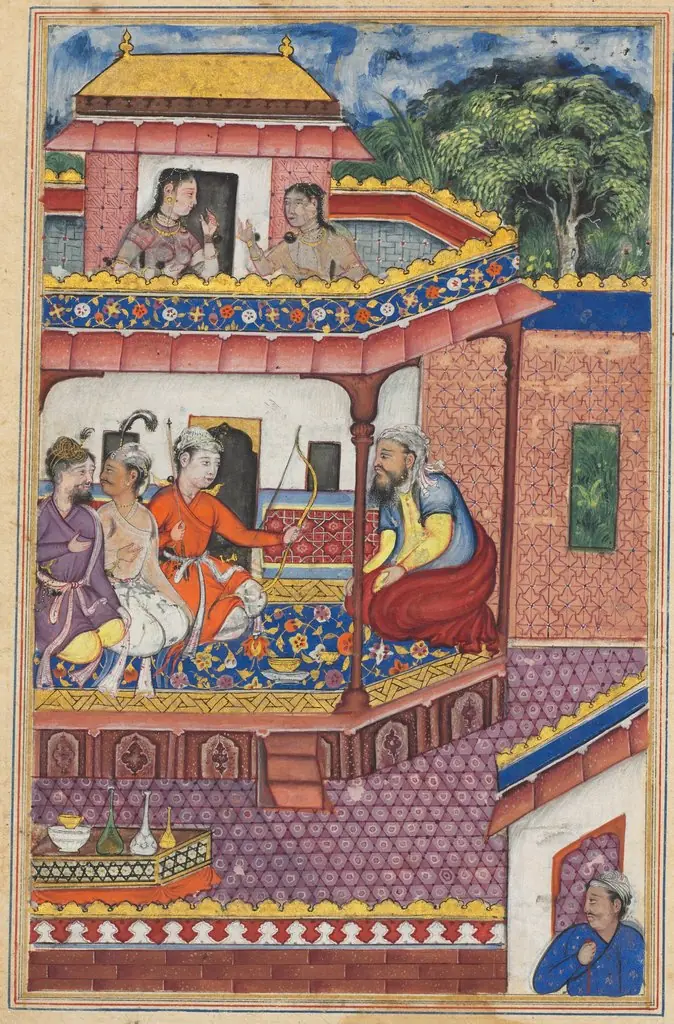 The three young men present themselves as suitors for the hand of Zuhra, the daughter of the merchant of Kabul, from a Tuti-nama (Tales of a Parrot): Thirty-fourth Night
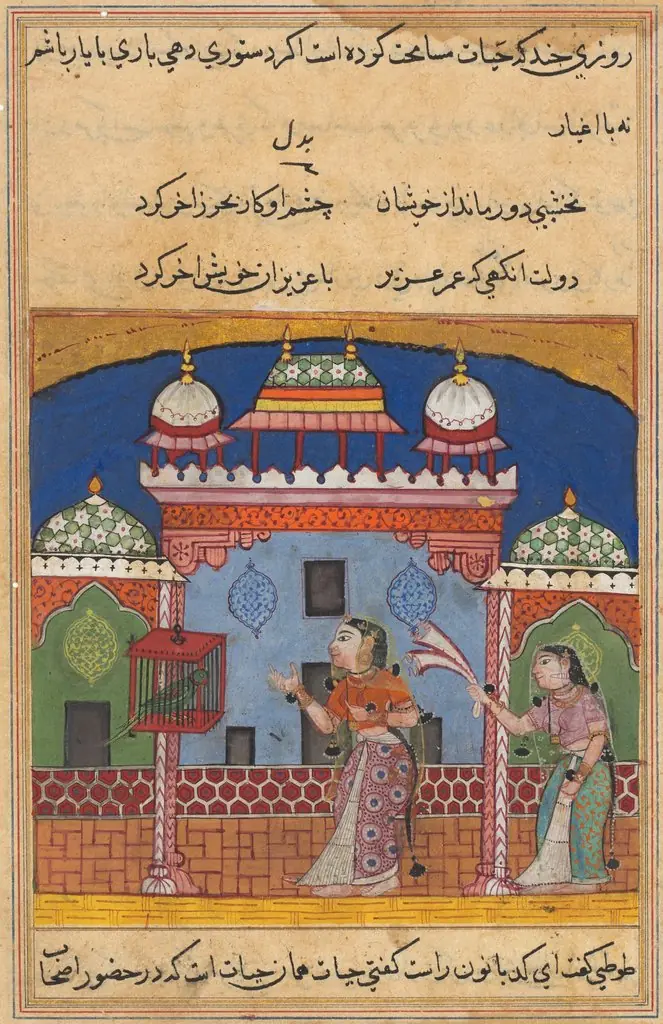 The Parrot Addresses Khujasta at the Beginning of the Twenty-second Night, from a Tuti-nama (Tales of a Parrot)
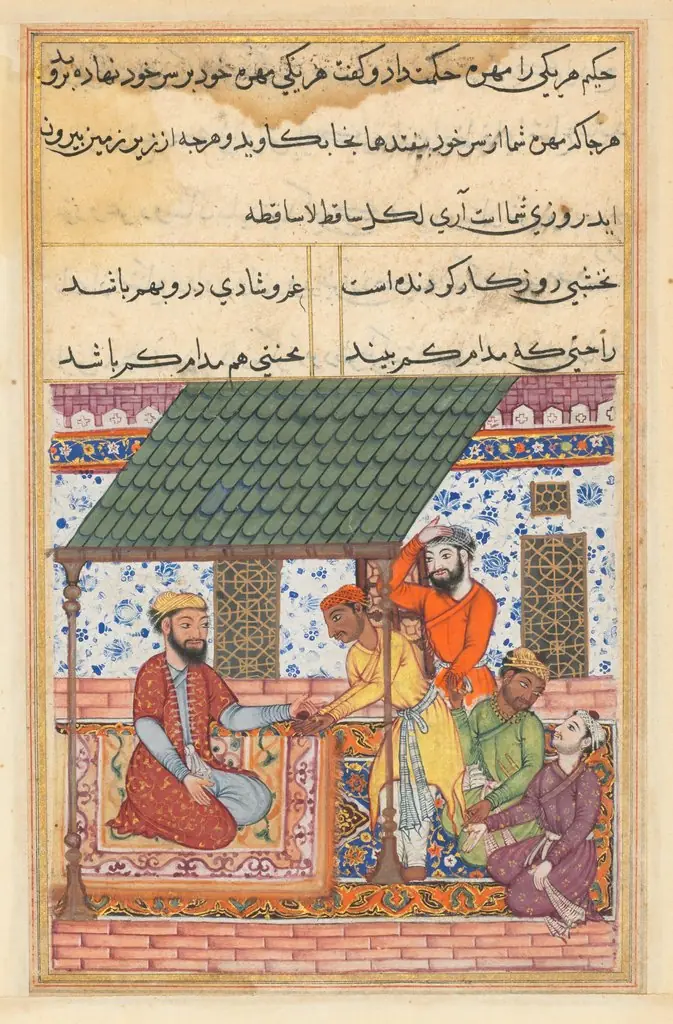 The four destitute friends go to a wise man who gives each one of them a magic shell to be placed on top of the turban, from a Tuti-nama (Tales of a Parrot): Forty-seventh Night
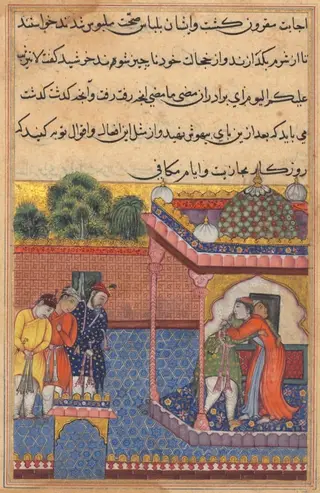 Khurshid reunited with her husband Utarid, from a Tuti-nama (Tales of a Parrot): Thirty-second Night
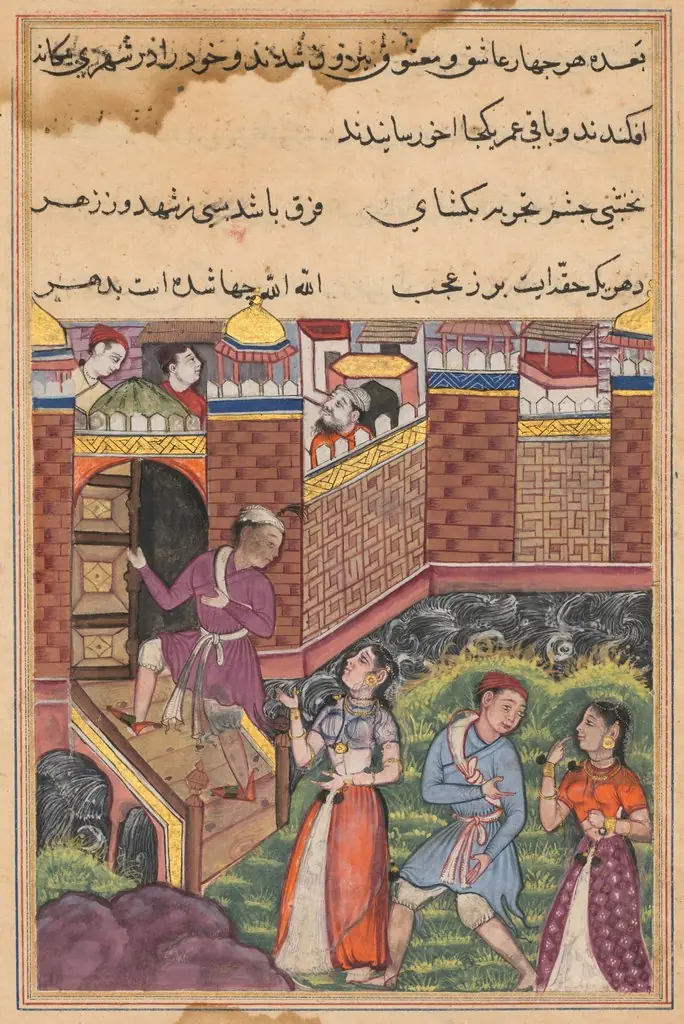 The two couples reach a foreign city where they make their home, from a Tuti-nama (Tales of a Parrot): Thirty-third Night
 The four destitute friends go to a wise man who gives each one of them a magic shell to be placed on top of the turban, from a Tuti-nama (Tales of a Parrot): Forty-seventh Night