Artwork
Venus with Cupid the Honey Thief
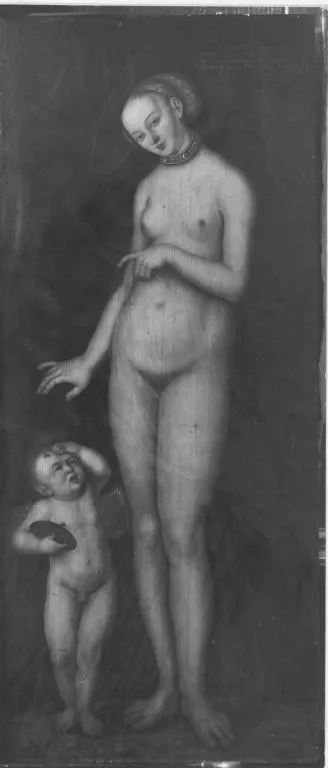
Venus with Cupid the Honey Thief is an unspecified painting by the Northern Renaissance artist Lucas Cranach the Elder. It dates from 1549 and is held in the collection of the Bavarian State Painting Collections.
About this work
Subject & Meaning
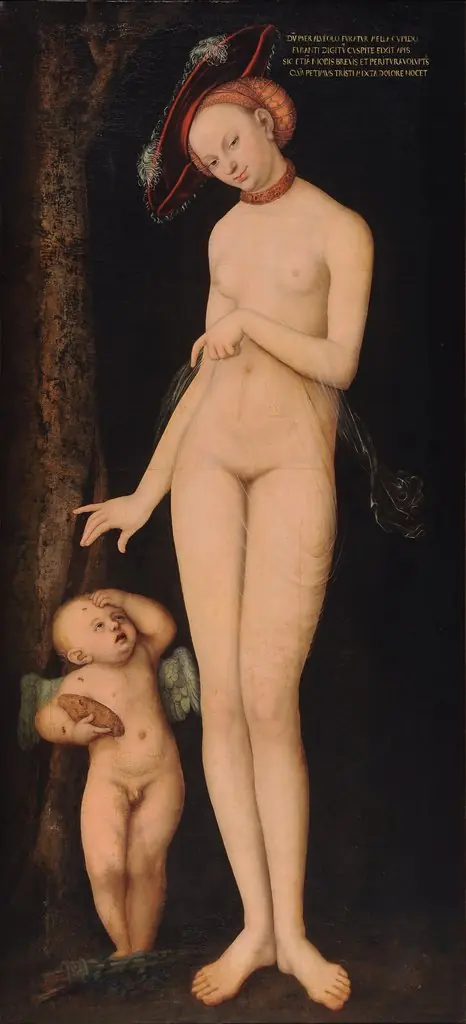
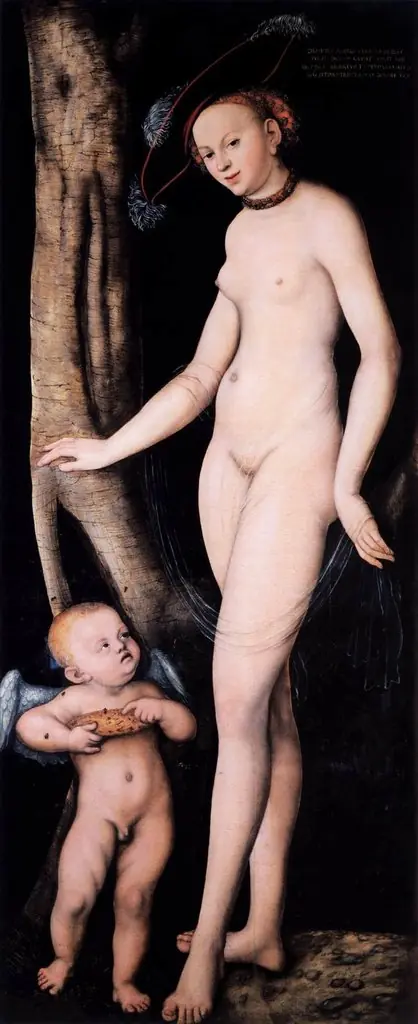
In the composition, Cupid reaches for the honeycomb while a small bee threatens to steal it, underscoring the fleeting nature of sensual pleasure.
The painting shows Venus handing a honeycomb to her son Cupid, a scene drawn from classical mythology that emphasizes themes of love and desire. In the composition, Cupid reaches for the honeycomb while a small bee threatens to steal it, underscoring the fleeting nature of sensual pleasure. The work belongs to the mythological genre and was created by Lucas Cranach the Elder in 1549 for the Bavarian State Painting Collections, where it remains on display at the Alte Pinakothek.
The iconography links Venus to love and Cupid to the mischievous forces that drive romantic attraction, while the honey motif serves as a visual metaphor for the sweetness and peril of desire. This symbolic use of honey reflects Renaissance interest in translating moral and erotic ideas into tangible visual cues.
The painting is catalogued as a mythological work within the collection of the Alte Pinakothek, confirming its provenance and historical context.
Technique & Style
The work is executed in oil on panel, measuring 174 cm in height and 74 cm in width. It belongs to the mythological painting genre and portrays Venus and Cupid in a sensual scene where Cupid steals honey. The composition demonstrates the characteristic linear grace and rich coloration of the school of Lucas Cranach the Elder, with fine brushwork that emphasizes the delicate textures of flesh and fabric. The painting is housed in the Alte Pinakothek of the Bavarian State Painting Collections.
History & Provenance
Painted in 1549, this panel entered the Bavarian State Painting Collections (Alte Pinakothek, Munich) as part of the holdings inventoried as BStGS 5466.
Its creation history is consistently attributed to Lucas Cranach the Elder on the basis of the 1549 date inscribed on the original panel and the workshop’s characteristic handling of mythological subjects.
The painting is held by the Bavarian State Painting Collections (Alte Pinakothek, Munich), where it is inventoried as BStGS 5466.
It was included in the museum’s holdings by 1949, when its Cranach school attribution was already associated with Lucas Cranach the Elder. The work has not been recorded in major loan exhibitions since its acquisition, and no further exhibition history beyond institutional custody at the Alte Pinakothek is documented.
Legacy
The painting has been frequently cited as an influential example of Northern Renaissance mythological imagery, shaping later interpretations of Venus and Cupid themes in European art. Its composition and sensual treatment of the figures informed subsequent Baroque and Rococo depictions of similar subjects, particularly in German and Austrian academic circles of the 17th and 18th centuries. The work's presence in the Bavarian State Painting Collections at the Alte Pinakothek has ensured its continued scholarly attention, with art historians referencing its stylistic qualities in studies of Cranach's workshop and the transmission of mythological motifs.
The painting's legacy is primarily documented through its inclusion in academic analyses of Renaissance art history and its role as a reference point in museum collections focused on German Renaissance painting.
Overview
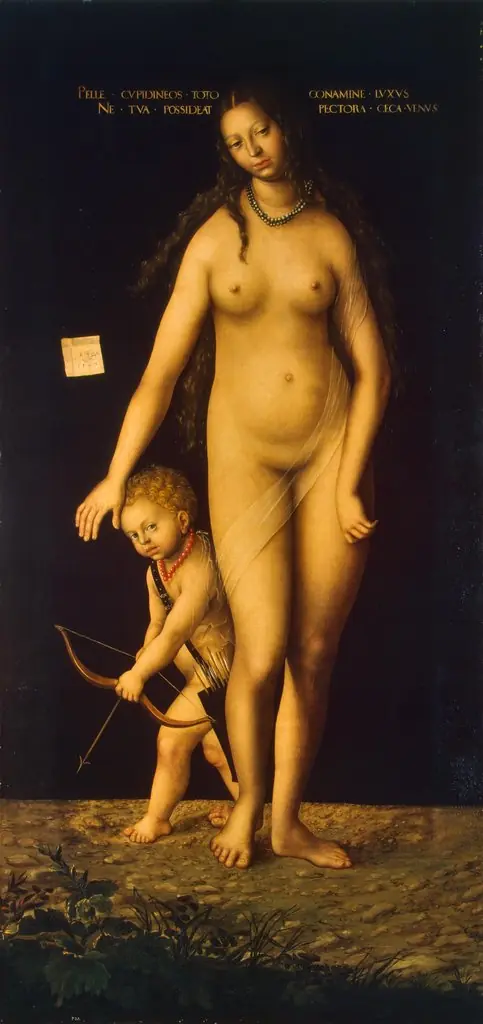
Lucas Cranach the Elder’s 1549 oil painting ‘Venus with Cupid the Honey Thief’ presents a nude Venus standing beside a small, also nude, Cupid. The goddess leans forward, her right hand reaching toward the child, who gazes up at her while clutching an object. The scene unfolds against a deep, shadowed backdrop, emphasizing the intimate interaction between the figures.
Context
During the mid‑16th century, Northern artists like Cranach frequently revisited classical themes, adapting them to contemporary tastes and moral discourse. This work exemplifies the blend of humanist interest in antiquity with the Protestant environment of Germany, where mythological scenes were often employed for allegorical or didactic purposes.
Artist & collection
Artist
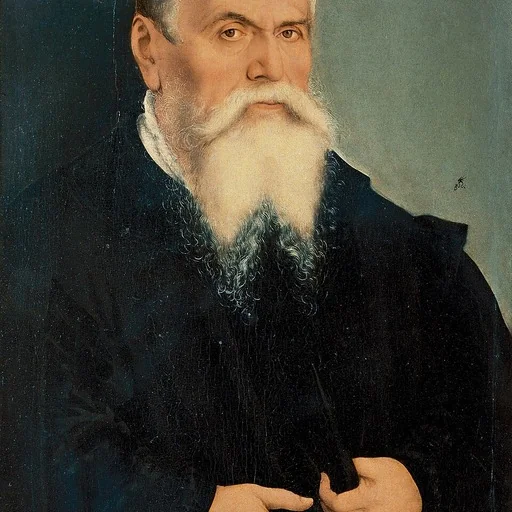
Lucas Cranach the Elder was a German Renaissance painter and printmaker in woodcut and engraving.