Artwork
Hope
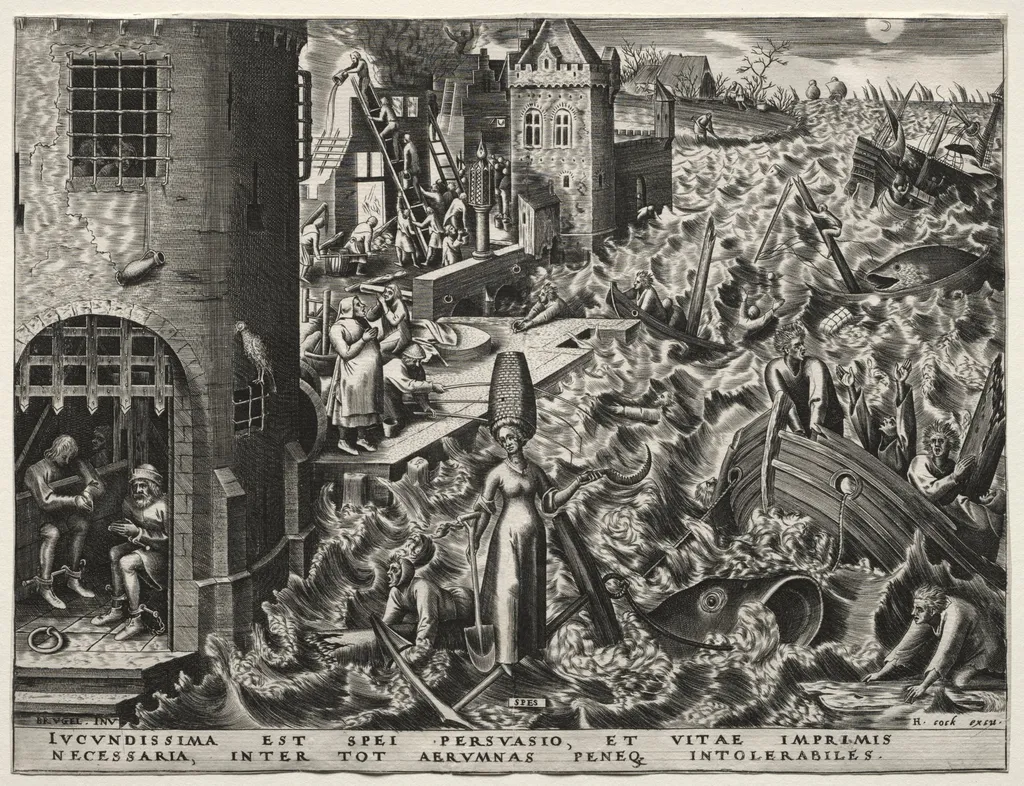
Hope is a print by the Renaissance artist Pieter Brueghel I. It dates from 1559 and is held in the collection of the Cleveland Museum of Art.
- Accession no.
- 1964.447
- Credit line
- Delia E. Holden Fund
About this work
Overview
Unlike many contemporaries focused on religious narratives, Bruegel turned to allegorical scenes drawn from everyday life.
Created in 1559, Hope is a print by Pieter Bruegel the Elder, part of a series exploring the theological virtues. Unlike many contemporaries focused on religious narratives, Bruegel turned to allegorical scenes drawn from everyday life. His choice to render abstract concepts through human activity marked a shift in Northern European art, aligning spiritual ideas with observable reality rather than iconographic tradition.
Subject & Meaning
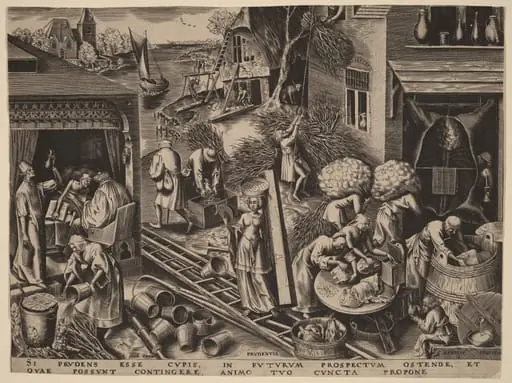
The image depicts a solitary figure seated in a barren landscape, gazing upward as she spins thread from a distaff. This act of patient labor symbolizes hope as an enduring, quiet force. The sparse surroundings and minimal figures emphasize introspection over spectacle.
Bruegel avoids overt religious symbols, instead using domestic activity to convey a moral state, inviting viewers to interpret faith through perseverance rather than doctrine.
Technique & Style
Bruegel employed engraving to achieve fine linear detail and subtle tonal variation. His composition balances emptiness and structure, using horizontal bands of earth and sky to ground the figure in a vast, unyielding world. The meticulous rendering of textures, fabric, soil, foliage, reflects his interest in natural observation.
The scale is modest, yet the emotional weight is amplified by restraint, avoiding dramatic gestures in favor of quiet resolve.
History & Provenance
The print was produced during Bruegel’s time in Antwerp, where he collaborated with publishers to disseminate his imagery through prints. It circulated widely among educated patrons and artisans, contributing to his reputation beyond painting. Early ownership records are sparse, but surviving impressions in major European collections suggest its early and sustained reception as a significant work within his allegorical series.
Context
In the late 1550s, the Low Countries were undergoing religious and political upheaval. As Catholic iconography faced scrutiny, artists turned to secular and moral themes. Bruegel’s focus on virtues like hope, faith, and charity responded to this climate, not through dogma, but by embedding spiritual ideals in the rhythms of rural life. His work offered a new visual language for belief in uncertain times.
Legacy
Bruegel’s approach influenced later Northern artists who favored genre scenes infused with moral depth. Hope exemplifies a transition from medieval symbolism to human-centered allegory, paving the way for the Dutch Golden Age’s emphasis on everyday life as a vessel for meaning. Though not widely exhibited as a standalone work, its conceptual framework resonated in the works of Rembrandt and others who sought dignity in the ordinary.
Own this work as a print
Artist & collection

Artist
Pieter Bruegel (also Brueghel or Breughel) the Elder ( BROY-gəl, US also BROO-gəl; Dutch: ; c.

![Storm off the Coast of Barcelona [recto], by Jacques Callot](https://artifactworldgallery.com/img/jacques-callot--storm-off-the-coast-of-barcelona-recto--92a18ea3f3786efe-w320.webp)