Artwork
Rembrandt and Saskia in the parable of the Prodigal Son
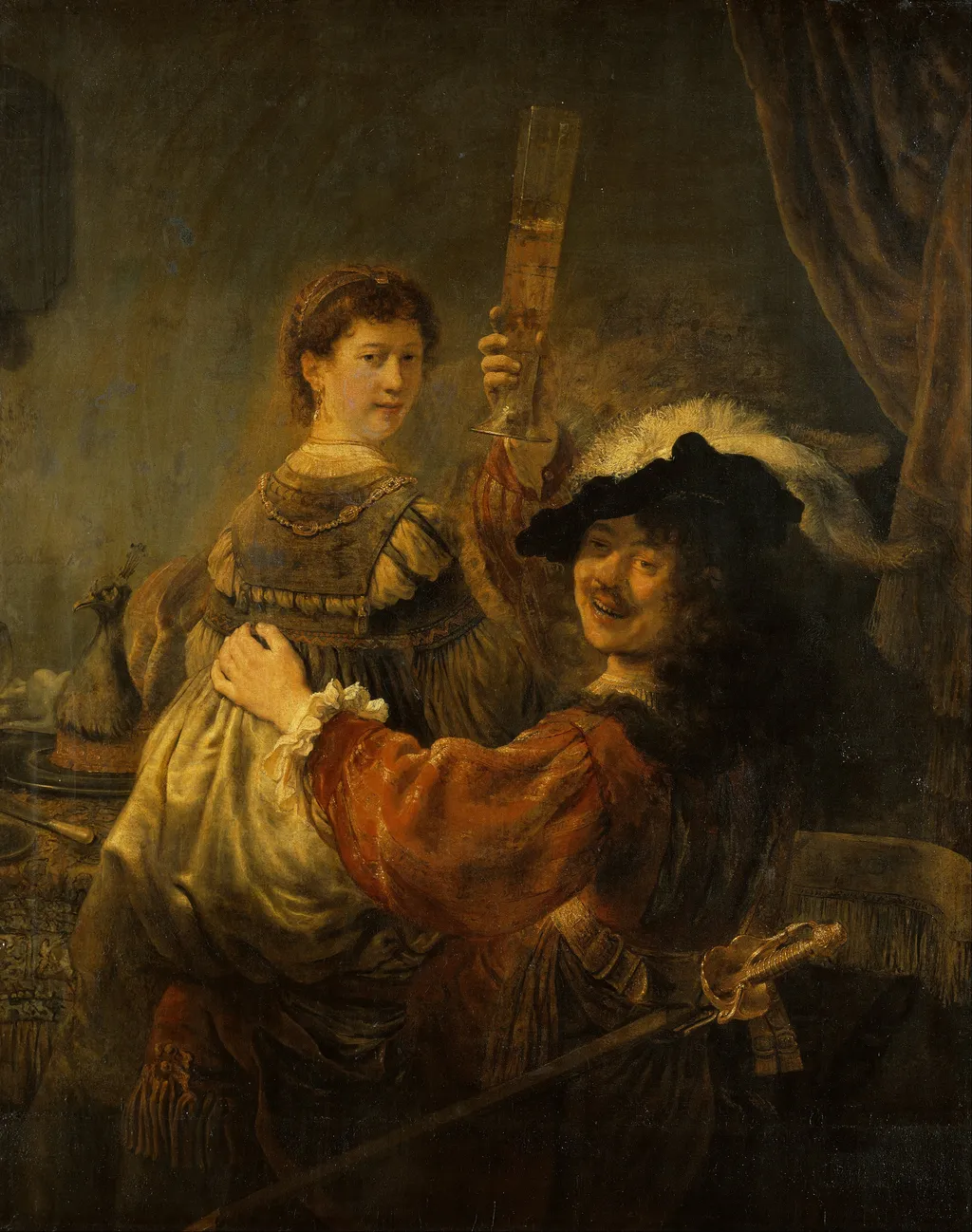
Rembrandt and Saskia in the parable of the Prodigal Son is an oil painting by the Dutch Golden Age artist Rembrandt van Rijn. It dates from 1635 and is held in the collection of the Staatliche Kunstsammlungen Dresden.
About this work
Technique & Style
This alteration transformed the piece from a typical tavern scene into a focused double portrait, enhancing the dramatic impact of the richly dressed couple.
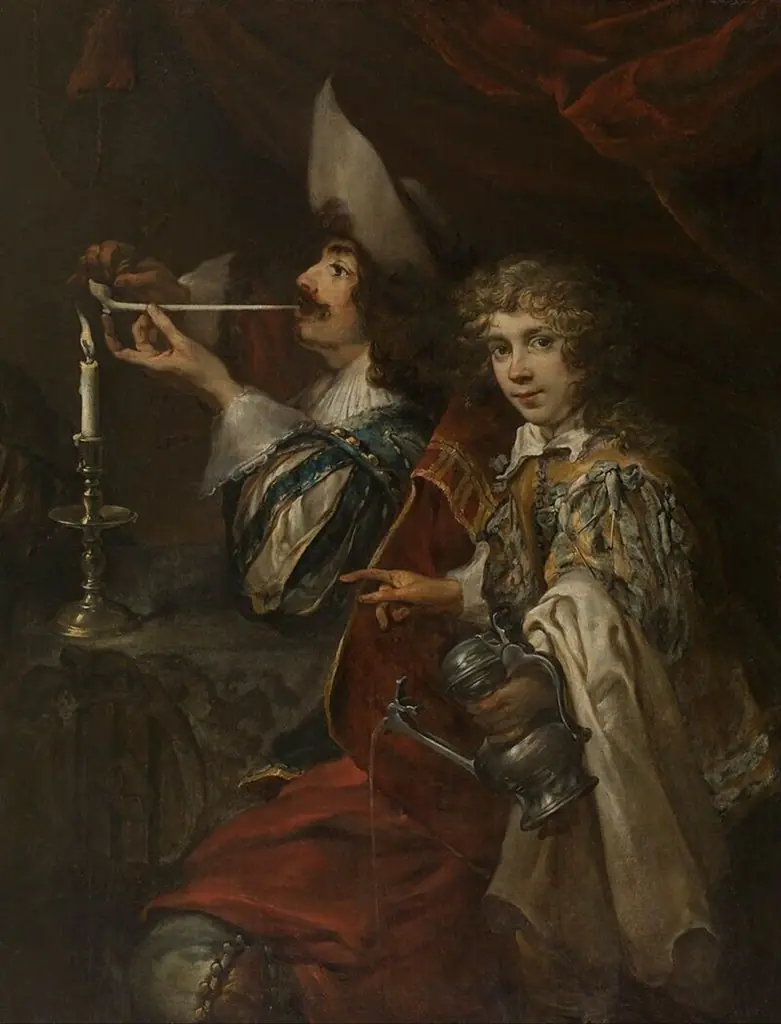
Executed in oil on canvas, the work measures 161 by 131 cm and bears the signature "REMBRANDT F.". The artist employed a multilayer technique utilizing Baroque pigments including red ochre, lead-tin-yellow, madder lake, and smalt. Stylistically, the painting exhibits a realistic Baroque approach defined by chiaroscuro, which isolates the central figures against a uniform greenish-brown background. The composition was originally wider but was cut on the left side, likely by Rembrandt himself around 1638, to remove secondary characters such as a nude flute player revealed by X-ray analysis. This alteration transformed the piece from a typical tavern scene into a focused double portrait, enhancing the dramatic impact of the richly dressed couple.
History & Provenance
Rembrandt’s *Rembrandt and Saskia in the parable of the Prodigal Son* was created in 1635 as an oil-on-canvas painting, initially conceived as a horizontal tavern scene with multiple figures. By 1638, the artist reworked the composition, trimming the left edge, possibly to eliminate secondary characters, and overpainting a nude flute player, transforming it into a double portrait focused on himself and Saskia van Uylenburgh, whom he had married in 1634. The work entered the collection of Friedrich August II of Saxony in 1749, acquired through the Parisian art dealer Noël Araignon. During World War II, it was relocated to Albrechtsburg in Meissen and later to a railway tunnel near Rottwerndorf for protection. Confiscated by Soviet authorities in 1945, it was exhibited in Moscow’s Pushkin Museum and Berlin’s Nationalgalerie before being returned to Dresden in 1955. Since then, it has remained in the Gemäldegalerie Alte Meister. The painting Rembrandt and Saskia in the parable of the Prodigal Son is held in the Gemäldegalerie Alte Meister in Dresden, Germany. Its inventory number is not explicitly stated in the provided sources, but its presence in the collection is confirmed by multiple references to its location and provenance. The work was acquired in 1749 through the Parisian art dealer Noël Araignon for Elector Friedrich August II of Saxony and later relocated during World War II for protection. After being transported to the Soviet Union as war reparations, it was returned to Dresden in 1955 and reinstalled following the reopening of the Semper Gallery in 1956. The painting has been exhibited in several institutions, including the Pouchkine Museum in Moscow and the Alte Nationalgalerie in Berlin during its return journey. It is signed "REMBRANDT F." and measures 161 cm by 131 cm.
Context
The painting was created between 1634 and 1638 and originally conceived as a genre scene of a tavern with multiple figures, later transformed by Rembrandt in 1638 into a focused composition emphasizing the central couple, possibly to meet client specifications or to adjust format. It depicts Rembrandt and his wife Saskia as models embodying the Prodigal Son parable, a theme recurrent in Dutch Golden Age art due to its moral duality of condemning sinful excess yet offering redemption. The work underwent significant revisions, including the removal of secondary characters and alteration of background elements, revealing underlying symbolism such as a changed musical instrument representing a sinful life. Its interpretation evolved over centuries, with 18th-century collections referencing it under secular titles before 20th-century scholarship firmly linked it to the biblical narrative, reflecting its enduring significance in Rembrandt's oeuvre and art historical discourse.
Legacy
Rembrandt’s *Rembrandt and Saskia in the Parable of the Prodigal Son* (1635) has exerted enduring influence on interpretations of biblical narrative in art. Initially misunderstood, listed in the 18th century as a genre scene titled *Officer Seated Caressing a Lady*, its connection to the Prodigal Son parable was firmly established only in the 20th century, following X-radiographic evidence revealing an overpainted female musician, a symbol of moral dissipation. The painting’s innovative focus on the prodigal’s dissolute phase, rather than his repentance, inspired later artists to explore less conventional moments within religious stories. Its compositional refinement, including the cropped left edge to emphasize the central figures, and its moral ambiguity, juxtaposing lavish indulgence with impending reckoning, have cemented its reputation as a masterful fusion of portraiture, allegory, and genre painting. Displayed in the Gemäldegalerie Alte Meister, Dresden, it remains a key reference for studies of Rembrandt’s engagement with Protestant moral themes and his evolving pictorial techniques.
Own this work as a print
Artist & collection

Artist
Rembrandt Harmenszoon van Rijn, known mononymously as Rembrandt, was a Dutch Golden Age painter, printmaker, and draughtsman.