Artwork
The Conspiracy of Claudius Civilis
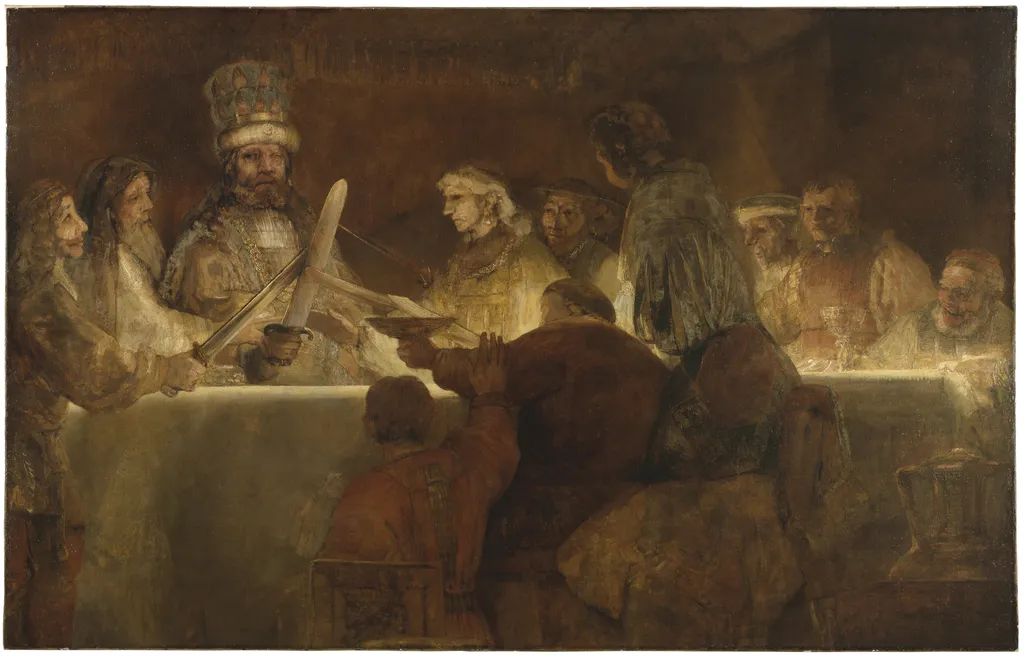
The Conspiracy of Claudius Civilis is an oil painting by the Dutch Golden Age artist Rembrandt van Rijn. It dates from 1661 and is held in the collection of the Rijksmuseum.
About this work
Subject & Meaning
The scene is set in a darkened vaulted hall lit only by candles the figures partly shield, heightening the conspiratorial tension.
The painting depicts an episode from the Batavian rebellion of 69–70 AD, as recounted in Tacitus's Histories. The one-eyed chieftain Claudius Civilis (called Julius Civilis by Tacitus) gathers the chiefs of his nation and the boldest commoners in a sacred grove under the pretext of a banquet, then binds them with barbarous rites and oaths to revolt against Rome. Civilis is shown frontally, displaying his missing left eye, a disfigurement Rembrandt drew directly from Tacitus, whereas earlier depictions such as Otto van Veen's 1612 engravings always showed him in profile to conceal it.
Rembrandt invented the central iconographic motif: a sword oath in which the conspirators lay their blades together, with one extra sword touching the leader's blade. Earlier treatments, including Antonio Tempesta's engraving after Van Veen, showed the oath sealed by handshakes. By Tacitus's account, the rites were barbaro ritu, with swords joined above a golden bowl from which the assembly drank, Rembrandt's composition preserves this, with a single attendant offering a cup, likely containing blood.
The scene is set in a darkened vaulted hall lit only by candles the figures partly shield, heightening the conspiratorial tension. The conspirators wear fanciful costumes blending antique and seventeenth-century Dutch dress, while Rembrandt deliberately renders their faces coarse and grotesque, even applying face paint to the figure at the far left. A crown incongruously placed on Civilis's head and his dominance of the scene clashed with the republican sensibilities of the Amsterdam council, for whom the Batavian revolt symbolized the recently concluded Dutch struggle against Spain.
Technique & Style
The Conspiracy of Claudius Civilis is an oil painting on canvas created by Rembrandt Harmenszoon van Rijn between 1661 and 1662. The work was executed on a large wooden support measuring originally approximately 500 by 500 centimetres in a lunette format, but was later reduced to 196 by 309 centimetres after the artist cut down the composition for commercial reasons. Rembrandt employed his characteristic chiaroscuro technique, using iridescent greyish blues, pale yellows and stark contrasts of light and shadow to model the figures within a vaulted interior space.
The composition depicts the moment of oath-taking among Batavian leaders, rendered with a dramatic, quasi‑mythical atmosphere that diverges from contemporary Dutch Golden Age conventions. The painting features a prominent, historically inaccurate crown upon the head of the chieftain and emphasizes a solitary, one‑eyed figure, both elements that contributed to its rejection by the Amsterdam city council. Following its brief display in the town hall, the canvas was returned to the artist, who re‑sized and altered it before selling the fragment, which now resides in the Nationalmuseum in Stockholm.
History & Provenance
The Conspiracy of Claudius Civilis was commissioned by the Amsterdam city council in 1659 for the new Amsterdam Town Hall (now the Royal Palace) as part of a decorative program for the gallery, intended to depict scenes from Dutch history. Rembrandt was tasked with illustrating an episode from Tacitus's Histories concerning the Batavian revolt led by Claudius Civilis, originally conceived as a large lunette measuring approximately 5 meters by 5 meters. The work was delivered in July 1662 but was quickly removed after brief display, likely due to concerns over its decorum, style, and perceived lack of republican heroism, possibly related to its depiction of Civilis with a crown and a missing eye.
Rembrandt may not have been paid, and he later reduced the painting to roughly one-quarter of its original size to make it sellable, cutting away the majority of the composition. The surviving fragment, now in the Nationalmuseum in Stockholm, measures 196 by 309 centimeters and represents the central portion of the original work.
The surviving fragment of The Conspiracy of Claudius Civilis is held in the collection of the Nationalmuseum in Stockholm, Sweden. Originally commissioned for the Amsterdam Town Hall around 1661–1662, the work was briefly installed before being returned to Rembrandt, likely due to stylistic disagreements with the city council. The artist subsequently cut the canvas from its original monumental lunette shape, measuring approximately five by five meters, down to its current dimensions of 196 by 309 centimeters to facilitate a sale.
Regarding its exhibition history, the painting was displayed in the Amsterdam Town Hall gallery for a short period in 1662, specifically disappearing from the site before September 24 of that year. In modern times, the work has been featured in exhibitions at the Nationalmuseum, including displays focused on the museum's masterpieces and specific retrospectives on Rembrandt.
Context
The Conspiracy of Claudius Civilis occupies a singular place in Rembrandt's late career as his last completed secular history painting, executed c. 1661–62 for the Amsterdam Town Hall gallery. Sources frame the work as a direct confrontation with the classicist norms governing Dutch Golden Age history painting, a hierarchy Rembrandt himself acknowledged. Commissioned after Govert Flinck's death, the painting was judged by the Amsterdam council to lack the decorum expected of the genre: its frontal depiction of Civilis's missing eye, the incongruous crown, and its dark, sparsely populated background clashed with the more conventional Baroque treatments by Van Veen and Tempesta that had shaped public expectations.
Kenneth Clark later described the surviving fragment as a "most marvellous picture" whose "quasi-mythical, heroic-magical past" evoked Shakespearean grandeur, while Crenshaw attributed the rejection partly to Rembrandt's absence from Amsterdam and lack of political support. The episode is widely cited in scholarship as emblematic of Rembrandt's resistance to prevailing classicist standards and of the financial pressures that forced him to cut the canvas down to roughly a quarter of its original lunette form.
Legacy
After its brief, contentious display in Amsterdam’s Town Hall, the rejected painting was cut down by Rembrandt and resold in a reduced state, which curtailed its immediate public impact. By the late nineteenth century, however, the surviving fragment in Stockholm had become recognized as a canonical late work, cited in surveys of Dutch Golden Age painting for its bold chiaroscuro and unorthodox treatment of a republican subject. Twentieth-century critics such as Kenneth Clark emphasized its Shakespearean grandeur and grotesque vitality, aligning it with Rembrandt’s late manner rather than the decorous history painting expected by his original patrons.
This shift in reception contributed to its modern status as a masterpiece, anchoring the Nationalmuseum’s holdings and appearing in major Rembrandt exhibitions, including the 1961 survey Mästerverk i Nationalmusei samlingar.
The episode itself entered art-historical discourse as an emblem of artistic independence: the rejected commission’s radical form anticipated later reevaluations of Rembrandt’s late style, securing the work’s legacy beyond its original civic context.
Overview
Rembrandt’s oil work titled The Conspiracy of Claudius Civilis dates from around 1661–62. Originally painted on a massive lunette panel measuring roughly five metres on each side, it was the largest canvas the artist ever tackled. The piece was intended for the Amsterdam Town Hall, commissioned by the city council, but was soon returned to the painter and subsequently reduced in size.
Own this work as a print
Artist & collection

Artist
Rembrandt Harmenszoon van Rijn, known mononymously as Rembrandt, was a Dutch Golden Age painter, printmaker, and draughtsman.

- San Fernando rey de España
 Ahasuerus and Haman at the Feast of Esther
 Assassination of the Bishop of Liège
 Courtyard of a temple
 Belshazzar's feast (Daniel 5:1-31)
 The Tribute Money
 King Ahasuerus condemning Haman
 Tobias's Farewell to his Parents
 Christ and the Adulteress
 The Continence of Scipio
 Mucius Scaevola Confronting King Porsenna
 The Magnanimity of Scipio Africanus