Artwork
The Man with the Golden Helmet
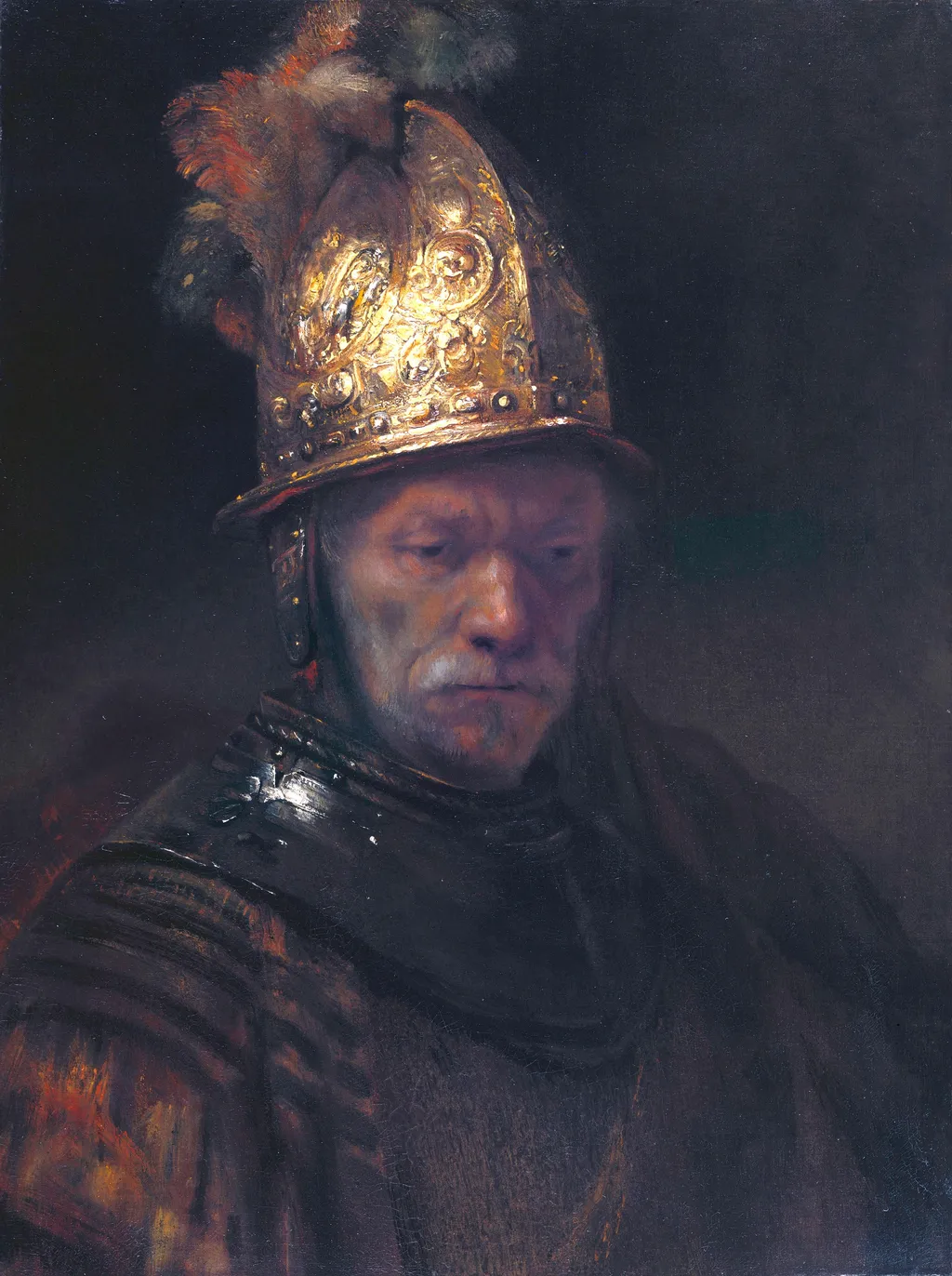
The Man with the Golden Helmet is an oil painting by the Dutch Golden Age artist Rembrandt van Rijn. It dates from 1650 and is held in the collection of the Gemäldegalerie Berlin.
About this work
Subject & Meaning
Abraham Bredius characterized the picture as a "masterful still life of a helmet," noting how the attribute has eclipsed the identity of the man.
The painting presents a single male figure shown from the chest up against a dark, undefined background. He wears an ornate golden helmet with embossed scrollwork and a feathered plume in red and brown tones, a dark metal gorget at his neck, and heavy fabric in deep browns and blacks across his shoulders. His eyes are cast downward, his face partly shadowed, giving him a pensive or melancholic air. The work belongs to the genre of the tronie, a study of a character or type rather than a commissioned portrait of a specific individual. Early speculation identified the sitter as Rembrandt's brother Adriaen, a shoemaker in Leiden, though this theory was discredited since Adriaen died in 1652 and the model appears in works dated 1654. Art historians have proposed various allegorical readings: Wolfgang Schöne suggested the figure might represent Mars, the god of war, or the Roman soldier Longinus, while the helmet itself, already an antiquity by the late seventeenth century, signals the sitter as a warrior of the past whose rank was marked by this splendid headgear. Abraham Bredius characterized the picture as a "masterful still life of a helmet," noting how the attribute has eclipsed the identity of the man.
Technique & Style
Painted in oil on canvas, the work displays the dramatic chiaroscuro associated with Dutch Baroque painting. Light falls strongly from the upper left, illuminating the helmet and parts of the face while the remainder dissolves into shadow. The brushwork is thick and visible in the helmet and plume, with heavy impasto creating a sculptural, light-catching surface, while the background and costume are handled more loosely and atmospherically. The palette is dominated by umbers, blacks, and muted earth tones, punctuated by the brilliant gold of the helmet. Fine craquelure is visible throughout the surface. The painting was cropped at some point in the eighteenth or early nineteenth century, and it has undergone three major restorations. A particularly damaging intervention in the early twentieth century applied an ochre varnish that artificially altered the tonality; the 1993 restoration sought to return the work closer to its original coloring.
Context
The painting's attribution history reflects evolving methods and standards in Rembrandt scholarship. Even at the time of its museum acquisition, skeptics including Hofstede de Groot and Abraham Bredius questioned its authenticity. Wilhelm von Bode's advocacy helped establish it as a canonical Rembrandt, yet Werner Sumowski raised fresh doubts in 1957. The decisive turning point came with the Rembrandt Research Project, launched in 1968. In 1984 a Dutch curators' commission examined the painting in West Berlin and questioned its provenance; in November 1985 Berlin art expert Jan Kelch announced that essential stylistic details did not match Rembrandt's known works, proposing instead a student working around 1650. The following year, based on radiographic analysis, study of the support and underdrawing, and the restoration findings, the Rembrandt Research Project formally removed the attribution. The de-attribution attracted intense media attention and emotional reactions, illustrating how a work's perceived value and public meaning could shift dramatically with scholarly reassessment. Various names were proposed for authorship, including Carel van den Pluim, Heyman Dullaert, and Johann Ulrich Mayr, an Augsburg painter active in Rembrandt's workshop around 1648-1649, though the helmet's origin with Augsburg armorers was noted as circumstantial evidence. Werner Busch observed that under seventeenth-century studio practice, a master had the right to sell everything produced in his atelier under his name, complicating the distinction between master and pupil works.
Legacy
For decades The Man with the Golden Helmet stood as one of the most popular and reproduced works in the Rembrandt canon, its image disseminated through prints, embroideries, and other media into countless homes. The Impressionist generation particularly admired it as a model of their own artistic values. Its fame made the 1986 de-attribution a cultural event with reverberations far beyond specialist circles, raising questions about how authenticity is constructed and how market and institutional interests intersect with connoisseurship. Since losing its Rembrandt attribution, the painting's public profile has diminished, though scholars and critics continue to affirm its quality. Martin Warnke noted that it remains a work of considerable merit regardless of authorship. Today it serves as a case study in the complexities of attribution, the sociology of taste, and the afterlife of images in museum culture.
Own this work as a print
Artist & collection

Artist
Rembrandt Harmenszoon van Rijn, known mononymously as Rembrandt, was a Dutch Golden Age painter, printmaker, and draughtsman.



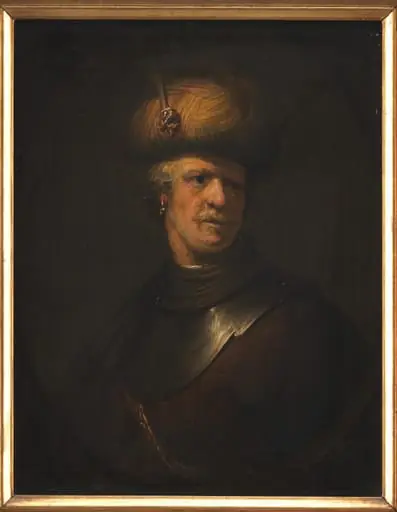 Half-Length Portrait of an Old Man
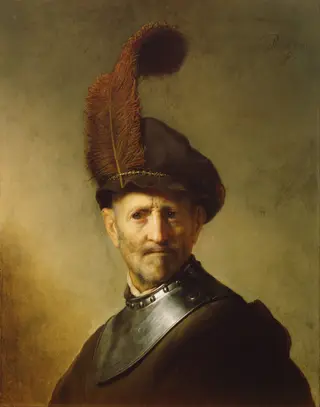 An Old Man in Military Costume
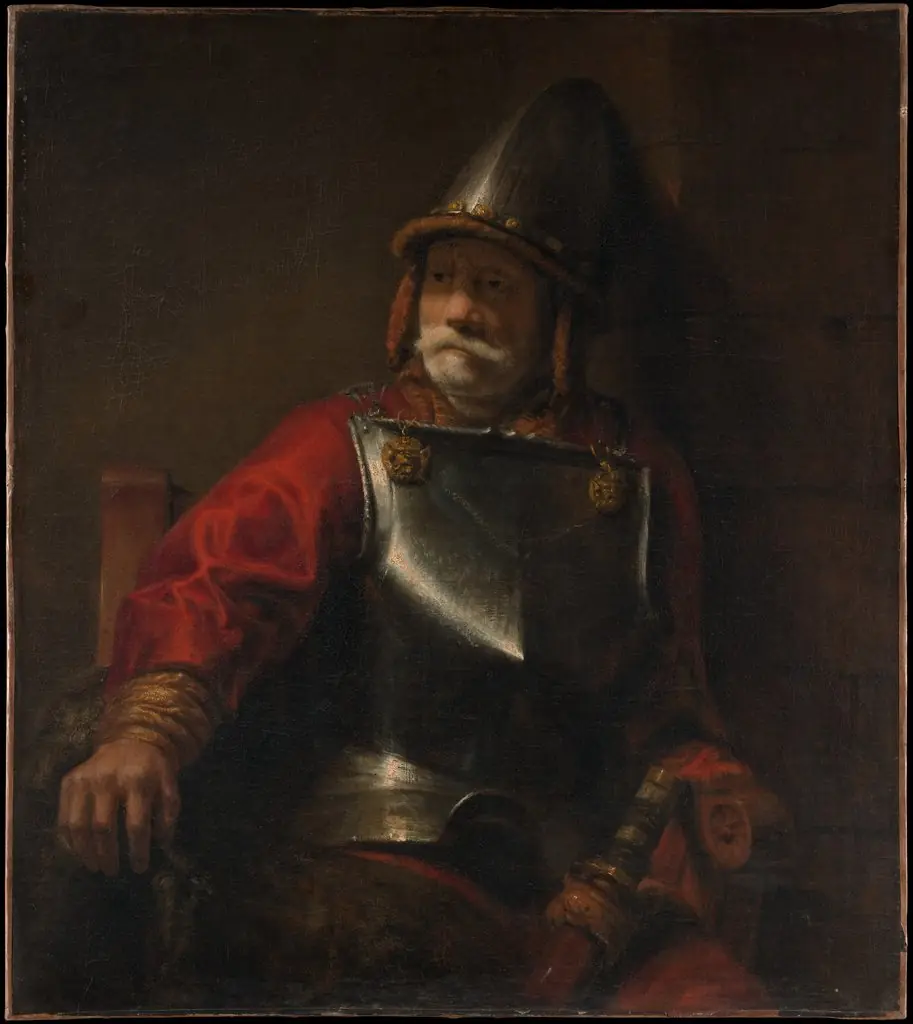 Man in Armor (Mars?)
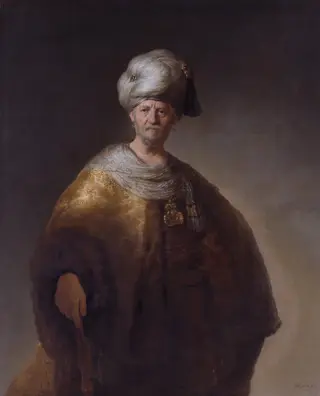 Man in Oriental Costume ("The Noble Slav" or "Man in a Turban")
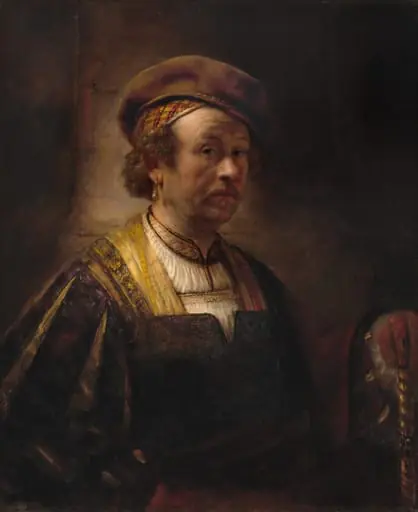 Portrait of Rembrandt
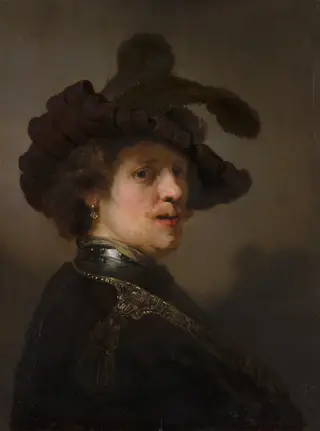 Portrait of a man in a plumed hat
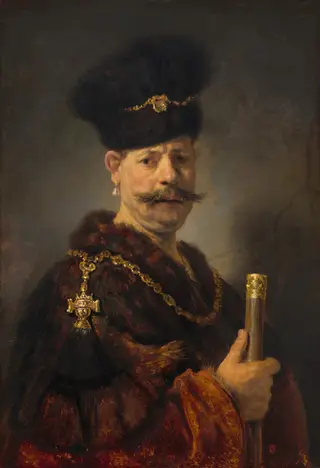 A Polish Nobleman
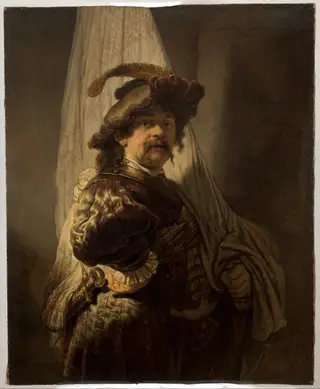 The Standard Bearer
 Man in Oriental Dress
 Man with a hat decorated with pearls
 Pallas Athena
- Man in Armour