Artwork
Self-Portrait (?) with Plumed Cap and Lowered Sabre
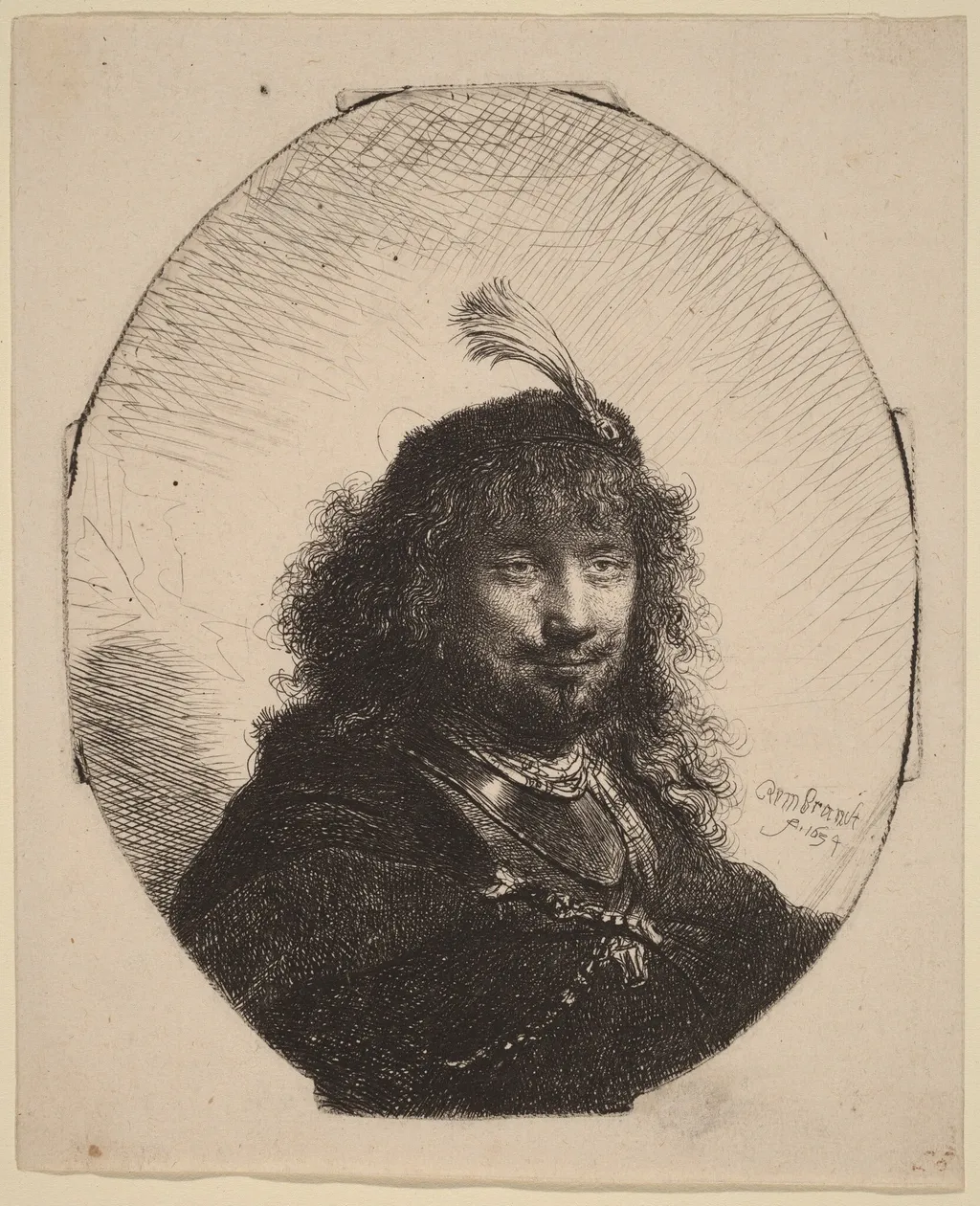
Self-Portrait (?) with Plumed Cap and Lowered Sabre is an ink print by the Baroque artist Rembrandt van Rijn. It dates from 1634 and is held in the collection of the National Gallery of Art. Self-Portrait (?
- Inscription
- Inscribed:lower right in plate above arm: Rembrandt / f. 1634
About this work
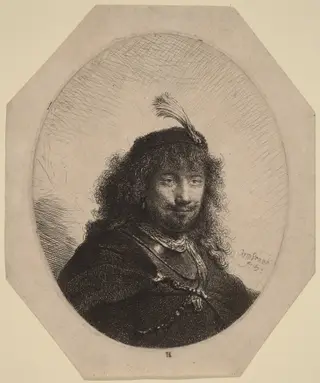
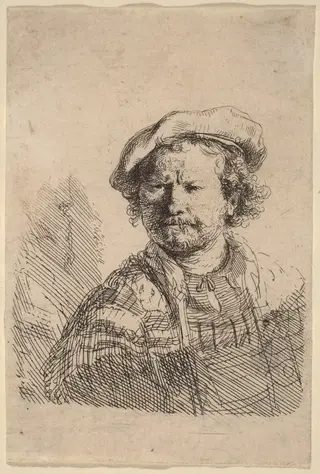
This sketch shows a man with curly hair and a dark plumed cap. He wears a fur collar and holds a sword at his side. The lines are loose and dark, with some shading on his face.
The artist used a technique that lets ink fill the scratched lines, making the image pop. This was done in 1634 by a Dutch painter.
Next, check out etching to see how artists create prints like this.
Overview
) with Plumed Cap and Lowered Sabre is an etching by Rembrandt van Rijn created in 1634.
Self-Portrait (?) with Plumed Cap and Lowered Sabre is an etching by Rembrandt van Rijn created in 1634. The work depicts a young man, widely believed to be the artist himself, dressed in historical costume that includes a dark plumed cap, a fur collar, and a lowered sabre at his side. Executed with loose, energetic lines characteristic of Rembrandt's early etching style, the image captures a moment of dynamic movement and theatrical self-presentation.
The composition relies on strong contrasts between light and shadow, achieved through the etching process where ink fills the scratched lines to create depth and volume. This piece belongs to a series of early self-portraits in which Rembrandt experimented with various roles and costumes, exploring themes of identity and the artist's social standing. Created during the artist's first years in Amsterdam, shortly after his return from Leiden, the work demonstrates his rapid mastery of the etching medium and his interest in capturing fleeting expressions and dramatic lighting.
The title's question mark reflects ongoing scholarly debate regarding the precise identification of the sitter, though the consensus leans toward a self-representation intended to project an image of the artist as a gentleman and a man of action.
Subject & Meaning
The image depicts a man with tightly curled hair beneath a dark, feathered cap, his fur‑trimmed collar suggesting a status of wealth or military affiliation. He holds a lowered sabre at his side, a gesture that may convey readiness tempered by restraint, inviting speculation about identity and intent.
Technique & Style
Rembrandt employed a traditional intaglio process, incising lines into the plate and allowing ink to settle in the recessed areas. The drawing is marked by loose, expressive strokes and deep shadows that model the face, demonstrating the artist’s early mastery of tonal contrast within the etching medium.
History & Provenance
The plate was first printed in the mid‑17th century and later entered various European collections, though its exact ownership trail is fragmented. Scholars have debated its authenticity as a true self‑portrait, but it remains a documented work within Rembrandt’s oeuvre of 1630s prints.
Context
Produced during a prolific period when Rembrandt was establishing his reputation in Amsterdam, the etching reflects contemporary Dutch interest in individual portraiture and the emerging market for affordable prints. Its martial accessories echo the era’s fascination with chivalric and civic virtues.
Legacy
Although not among Rembrandt’s most celebrated prints, the work offers insight into his experimental approach to line and shading. It continues to be studied for its contribution to the development of self‑portraiture and the technical possibilities of early modern etching.
Own this work as a print
Artist & collection

Artist
Rembrandt Harmenszoon van Rijn, known mononymously as Rembrandt, was a Dutch Golden Age painter, printmaker, and draughtsman.

- Self-Portrait (?) with Plumed Cap and Lowered Sabre
 Self-Portrait (?) with Plumed Cap and Lowered Sabre
 Self-Portrait with Raised Sabre
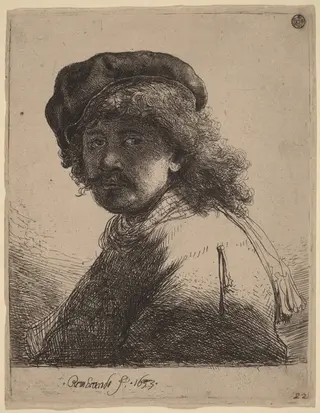 Self-Portrait in a Cap and Scarf with the Face Dark
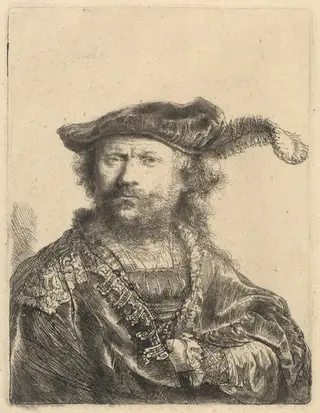 Self-Portrait in a Velvet Cap with Plume
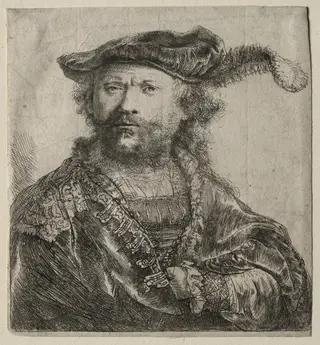 Self-Portrait in Velvet Cap with Plume
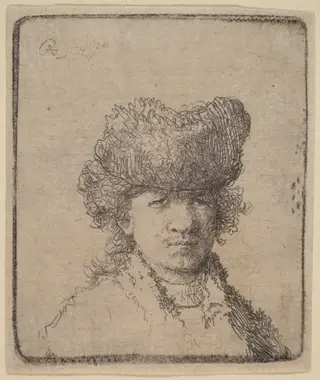 Self-Portrait in a Fur Cap
 Self-Portrait in a Flat Cap and Embroidered Dress