Artwork
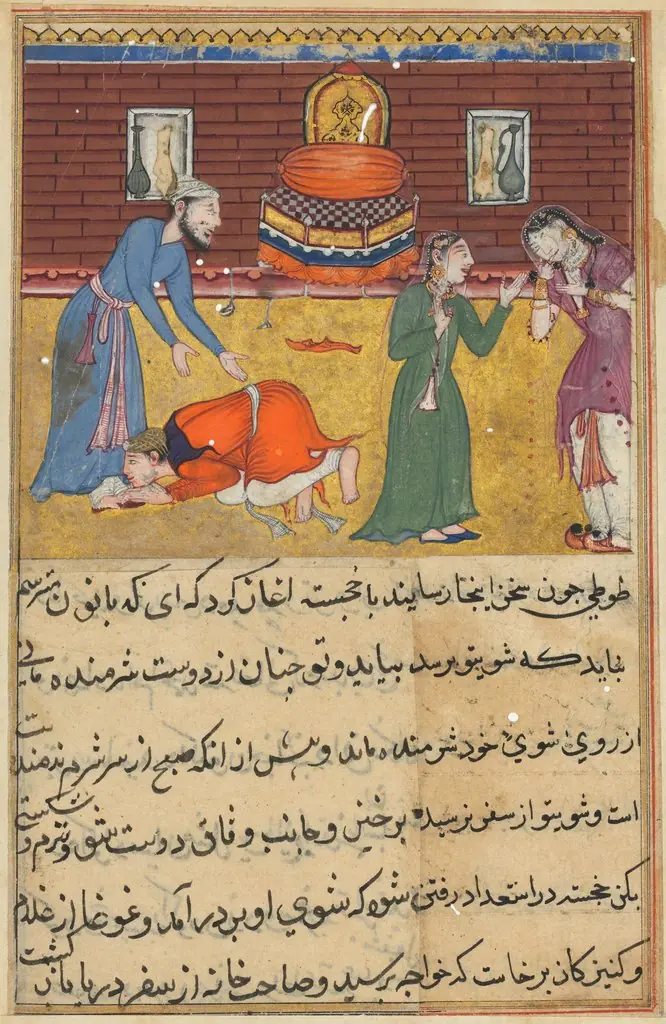
The Raja’s daughter, born with three breasts, accompanies her blind husband and his hunchback guide on a journey, from a Tuti-nama (Tales of a Parrot): Forty-second Night
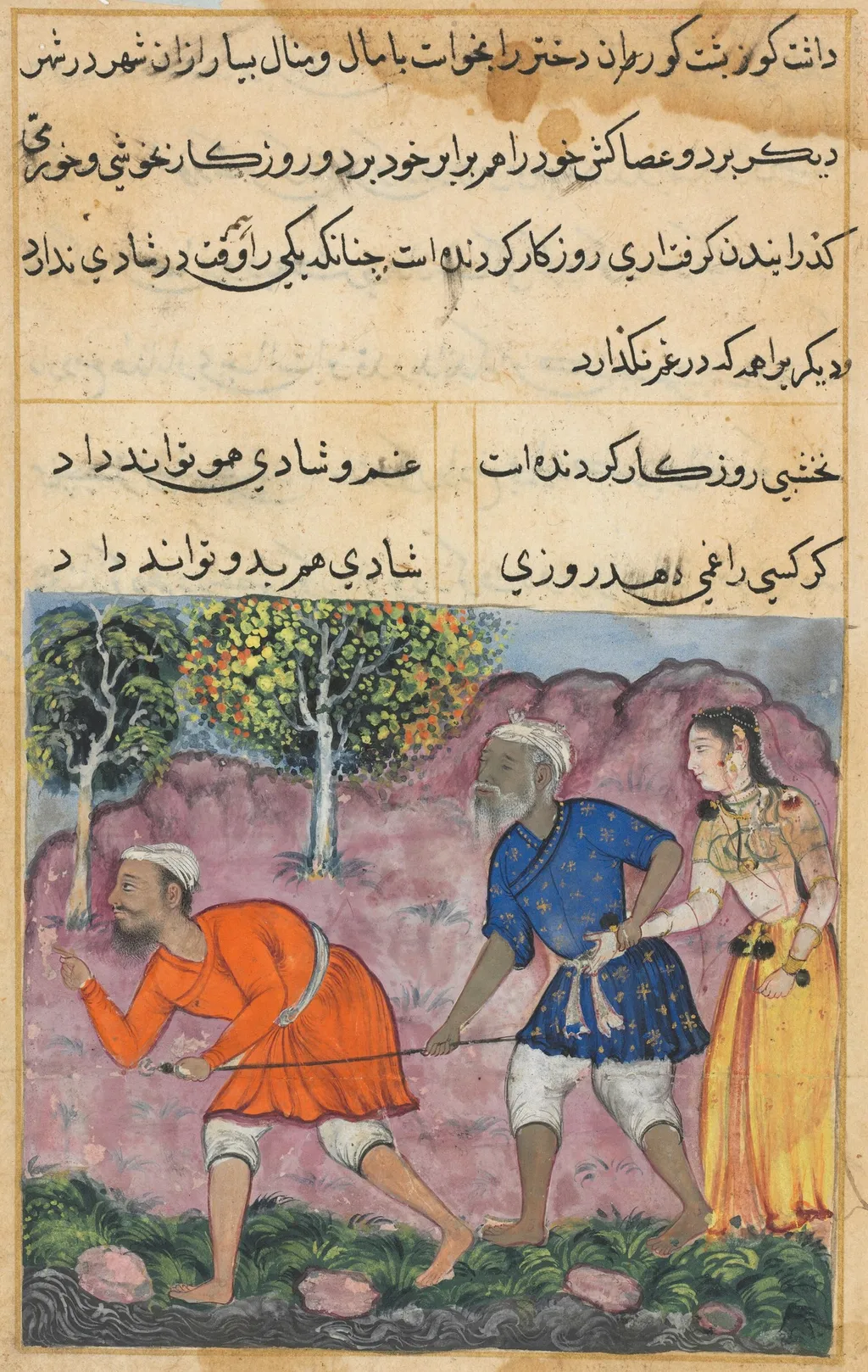
The Raja’s daughter, born with three breasts, accompanies her blind husband and his hunchback guide on a journey, from a Tuti-nama (Tales of a Parrot): Forty-second Night is an unspecified painting. It dates from 1560 and is held in the collection of the Cleveland Museum of Art.
About this work
Subject & Meaning
The three‑breasted figure marks her as extraordinary, while the blind husband and the hunchback companion suggest vulnerability and the need for assistance.
The painting illustrates a scene from the Tuti-nama (Tales of a Parrot) in which the Raja’s daughter, born with three breasts, accompanies her blind husband and his hunchback guide on a journey. The three‑breasted figure marks her as extraordinary, while the blind husband and the hunchback companion suggest vulnerability and the need for assistance. Together they embody the tale’s exploration of loyalty, fate, and the interplay of physical peculiarity with inner virtue, reflecting the moral and narrative concerns typical of the Mughal‑era manuscript.
Technique & Style
The work is a Mughal miniature executed as a painting on paper in the mid‑16th century. It is rendered in opaque pigments with fine brushwork that defines figures and narrative detail, typical of courtly manuscript illustration. The composition shows the Raja’s daughter with three breasts, her blind husband, and a hunchbacked guide, arranged in a flattened spatial scheme that emphasizes linear contour and decorative patterning. The style reflects Persian‑influenced narrative figuration characteristic of the Tuti‑nama manuscript tradition.
The support is paper, and the handling is gentle, preserving the delicate wash of color and the fine ink outlines. The condition is stable, with only minor surface wear noted in conservation records. The formal qualities include a restrained palette, rhythmic repetition of motifs, and an emphasis on narrative clarity over naturalistic perspective.
History & Provenance
The painting was created in 1560, during the period of the Mughal Empire, and is classified as a painting. It is held in the collection of the Cleveland Museum of Art, where it is catalogued under accession number 1962.279.271.a. The work is attributed to an unknown artist, and no further details regarding its commission, intermediate ownership, or acquisition history are documented in the available sources.
Legacy
The painting entered the collection of the Cleveland Museum of Art, where it is catalogued under the accession number 1962.279.271.a and described as a work of the Mughal Empire dating to 1560. Its visual narrative of a tri‑breasted princess traveling with a blind husband and a hunchback guide has been cited in studies of Rajput courtly imagination and in comparative analyses of Indian miniature traditions, influencing later manuscript illustrations that re‑interpret the same tale. The work continues to be referenced in scholarly discussions of gendered symbolism in early modern Indian art.
Overview
The miniature illustrates a scene from the forty‑second night of the Persian illustrated manuscript known as the Tuti‑nama, or Tales of a Parrot. In the composition three figures traverse a vivid landscape: a blind man in blue and white garments leaning on a staff, a hunch‑backed guide in orange supporting him, and a woman in a gold dress walking beside them. The background is rendered with pink clouds, verdant trees and scattered blossoms, typical of the manuscript’s decorative palette.
Context
The Tuti‑nama is a didactic anthology of fables and moral stories, often illustrated to accompany the text. This particular vignette aligns with the broader tradition of Persian narrative art, where visual storytelling reinforces the ethical lessons conveyed in the accompanying verses.
Artist & collection

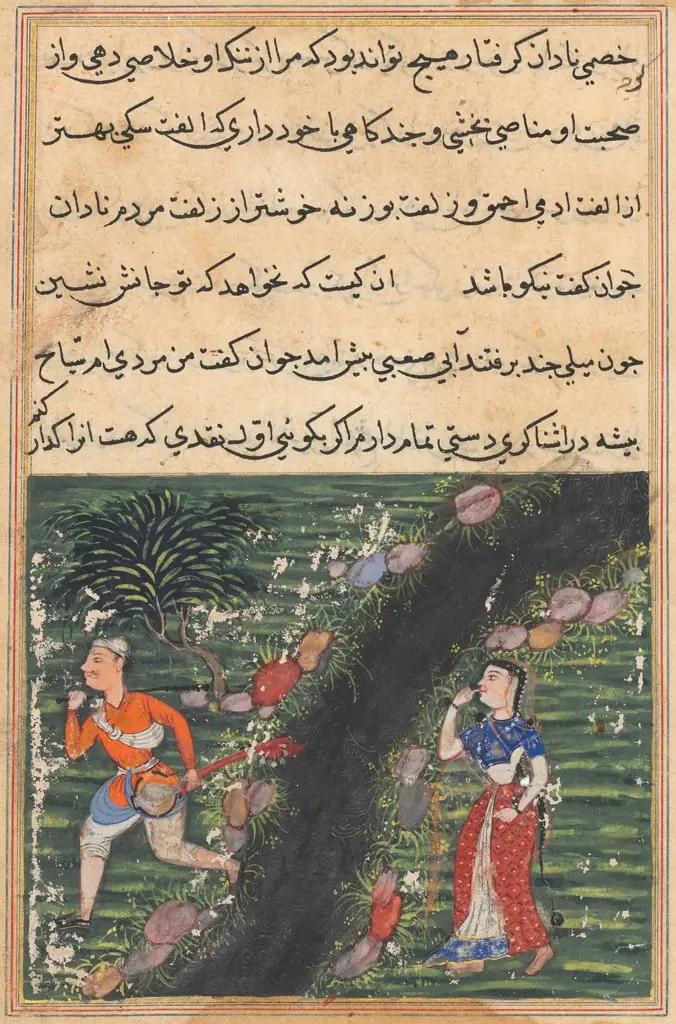 The vagabond crosses a stream with the possessions of the daughter-in-law of the king of Banaras and absconds, from a Tuti-nama (Tales of a Parrot): Sixteenth Night
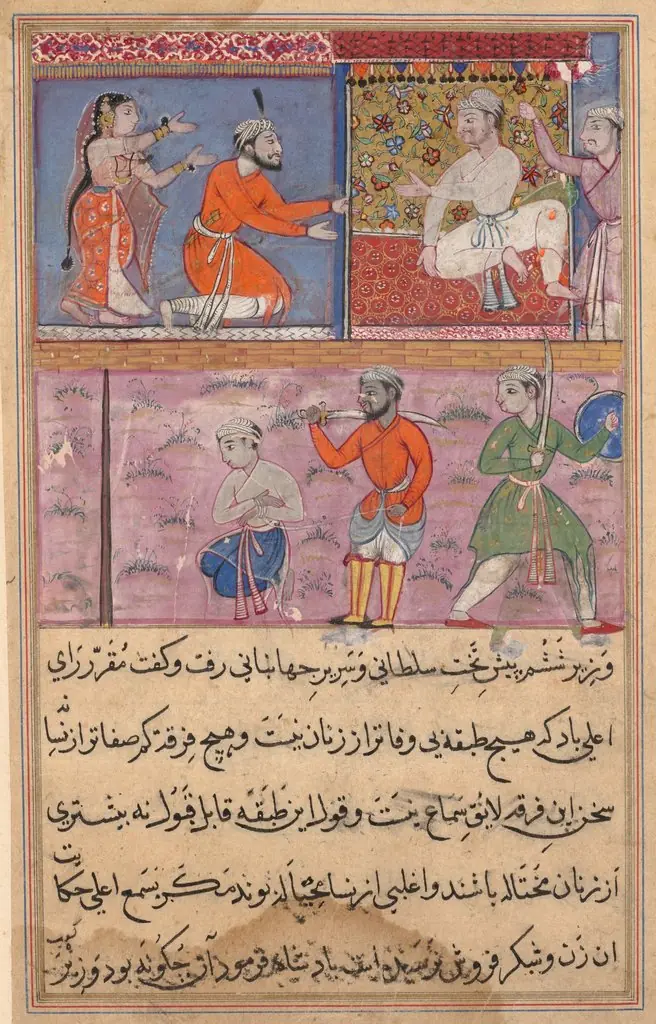 Page from Tales of a Parrot (Tuti-nama): text page
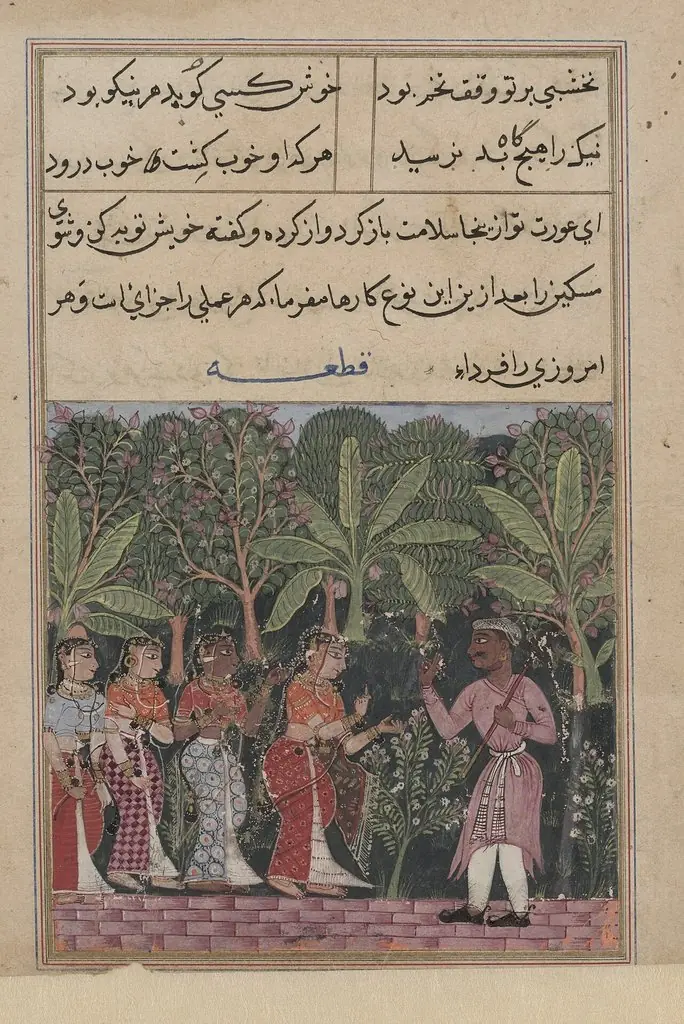 The merchant’s daughter meets the gardener, from a Tuti-nama (Tales of a Parrot): Twelfth Night
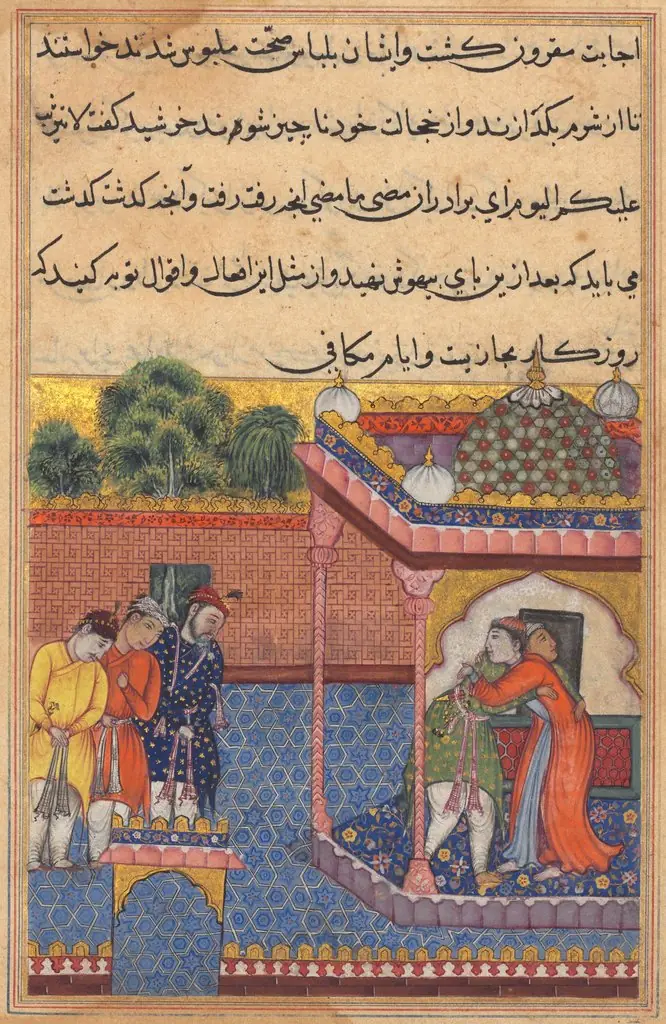 Khurshid reunited with her husband Utarid, from a Tuti-nama (Tales of a Parrot): Thirty-second Night
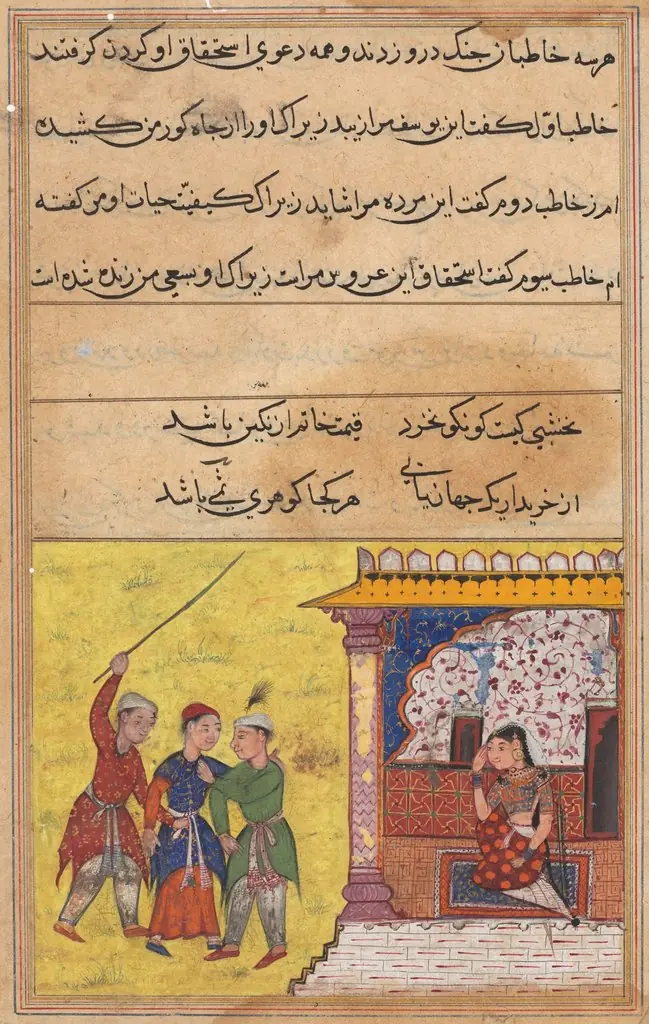 The three suitors again begin to quarrel among themselves for the hand of the devotee’s daughter, from a Tuti-nama (Tales of a Parrot): Twentieth Night
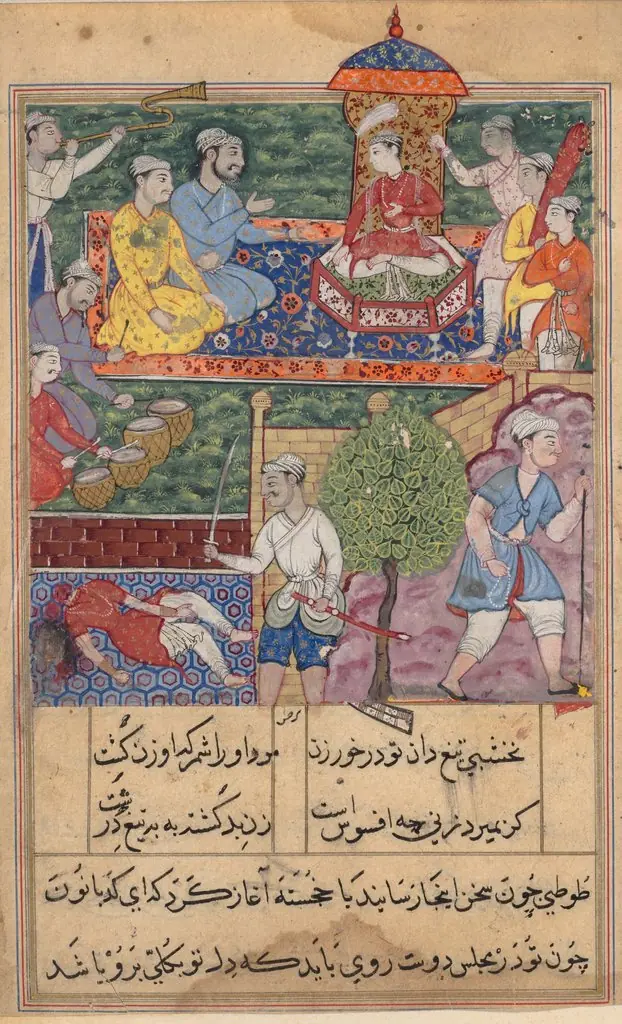 Page from Tales of a Parrot (Tuti-nama): text page
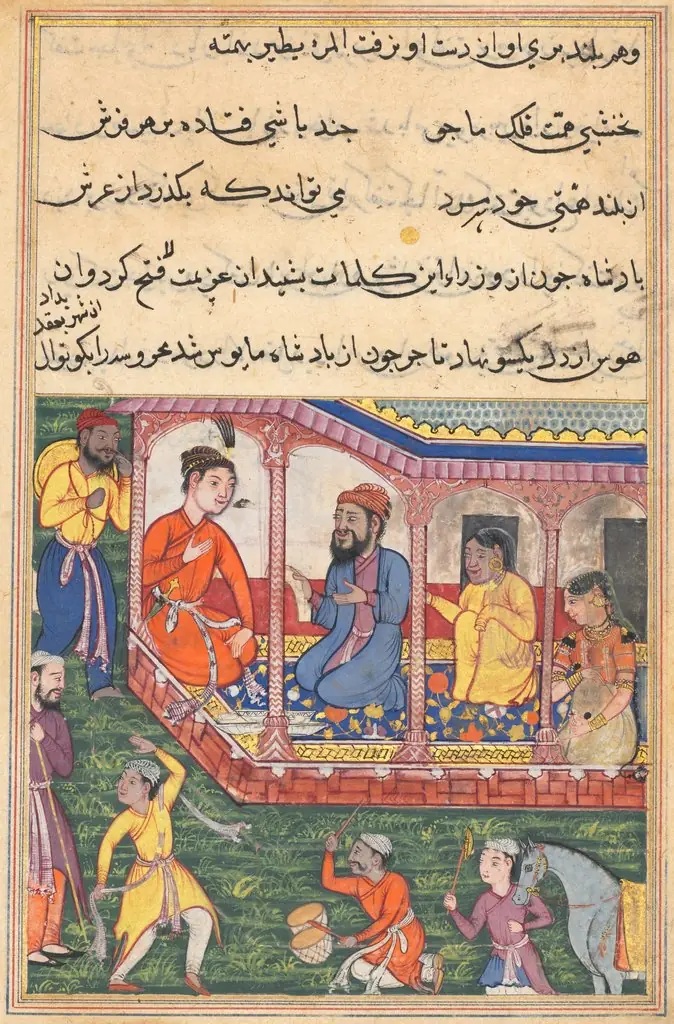 Mahrusa’s marriage to the prefect of the city, from a Tuti-nama (Tales of a Parrot): Thirty-sixth Night
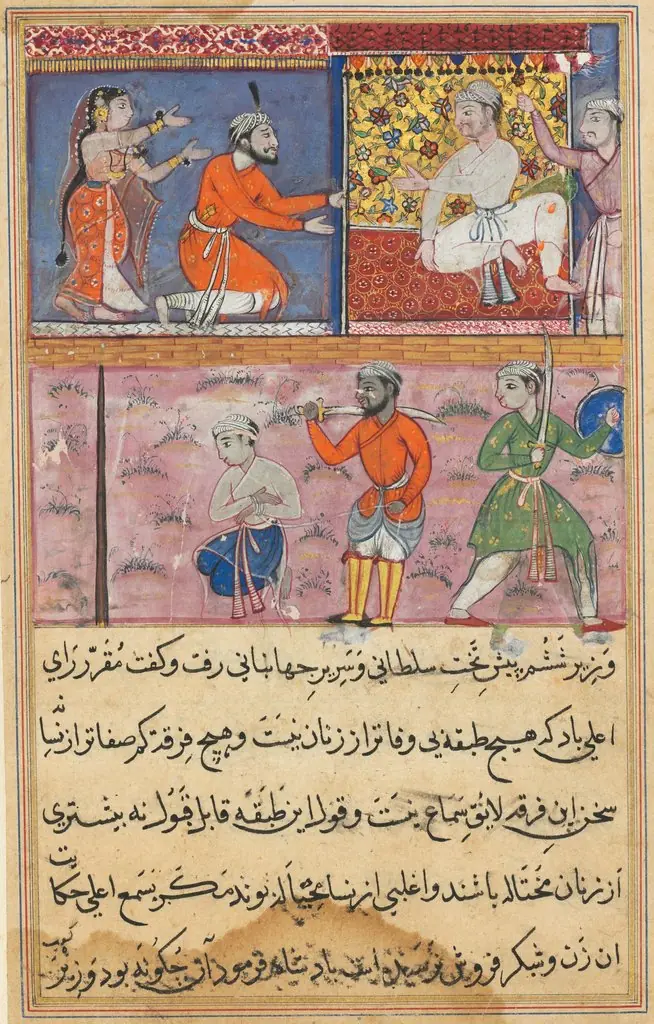 The prince sent back to the place of execution for the sixth time, from a Tuti-nama (Tales of a Parrot): Eighth Night
- The Raja’s daughter, born with three breasts, accompanies her blind husband and his hunchback guide on a journey, from a Tuti-nama (Tales of a Parrot): Forty-second Night
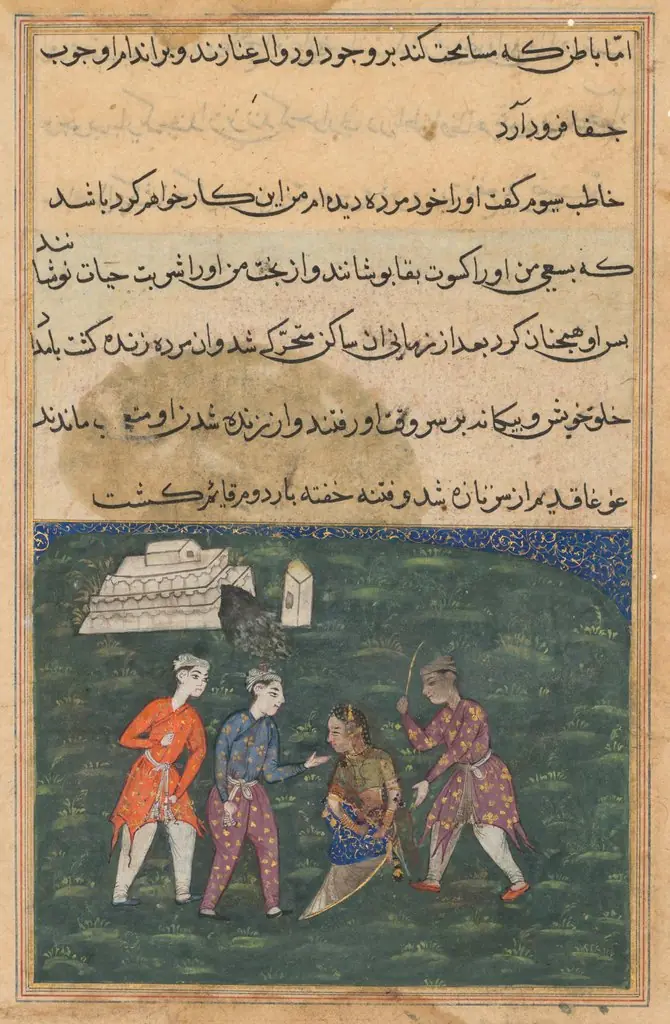 The third suitor strikes the devotee’s daughter and thus restores her to life, from a Tuti-nama (Tales of a Parrot): Twentieth Night
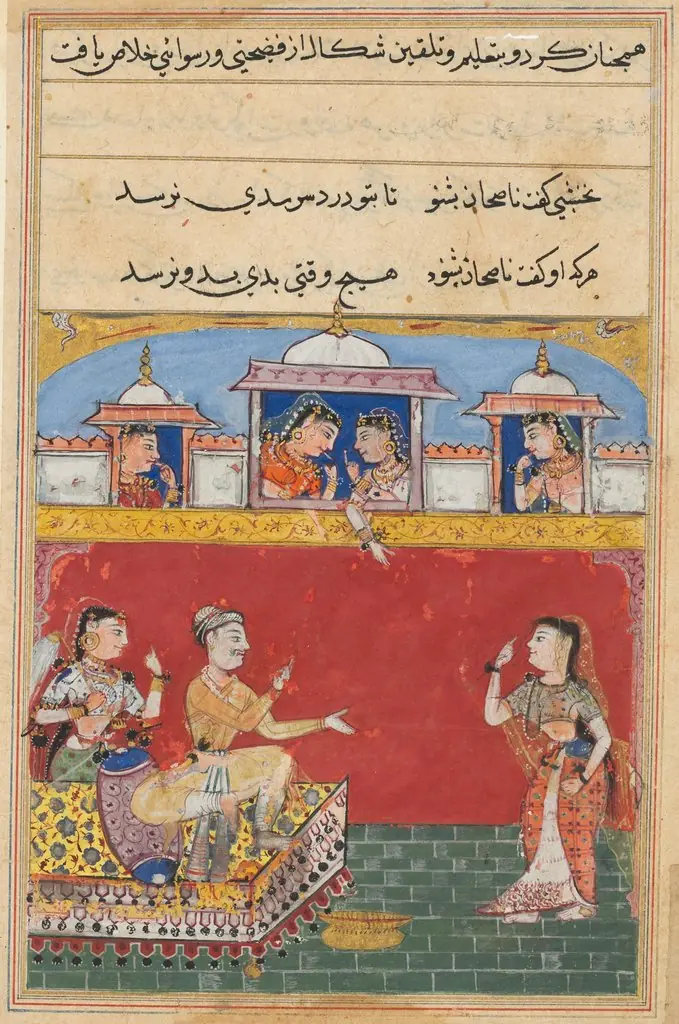 The daughter-in-law returns from her misadventure, feigning insanity, from a Tuti-nama (Tales of a Parrot): Sixteenth Night
 The pious man’s son, now a king, reveals himself to his father; his nurse upbraids his unfaithful mother, from a Tuti-nama (Tales of a Parrot): Fifty-second Night