Artwork
Sacred and Profane Love
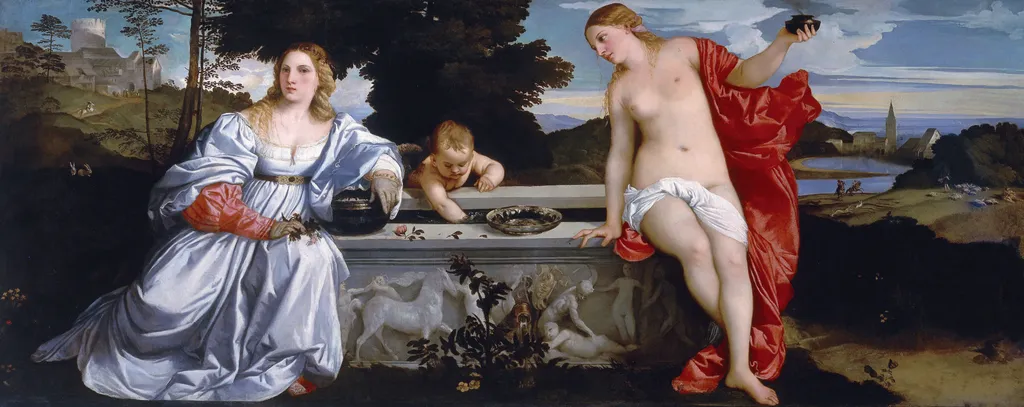
Sacred and Profane Love is an oil painting by the High Renaissance artist Titian. It dates from 1514 and is held in the collection of the Borghese Collection.
About this work
Overview
Titian’s early oil work, commonly called Sacred and Profane Love, dates to around 1514. The composition presents two female figures and an infant set within a tranquil landscape of trees, hills and water. One woman is clothed in a pale blue dress with red sleeves, the other is nude, a red drape covering her shoulder. Both hold dark objects, while the child rests on a stone ledge between them.
Subject & Meaning
Traditional interpretation links the clothed woman to a bride and the nude figure to Venus, suggesting an allegory of marital union versus sensual love.
The identities of the figures remain debated. Traditional interpretation links the clothed woman to a bride and the nude figure to Venus, suggesting an allegory of marital union versus sensual love. The infant may symbolize new life or the offspring of the couple.
However, the title, first recorded in the late 17th century, may reflect later curatorial labeling rather than Titian’s original intent, leaving the narrative open to scholarly dispute.
Technique & Style
Executed in oil on canvas, the painting showcases Titian’s nascent mastery of color modulation and atmospheric perspective. Muted blues, greens and earth tones create a serene backdrop, while the delicate handling of flesh and fabric demonstrates his early skill in rendering texture. The soft modeling of the figures against the landscape hints at the emerging Venetian emphasis on light and color over linear design.
History & Provenance
The work is thought to have been commissioned by Niccolò Aurelio, a secretary of Venice’s Council of Ten, whose heraldic device appears on a sarcophagus or fountain within the scene. The commission likely celebrated Aurelio’s marriage to the young widow Laura Bagarotto. The painting entered documented inventories in 1693 under the name Amor Divino e Amor Profano, indicating its continued presence in private collections before entering public holdings.
Context
Created during Titian’s formative years, the painting reflects the Renaissance fascination with allegorical representations of love, blending classical mythology with contemporary matrimonial themes. Its ambiguous symbolism mirrors the period’s intellectual climate, where patrons often sought artworks that could convey moral, devotional, and personal messages simultaneously. The piece thus occupies a pivotal position in the early development of Titian’s career and the broader Venetian tradition of poetic visual discourse.
Artist & collection

Artist
Tiziano Vecellio (Italian:; c. 1488/1490 – 27 August 1576), Latinized as Titianus, hence known in English as Titian ( TISH-ən), was an Italian Renaissance painter. The most important artist of Renaissance Venetian…