Artwork
A King Making Love in the Harem
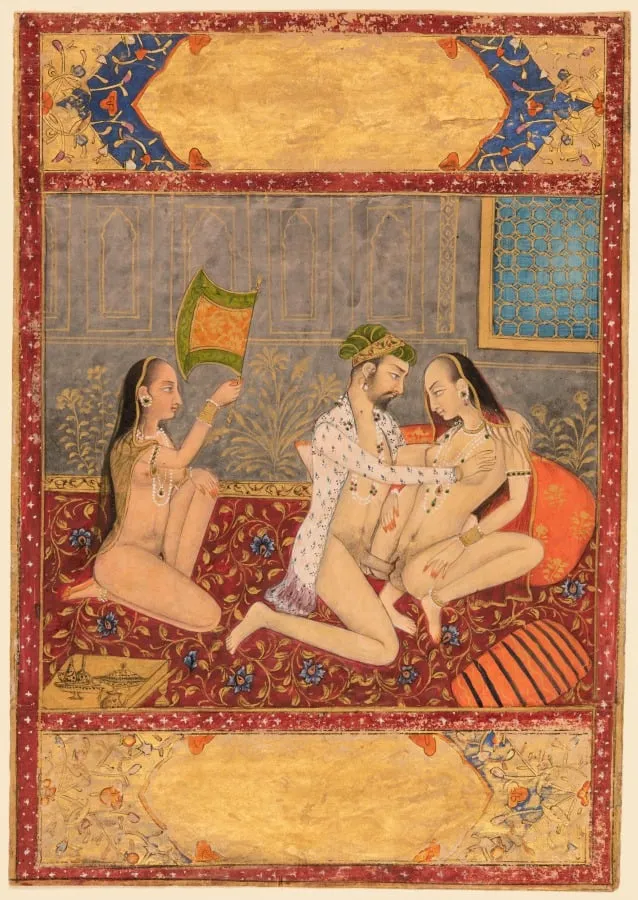
A King Making Love in the Harem is an unspecified painting by the Baroque artist Unknown. It dates from 1725 and is held in the collection of the Cleveland Museum of Art. This painting belongs to a series commissioned to depict the ruler’s personal authority through intimate scenes.
- Accession no.
- 2018.170
- Credit line
- Purchase and partial gift from the Catherine and Ralph Benkaim Collection; Severance and Greta Millikin Purchase Fund
About this work
Overview
Set within the private quarters of the palace, it portrays the king in a moment of quiet intimacy, surrounded by objects that signify refined courtly life.
This painting belongs to a series commissioned to depict the ruler’s personal authority through intimate scenes. Set within the private quarters of the palace, it portrays the king in a moment of quiet intimacy, surrounded by objects that signify refined courtly life. The composition avoids overt grandeur, instead emphasizing atmosphere and subtle luxury to reinforce the ruler’s dominion over both space and desire.
Subject & Meaning
The scene captures the king in a private encounter with a woman, not as a public act of power but as an assertion of personal vitality. The setting, confined, luminous, and richly furnished, frames the moment as both sensual and sovereign. The inclusion of daily luxuries like paan boxes and wine vessels suggests that the king’s charm lies in his mastery of refined pleasures, not merely in martial or political feats.
Technique & Style
The artist employs soft, muted tones to evoke evening light filtering through gold lattice windows, casting a warm glow over marble walls adorned with carved floral motifs. Details such as the mauve carpet and delicate vessels are rendered with precision, contrasting with the loose, atmospheric handling of shadows. The figures are rendered with gentle contours, blending into the ambient light rather than dominating it, reinforcing the scene’s quiet intimacy.
History & Provenance
Created in the 18th century under the patronage of the Jaipur court, this work was one of several in a thematic cycle celebrating the ruler’s physical and emotional potency. Likely produced by artists attached to the royal atelier, it was intended for private viewing among court elites. Its survival suggests it was preserved as a valued object, reflecting both aesthetic taste and political symbolism within the kingdom’s inner circles.
Context
In 18th-century Jaipur, the harem was not merely a domestic space but a symbol of royal prestige, where controlled access and refined surroundings affirmed status. Objects like paan boxes and ornate wine vessels were markers of elite identity, and their inclusion here aligns with broader Rajput traditions of portraying kingship through domestic elegance. The painting reflects a cultural emphasis on the ruler’s cultivated persona as much as his martial role.
Legacy
The painting contributes to a broader visual language of Rajput court art that privileged subtlety over spectacle. While less widely known than battle or ritual scenes, such intimate works reveal how rulers cultivated an image of personal authority through domestic settings. Its survival offers insight into the private dimensions of power in pre-colonial North India, where sovereignty was expressed as much in quiet luxury as in public ceremony.
Artist & collection









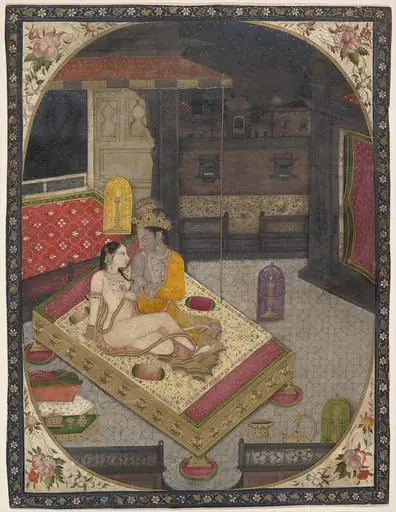 Untitled
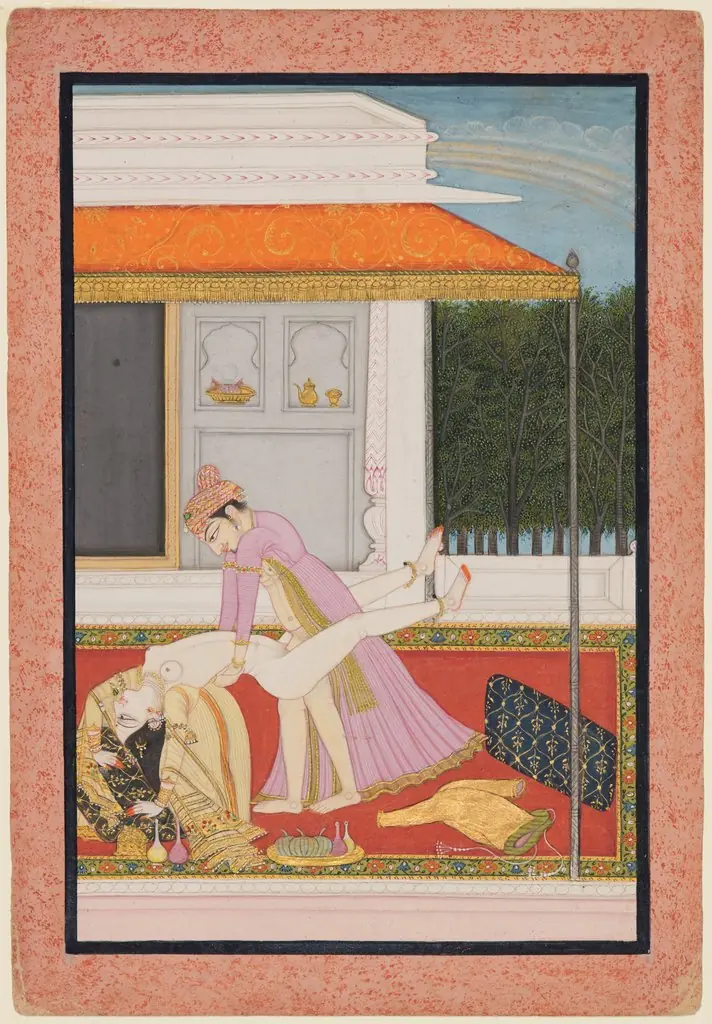 An Amorous Couple, Probably Raja Mahendra Pal of Basohli (r. 1806–13) with a Favorite Queen
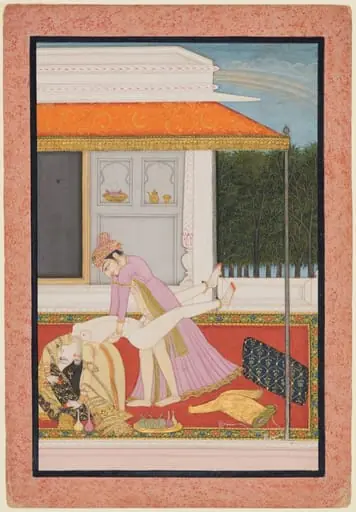 An amorous couple, probably Raja Mahendra Pal of Basohli with a favorite queen
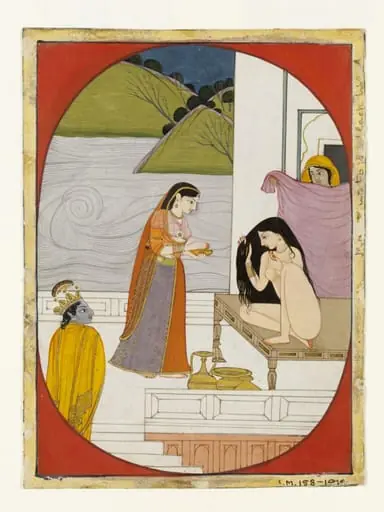 Krishna and Radha
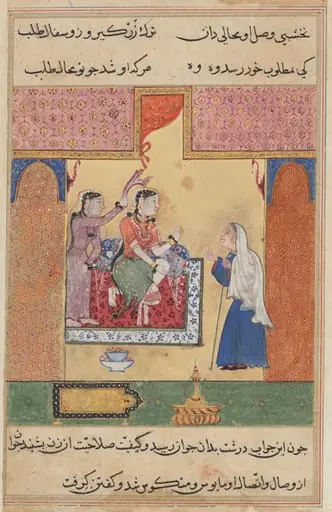 The old procuress conveys the young man’s message of love to Mansur’s wife, from a Tuti-nama (Tales of a Parrot: Seventeenth Night
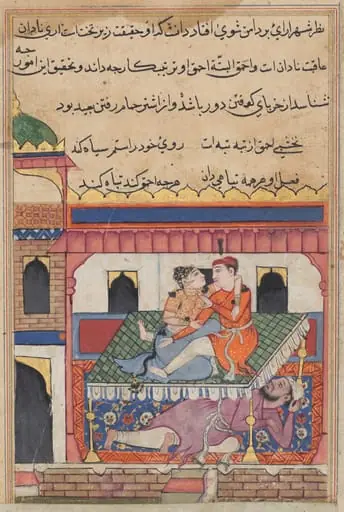 Shahr-Arai and her lover dallying on a bed beneath which is concealed her husband, from a Tuti-nama (Tales of a Parrot): Fortieth Night
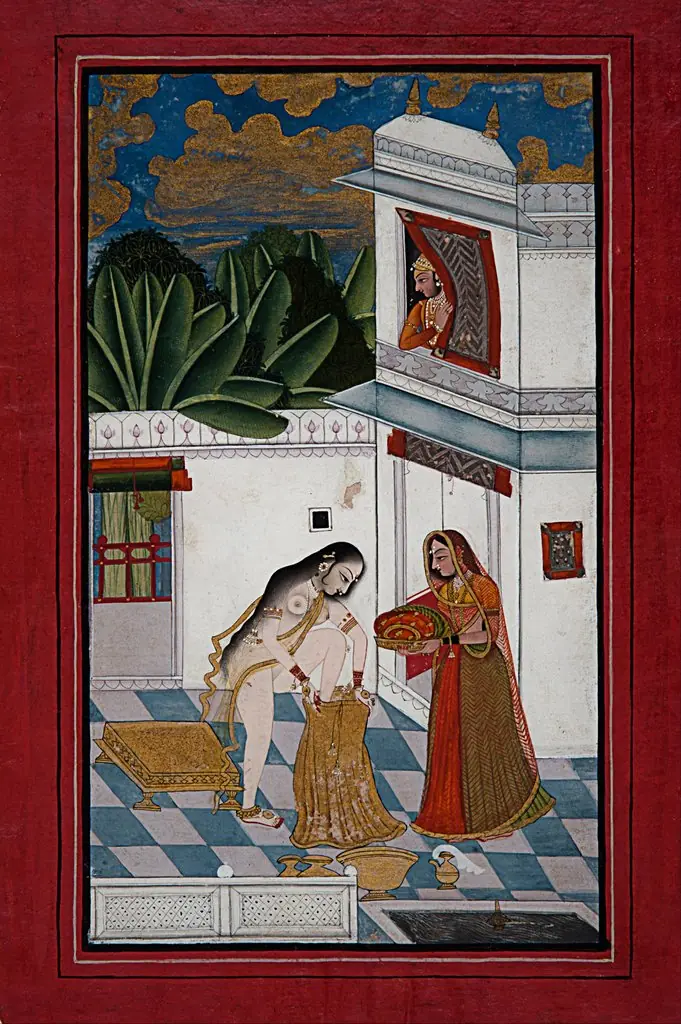 Hero enjoying the bathing beauty
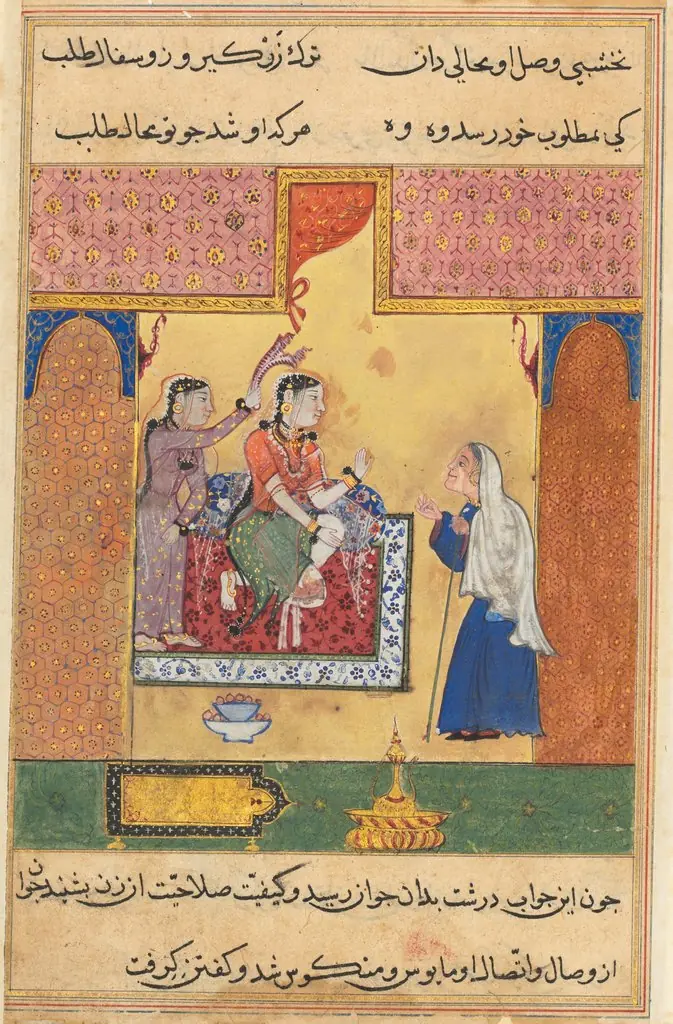 The old procuress conveys the young man’s message of love to Mansur’s wife, from a Tuti-nama (Tales of a Parrot: Seventeenth Night
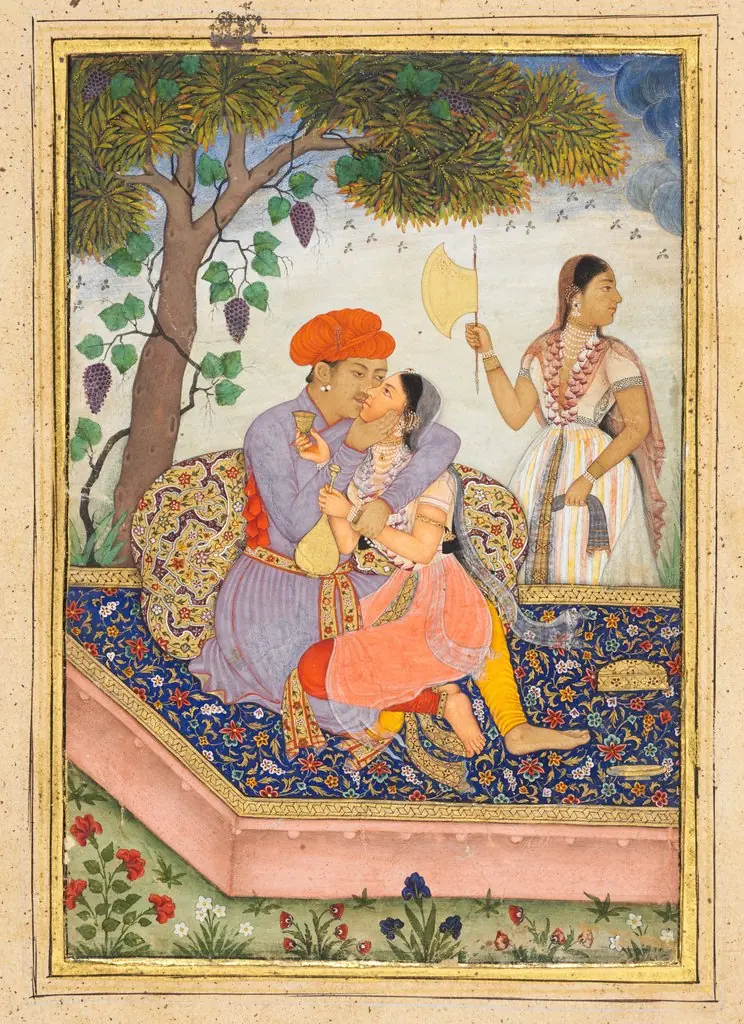 Lovers Embracing
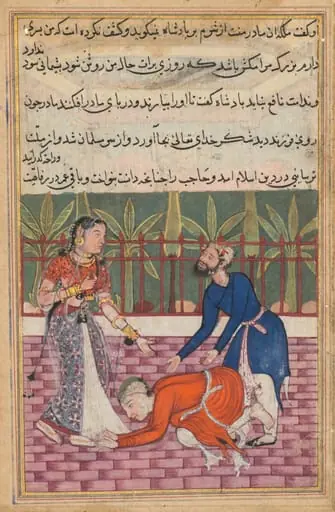 The guard restores the son who falls at his mother’s feet, from a Tuti-nama (Tales of a Parrot): Fiftieth Night