Artwork
Saint Rosalia
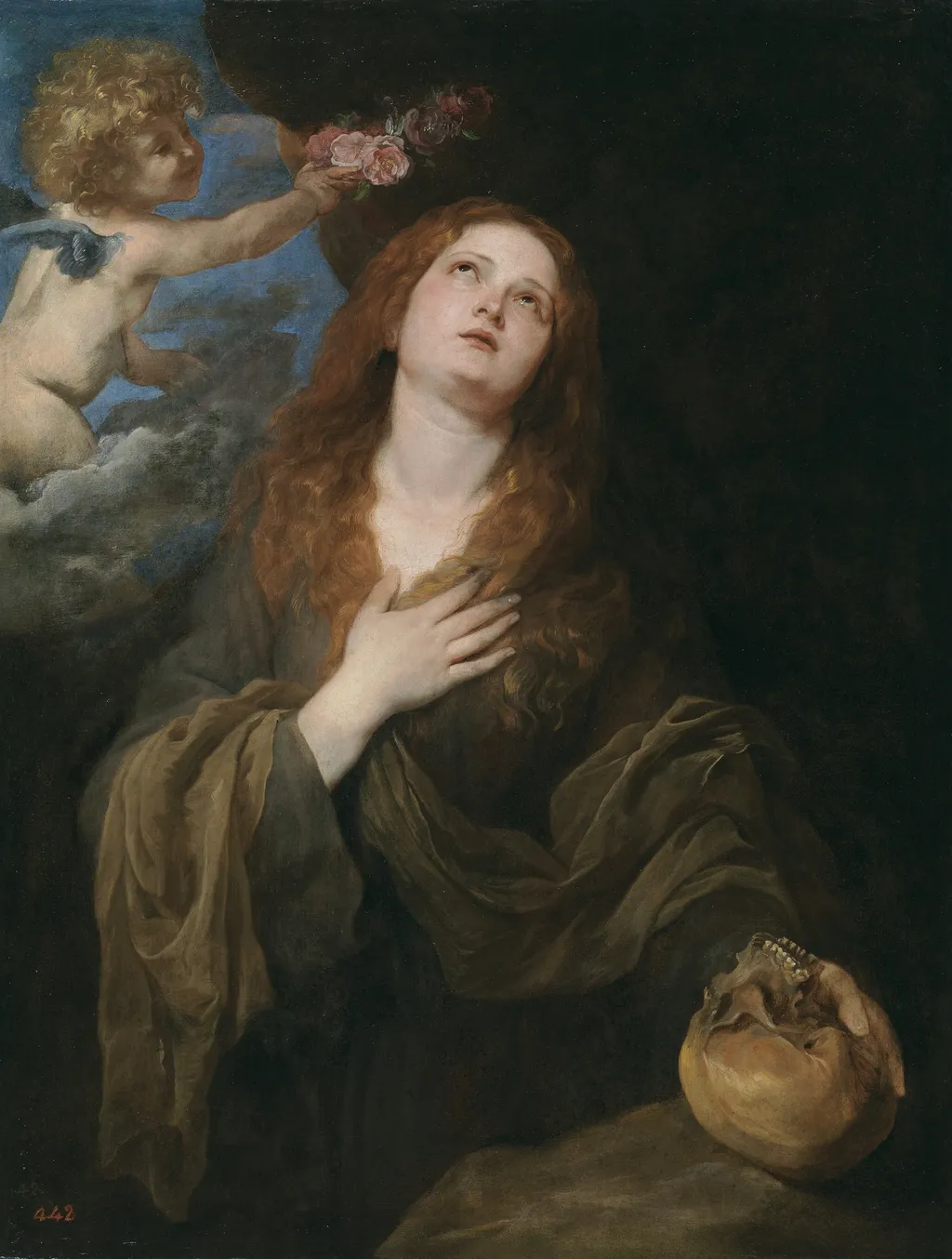
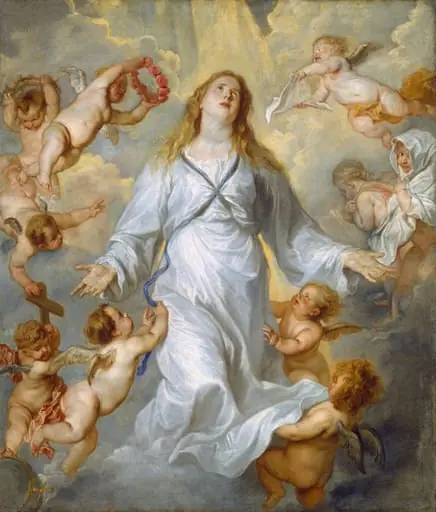
Saint Rosalia is an oil painting by the Flemish Baroque painting artist Anthony van Dyck. It dates from 1625 and is held in the collection of the Museo del Prado.
About this work
This painting shows Saint Rosalia, done in oil by Anthony van Dyck around 1625. It’s a religious portrait meant to honor a local saint. The work traveled from a private owner to Spanish royal hands before landing in its current home.
One twist: the king of Spain bought it in 1664 through his man in Naples. That’s how it ended up in Madrid.
Want to see more like it? Look up Anthony van Dyck.
Subject & Meaning
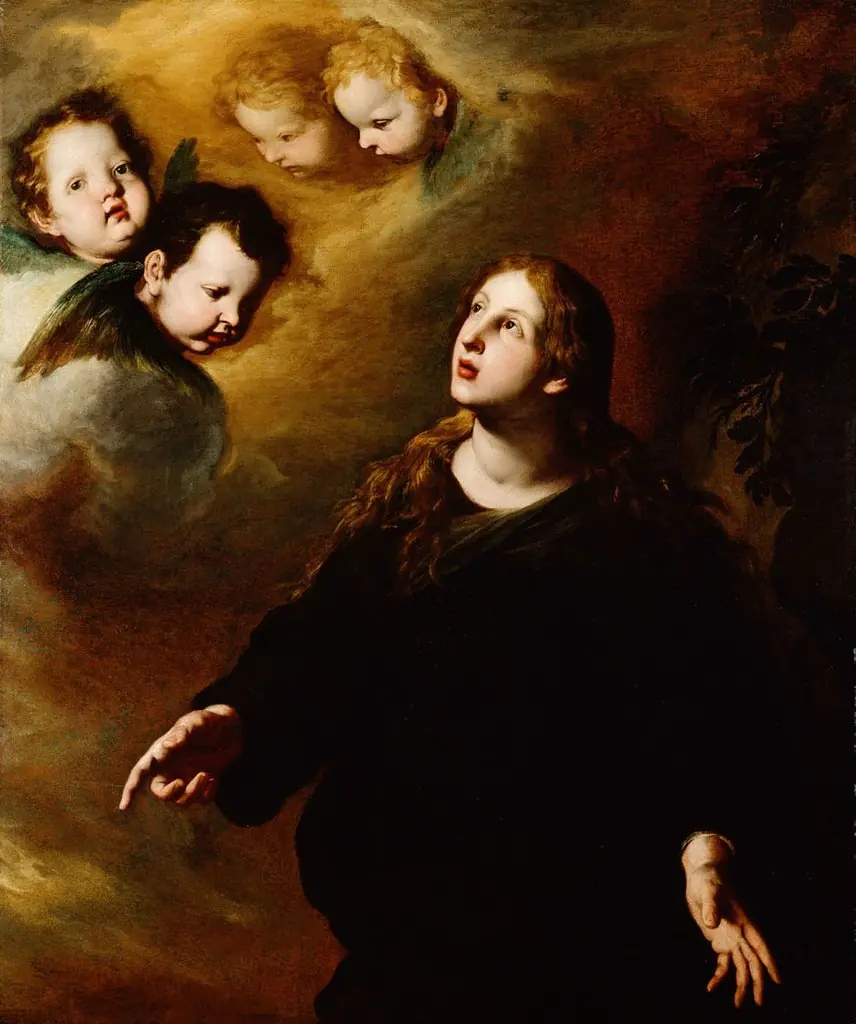
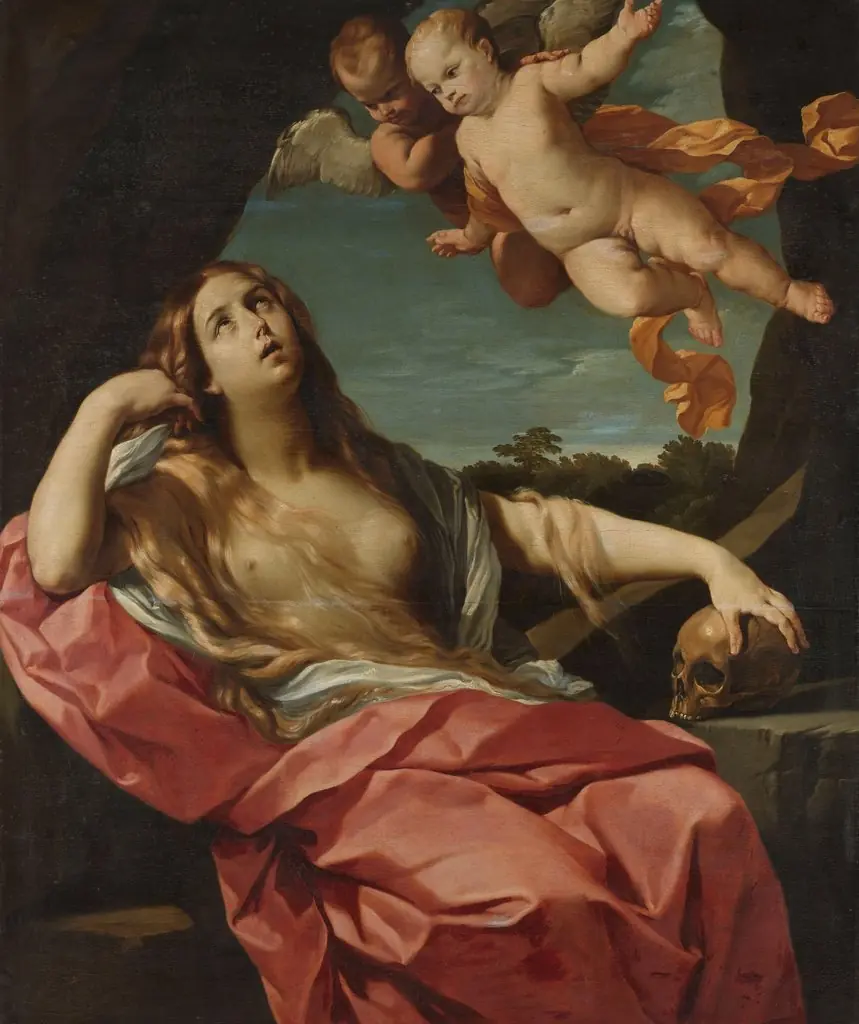
A putto crowns her with a wreath of flowers, while she presses her right hand against her chest over her red hair and rests her left hand on a human skull.
The painting depicts Saint Rosalia of Palermo, the patron saint of that Sicilian city, shown in a state of religious ecstasy at the mouth of a cave with her eyes lifted toward heaven. A putto crowns her with a wreath of flowers, while she presses her right hand against her chest over her red hair and rests her left hand on a human skull. The skull, a memento mori, signals meditation on mortality and penance, fitting the saint's association with hermit life and, by extension, with the plague that prompted Van Dyck to produce the work in Palermo in the mid-1620s. The three-quarter-length format and added skull distinguish this version from related full-length treatments of the same composition, intensifying the focus on contemplation and ascetic withdrawal.
Technique & Style
The work is an oil on canvas painting executed circa 1625 in Palermo, Sicily. It depicts Saint Rosalia receiving a crown of flowers from a cherub, shown in three-quarter length with a skull held in her left hand and her right hand resting on her chest, covering her red hair. The composition employs a vertical format and combines the influence of Pietro Novelli with Van Dyck’s characteristic naturalism. The painting was originally owned by Giovan Francesco Serra di Cassano, acquired by Philip IV of Spain through the Viceroy of Naples in 1664, and has been part of the Museo del Prado collection since then.
The technique utilizes oil paint applied to a canvas support, with a restrained palette and delicate modeling that emphasizes the saint’s ecstatic expression and the symbolic skull as a memento mori. Formal qualities include a balanced composition, chiaroscuro lighting, and a refined rendering of fabric and hair that reflect the transitional style between the High Renaissance and Baroque periods.
History & Provenance
Saint Rosalia is an oil on canvas painted by Anthony van Dyck around 1625 in Palermo, Sicily, during a period when the artist was confined in the city by an outbreak of plague. The work was originally owned by Giovan Francesco Serra di Cassano. It subsequently entered the Spanish royal collection when Philip IV of Spain acquired it in 1664 through his Viceroy of Naples, Gaspar de Bracamonte. The painting is now held by the Museo del Prado in Madrid, where it remains part of the collection. The canvas belongs to a group of related Saint Rosalia compositions Van Dyck produced in Palermo in the mid-1620s, sharing its basic arrangement with three companion versions now located in Palermo, London, and Houston. All four works were loaned to the Dulwich Picture Gallery in 2011-2012. The painting is held in the Museo del Prado in Madrid. It was originally owned by Giovan Francesco Serra di Cassano before being purchased by Philip IV of Spain in 1664 through his Viceroy of Naples, Gaspar de Bracamonte. In 2011-2012, the work was loaned to the Dulwich Picture Gallery as part of an exhibition that included other versions of Saint Rosalia from the same series.
Context
The *Saint Rosalia* of c.1625 by Anthony van Dyck emerged during the artist’s enforced stay in Palermo, where the mid-1620s plague shaped a distinct group of works on the subject. While aligned with compositions repeated in Palermo, London, and Houston, van Dyck’s version shifts from full-length to three-quarter-length and introduces a skull in the saint’s left hand, sharpening its memento mori resonance. The painting entered the Spanish royal collection in 1664 via Viceroy Gaspar de Bracamonte’s acquisition for Philip IV and is now in the Museo del Prado. A 2011-2012 loan to Dulwich Picture Gallery situated it within a broader reconsideration of van Dyck’s Sicilian period and its stylistic exchanges with Pietro Novelli.
Legacy
The painting entered the Spanish royal collection when Philip IV acquired it in 1664 through his Viceroy of Naples, and it has remained in the Museo del Prado ever since, forming part of the museum’s permanent holdings. It is one of a series of Saint Rosalia works van Dyck painted during the 1620s Palermo plague; these works shared a common composition and influenced the local painter Pietro Novelli. In 2011‑2012 the Prado loaned the canvas, together with the three related paintings now in Palermo, London and Houston, to the Dulwich Picture Gallery for a special exhibition, underscoring its continuing scholarly and public relevance.
Own this work as a print
Artist & collection
Artist
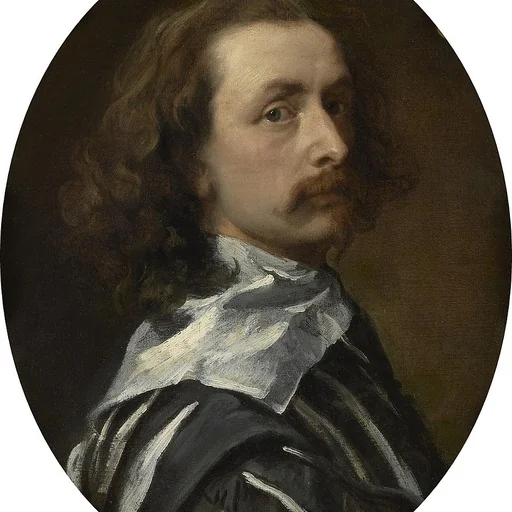
Sir Anthony van Dyck (; Dutch: Antoon van Dijck; 22 March 1599 – 9 December 1641) was a Flemish Baroque artist, who became the leading court painter in England after success in the Spanish Netherlands and Italy.