Artwork
An Apachee Village
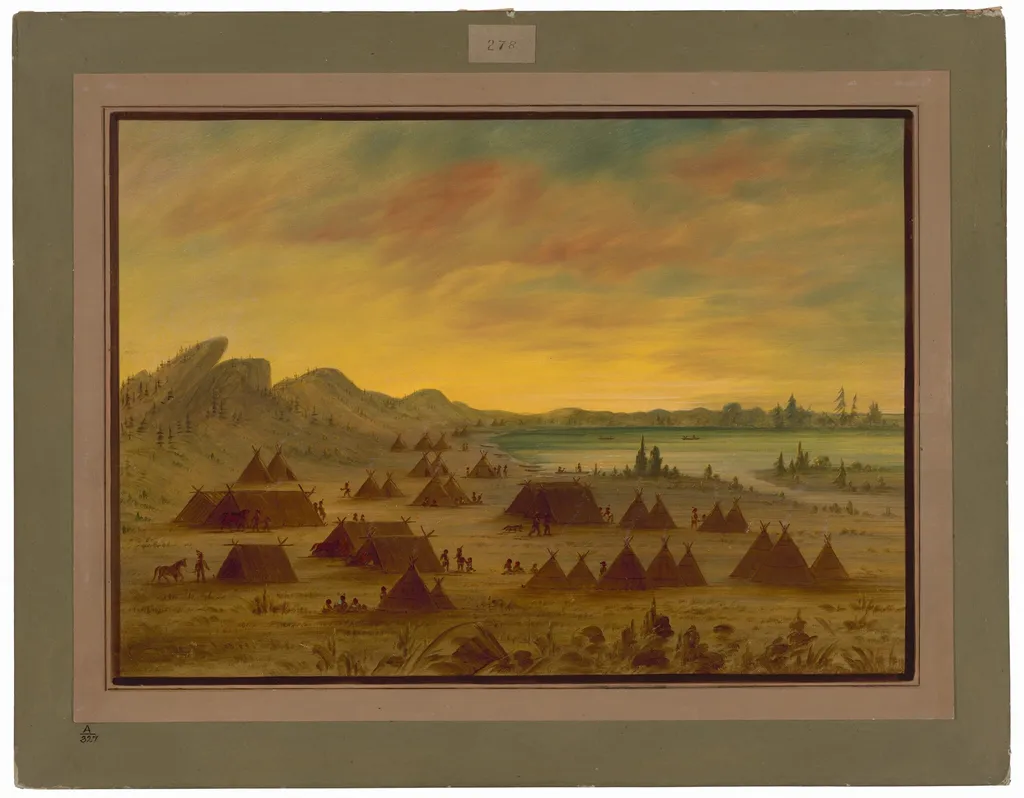
An Apachee Village is an oil painting by the Impressionist artist George Catlin. It dates from 1862 and is held in the collection of the National Gallery of Art. Created in 1862, An Apache Village is an oil painting on card that has been mounted on paperboard.
About this work
Overview
An Apachee Village is a landscape painting by the American artist George Catlin, dated between 1855 and 1869.
An Apachee Village is a landscape painting by the American artist George Catlin, dated between 1855 and 1869. Executed in oil on card mounted on paperboard, the artwork measures 45.7 by 62.3 centimeters. It forms part of Catlin's second major body of work, known as the Cartoon Collection, which he created in the 1850s and 1860s to reconstruct his earlier Indian Gallery. The painting is currently held by the National Gallery of Art in Washington, D.C., where it carries the accession number 1965.16.200.
Subject & Meaning
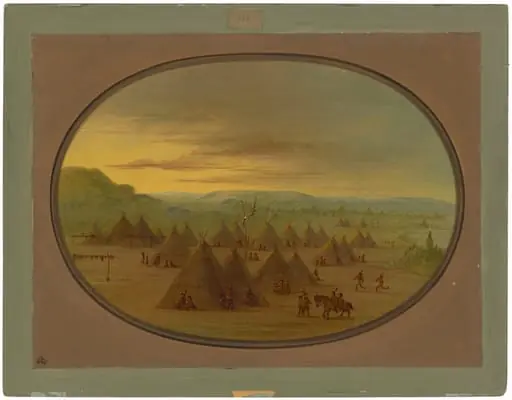
The painting depicts a large encampment of conical tipis arranged across a flat plain near a body of water, identified in Catlin's own 1871 exhibition catalog as Lake Ahrocum. Small human figures walk, stand, and gather between the dwellings, while several horses appear near the tents on the left side. The scene is set at sunset, with the sky dominating the upper half of the composition in warm yellows, oranges, and muted greens. Faint smoke or mist rises from a few points in the camp. The tipis are carefully crafted from animal hides stretched over wooden poles, a labor-intensive process that the work documents alongside the broader cultural encounter of Western expansion.
Technique & Style
Catlin employed oil paint on card mounted on paperboard to create this polished and descriptive landscape. The composition is rectangular, with the encampment clustered in the middle and foreground. Rolling hills and a distinctive rocky outcrop define the left background, while the right side opens to a lake or river with small boats and distant trees. The palette is predominantly earthy, relying on browns, ochres, and golden tones. Catlin's brushwork appears smooth and relatively detailed in the landscape elements, with softer blending in the expansive sky. The painting is mounted with wide olive-green and beige borders, and a small numbered label reading 278 appears at the top center of the mount, corresponding to the catalog entry.
History & Provenance
Following Catlin's death in 1872, the painting descended to his three daughters, Clara Gregory Catlin, Louise Catlin Kinney, and Elizabeth Wing Catlin. In 1912, the American Museum of Natural History in New York purchased the surviving works of the Cartoon Collection from Elizabeth Wing Catlin. When the museum deaccessioned the collection, Paul Mellon of Upperville, Virginia, purchased more than 300 of these paintings through Kennedy Galleries in New York in 1959. Mellon subsequently gifted 351 works, including this painting, to the National Gallery of Art in 1965. The painting has been included in several exhibitions, such as displays at the Newark Museum in 1954 and 1955, the Joslyn Art Museum from 1967 to 1974, and the Art Museum of Western Virginia in 1998. It was also placed on extended loan for use at the White House from 1982 to 1989, the United States Supreme Court from 2000 to 2017, and various American embassy residences.
Context
George Catlin was a lawyer turned painter and author who traveled to the American West five times during the 1830s to document Native American communities. He assembled his initial paintings and artifacts into his Indian Gallery, which he toured through the United States and Europe. After financial difficulties forced him to sell the original Indian Gallery to industrialist Joseph Harrison in 1852, Catlin spent his final decades recreating his life's work. This second endeavor resulted in the Cartoon Collection, comprising more than 600 works based on outlines drawn from his 1830s paintings. Catlin exhibited the Cartoon Collection in New York in 1871, publishing a catalog that listed and described each work. His broader exhibitionary practice has been analyzed by scholars for its use of material culture and props to authenticate claims of ethnographic realism regarding Indigenous life.
Legacy
An Apachee Village endures as both a visual record of an Apache settlement and an artifact of 19th-century Western expansion. The painting's inclusion in the National Gallery of Art ensures its continued study and visibility, while its extensive history of loans to the White House, the United States Supreme Court, and American embassies underscores its role in official cultural and diplomatic representations of the American West. Modern curatorial interpretation emphasizes the labor and skill involved in constructing the depicted tipis, positioning the work not merely as a picture but as a document of cultural encounter that reflects both ethnographic ambition and the missed opportunities for cross-cultural understanding during Catlin's era.
Own this work as a print
Artist & collection

Artist
George Catlin ( KAT-lin; July 26, 1796 – December 23, 1872) was an American lawyer, painter, author, and traveler, who specialized in portraits of Native Americans in the American frontier.

 Bulls Fighting
 Expedition Encamped on a Texas Prairie. April 1686
 An Alligator's Nest
 Mrs. George Catlin (Clara Bartlet Gregory)
 Chief of the Taensa Indians Receiving La Salle. March 20, 1682
 A Small Village - Payaguas Indians
 Omaha Chief, His Wife, and a Warrior
 Father Hennepin Leaving the Mississippi to Join La Salle. May 8, 1680
 A Crow Village of Skin Tents on the Salmon River
 Encampment of Pawnee Indians at Sunset
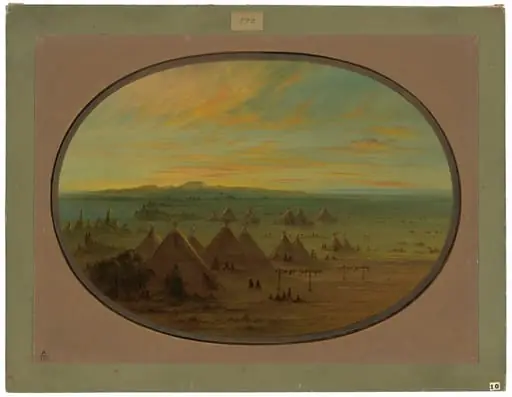 A Crow Village on the Salmon River
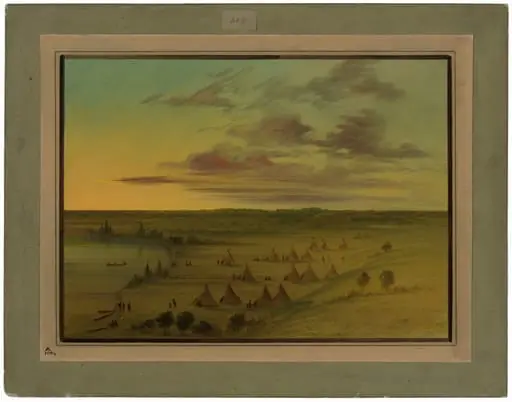 Sioux Village - Lac du Cygne
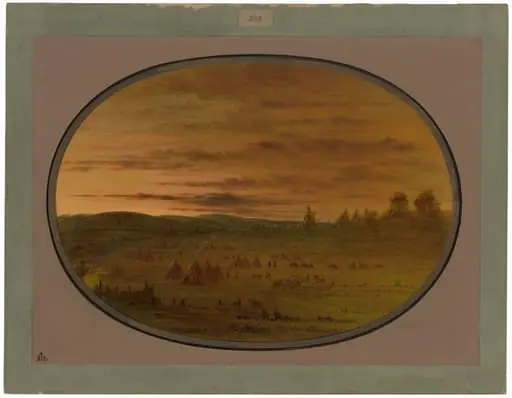 An Indian Encampment at Sunset
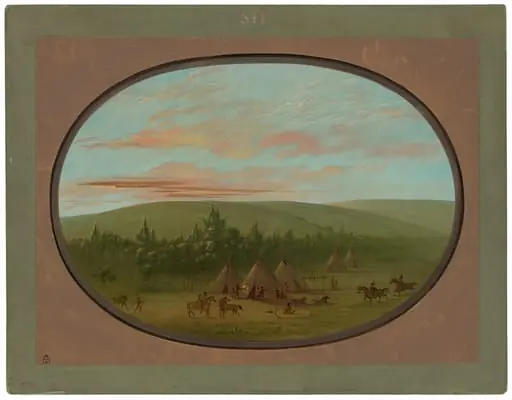 A Sioux Village
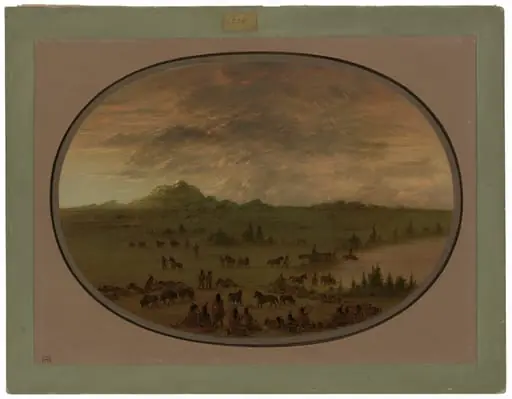 Bivouac of a Sioux War Party at Sunrise
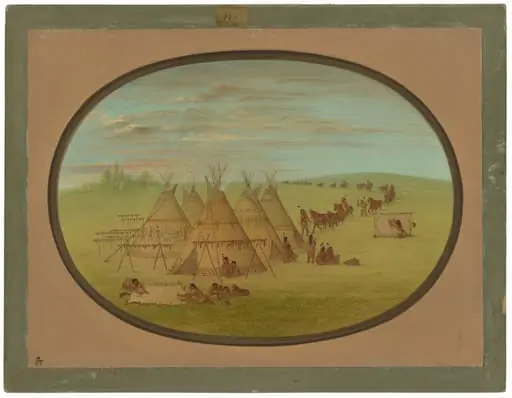 A Little Sioux Village
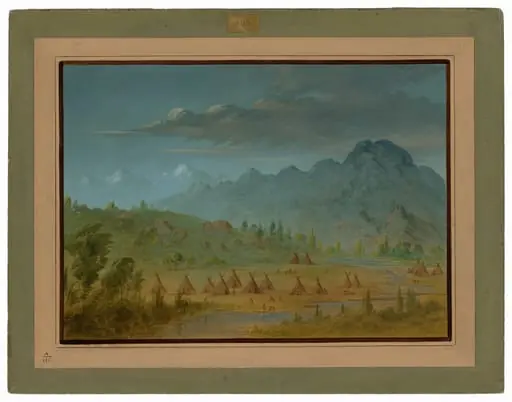 A Crow Village and the Salmon River Mountains
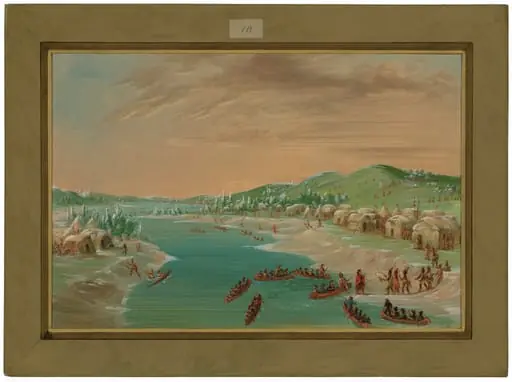 La Salle and Party Arrive at the Village of the Illinois. January 1, 1680
- Slaves' Dance - Saukie