Artwork
Naked Young Woman in Front of the Mirror
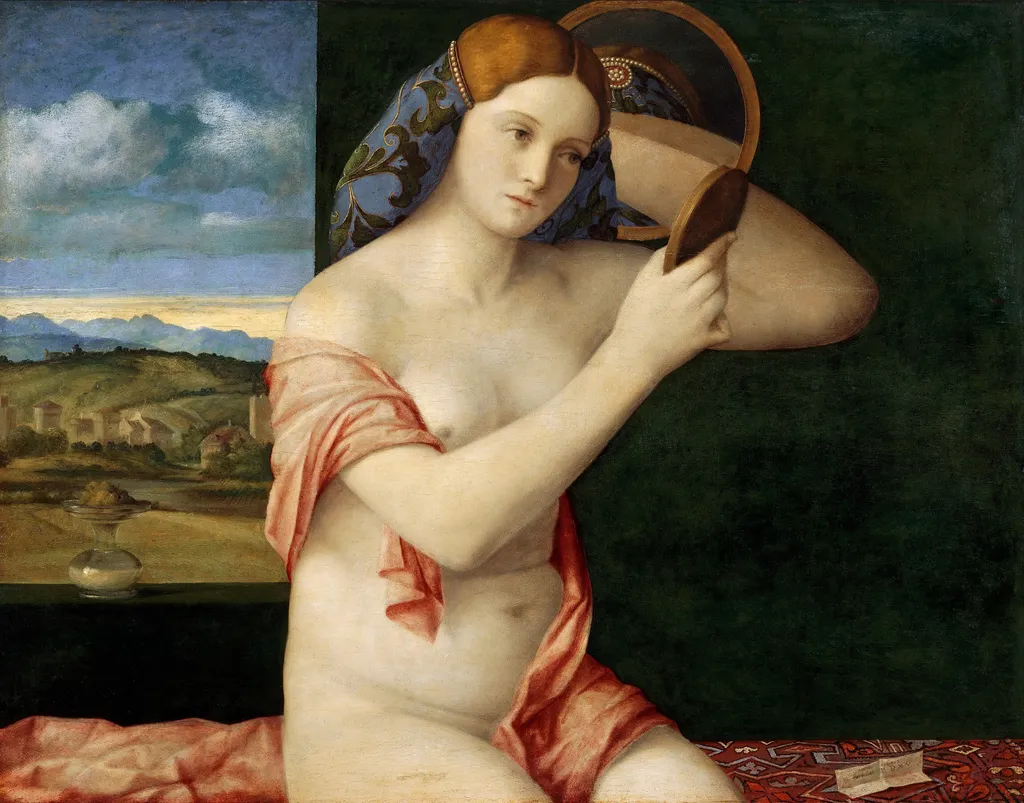
Naked Young Woman in Front of the Mirror is an oil painting by the High Renaissance artist Giovanni Bellini. It dates from 1515 and is held in the collection of the Kunsthistorisches Museum.
About this work
Subject & Meaning
The painting shows a young woman seated before a mirror, engaged in the act of adorning herself.
The painting shows a young woman seated before a mirror, engaged in the act of adorning herself. According to the German Wikipedia entry, the figure is interpreted as an embodiment of idealized femininity that simultaneously conveys social expectations such as marital humility. The mirror functions both as a literal device for self-examination and as a symbolic element that allows the artist to present an erotic yet chaste view of the nude, echoing the Venus Pudica motif.
Infrared studies reveal that Bellini prepared the composition with a detailed underdrawing, preserving precise contours of the drapery and anatomical features before applying layered pigments, underscoring his technique and the work's significance in the Venetian tradition.
Technique & Style
The painting was executed in oil on a poplar panel, a support typical of Venetian workshops in the early sixteenth century. Infrared examinations revealed a fully prepared underdrawing on a gessoed ground, with fine black lines defining the contours of the figure, the folds of drapery, and details such as the curtain shadow beneath the elbow and the line of the collarbone. These underdrawings were retained when color layers were applied, allowing Bellini to build up the modeling gradually.
The surface, observed in X-ray, shows a stippled brushwork used for areas other than the figure, indicating a deliberate handling of paint to achieve subtle tonal effects. The composition is rendered with delicate modeling that balances the interior shadows with the bright landscape seen through an open window, while the handling of light on the mirror and reflected elements enhances the poetic atmosphere of the scene.
History & Provenance
The painting was created by Giovanni Bellini in 1515 as one of his final works, reflecting his engagement with Giorgione's tonalism. Bellini signed the work, and it measures 62.9 cm by 78.3 cm in oil on poplar panel. Its provenance traces to 1638, when it was acquired by James Hamilton, 1st Duke of Hamilton, and it remained within the Hamilton family until 1659, when Archduke Leopold Wilhelm of Austria purchased it in Brussels.
Leopold Wilhelm brought the work to Vienna as part of the imperial collection, which now forms the core of the Kunsthistorisches Museum, where the painting is housed within the gallery of Italian Renaissance art.
Context
Giovanni Bellini's Naked Young Woman in Front of the Mirror (1515) occupies a pivotal position in his late oeuvre, reflecting his engagement with Giorgione's tonal innovations while marking one of his final works before his death in 1516. The painting exemplifies Renaissance ideals of idealized nudity, framed as both a study in mirror imagery and a symbolic representation of marital virtues, as noted in Otto Pächt's description of it as an 'Apotheose des Sehens.' Its symbolism, such as the hairnet read as signifying marital constraint, has been analyzed in relation to contemporary themes of female conduct, while its acquisition history traces from Archduke Leopold Wilhelm's collection to the Kunsthistorisches Museum in Vienna.
Technical studies, including infrared examinations, reveal Bellini's preparatory drafting methods and underpainting techniques, underscoring its significance in Venetian Renaissance art.
Scholarly discourse situates the painting within broader debates on Renaissance gender roles and artistic representation, with German-language sources emphasizing its role in redefining secular female portraiture through its blend of sacred and profane love motifs. The work's influence extends to later discussions, as evidenced by its inclusion in Paul Veyne's imagined museum, while technical analyses highlight structural details such as the rendering of reflective surfaces.
Legacy
The painting has been cited as an influence on later representations of the female nude in domestic interiors, particularly for its synthesis of sacred and profane love themes. Otto Pächt described it as an "Apotheose des Sehens," emphasizing its role in elevating the contemplation of idealized nudity within secular contexts. Subsequent scholarship, including analyses in German- and French-language sources, has linked its compositional strategies, such as the use of mirrored reflections to explore erotic and poetic tension, to the development of genre painting in the sixteenth and seventeenth centuries.
The work's iconography, interpreted as embodying social expectations of female virtue, has informed studies on Renaissance gender representation, while its technical innovations in underdrawing and layered glazing have shaped conservation approaches to Venetian Renaissance painting.
Overview
Giovanni Bellini’s oil painting on poplar panel, titled Naked Young Woman in Front of the Mirror, dates from around 1515. Executed in the later phase of Bellini’s career, the work reflects the tonal atmosphere that the Venetian painter Giorgione had introduced to the region.
Own this work as a print
Artist & collection

Artist
Giovanni Bellini (Italian: ; Venetian: Zuane Belin; c. 1430 – 29 December 1516) was an Italian Renaissance painter, probably the best known of the Bellini family of Venetian painters. He was raised in the household of…