Artwork
The Holy Family. The Rest on the Flight into Egypt
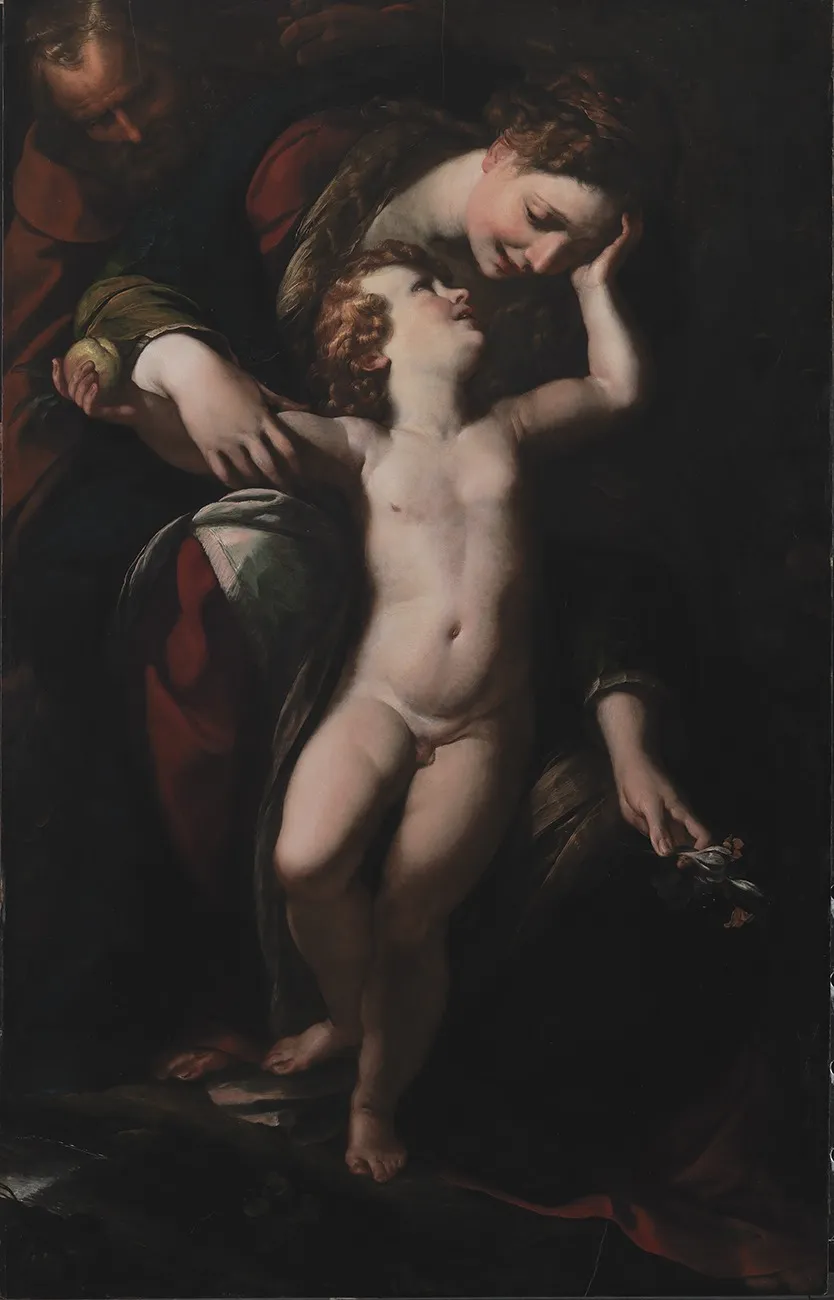
The Holy Family. The Rest on the Flight into Egypt is an unspecified painting by the Early Baroque Italian artist Giulio Cesare Procaccini. It dates from 1614 and is held in the collection of the Statens Museum for Kunst.
About this work
Overview
Measuring 1450 by 926 millimetres, the work exemplifies the transition from Mannerism to Baroque in early seventeenth-century Milanese painting.
The Holy Family. The Rest on the Flight into Egypt is an oil painting on panel by the Italian Baroque artist Giulio Cesare Procaccini, dated to 1614 and held in the collection of the Statens Museum for Kunst in Copenhagen. Measuring 1450 by 926 millimetres, the work exemplifies the transition from Mannerism to Baroque in early seventeenth-century Milanese painting. It depicts the biblical episode of the Holy Family's flight into Egypt, rendered with dramatic chiaroscuro and intense emotional immediacy. The painting is significant as a mature work by Procaccini, demonstrating his synthesis of Bolognese Mannerist training, Venetian colorism, and the emerging Baroque sensibility that would define his later career.
Subject & Meaning
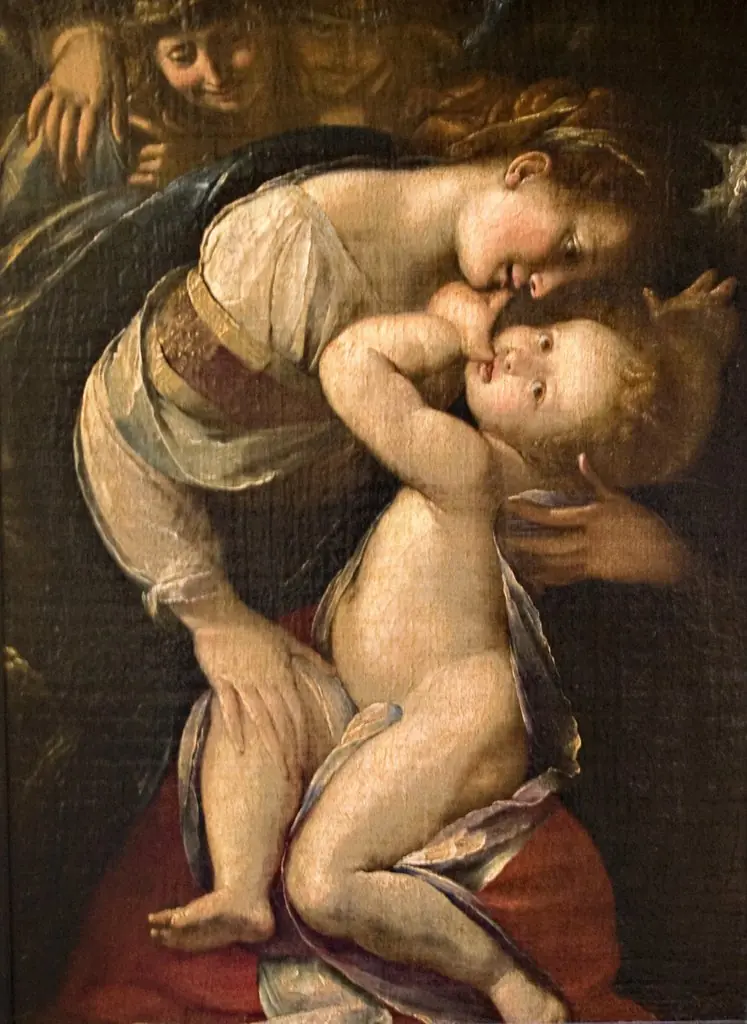
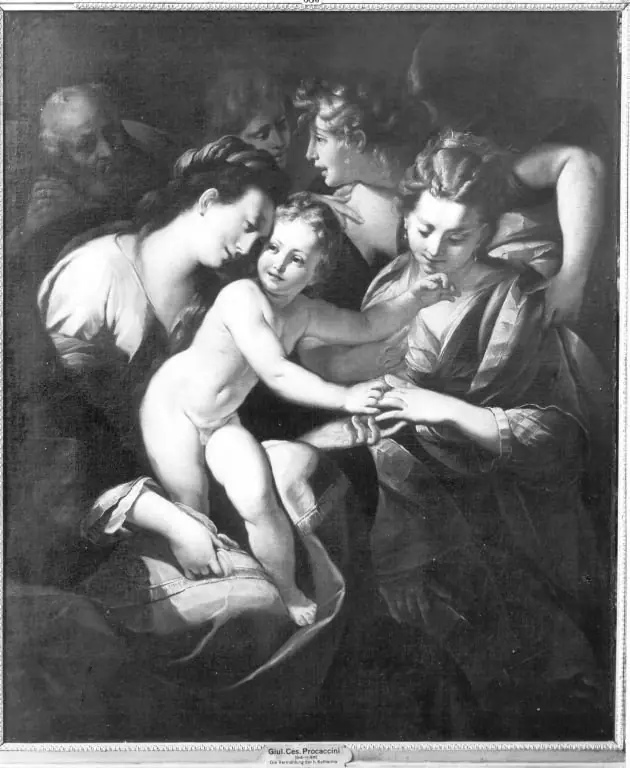
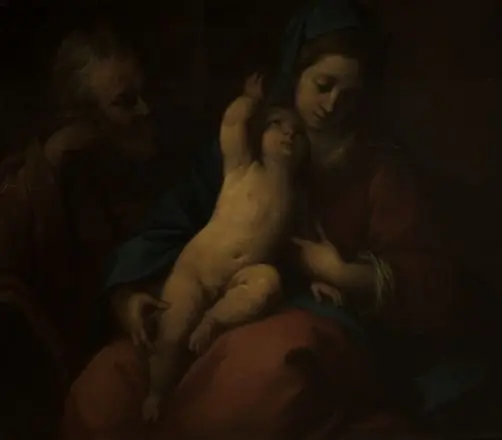
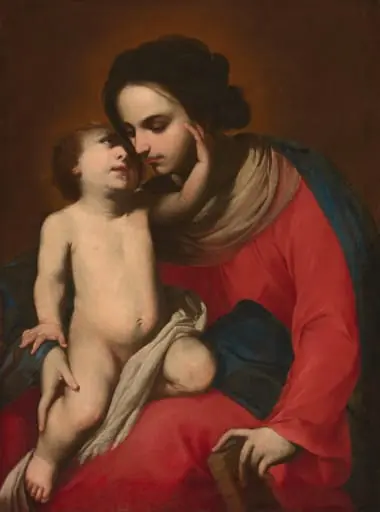
The painting represents the Rest on the Flight into Egypt, a popular subject in Catholic art that depicts the Virgin Mary, Joseph, and the infant Jesus pausing during their escape from Herod's massacre. Procaccini's treatment centers on three figures in a vertical format against a dark, undefined background. The nude Christ child stands in the foreground, his body turned slightly with head tilted upward, left hand raised to touch Mary's face while his right arm extends behind him toward Joseph, who appears partially visible in the upper left. Mary bends forward with downcast eyes, her right hand resting on the child's shoulder and her left hand holding a small flower. Joseph holds a round fruit in his right hand, an attribute that may allude to the Fall of Man and the redemption Christ offers. The composition creates a triangular arrangement of familial connection, with the child's upward gaze and outstretched arms generating dynamic movement. The absence of landscape or architectural setting focuses attention entirely on the human drama and emotional exchange between the figures, while the dramatic lighting from the upper left spotlights the Christ child's body and Mary's face, heightening the theatrical intimacy of the sacred encounter.
Technique & Style
The work is executed in oil on panel, a support that allowed Procaccini the control necessary for his refined handling. The palette is dominated by deep browns and blacks, with warm flesh tones and touches of red in the drapery; a green sleeve is visible on Joseph's arm. Light falls dramatically from the upper left, creating strong chiaroscuro effects that illuminate the child's body and the woman's face while allowing the background to recede into shadow. The brushwork shows smooth blending on the flesh, with more textured handling in the fabrics. This technical approach reflects Procaccini's dual inheritance: the Bolognese Mannerist precision learned from his father Ercole Procaccini the Elder, and the Venetian colorism he encountered through works available in Milan and Genoa. The emotional intensity conveyed through dramatic lighting and the destabilization of static composition marks the painting as characteristic of Procaccini's Baroque development, where movement and psychological ambiguity challenge fixed meanings.
History & Provenance
The painting is dated to 1614, with Wikimedia Commons sources suggesting a broader range of 1613 to 1615. It bears the accession number KMS7319 at the Statens Museum for Kunst in Copenhagen, where it remains in the national collection. The work has been discussed in several scholarly publications, including Olaf Koester's 1987 study of Giulio Cesare Procaccini and Hugh Brigstoke's 1985 monograph, which illustrates the painting as figure 13. It was also featured in Eva Friis's 1996 publication 100 mesterværker and in an exhibition catalogue around 1985 titled Around 1610: the onset of the Baroque. The painting has been referenced in connection with Saint-Non and Fragonard's Panopticon italiano by Pierre Rosenberg. Its presence in the Danish national collection indicates it was acquired at some point for the Statens Museum for Kunst, though the precise circumstances of its acquisition are not specified in the available sources.
Context
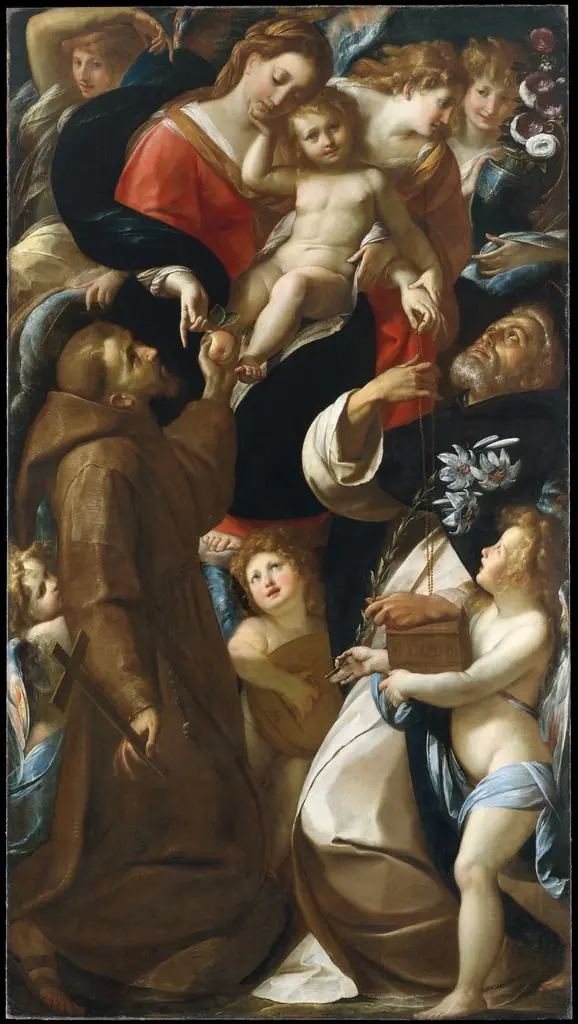
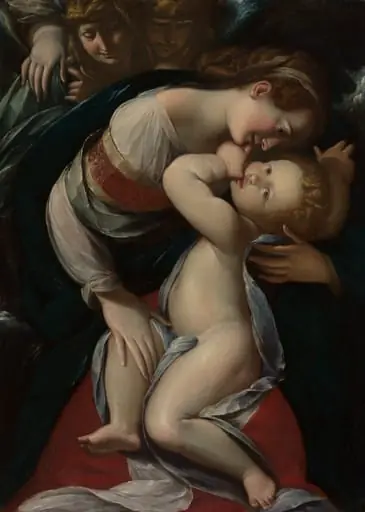
Giulio Cesare Procaccini was born in Bologna in 1574, the son of the Mannerist painter Ercole Procaccini the Elder. He began his career as a sculptor in Milan, working in the Cathedral and at Santa Maria presso San Celso, before turning to painting. By 1610 he had painted six of the Quadroni, large canvases celebrating Saint Charles Borromeo, establishing his reputation in the competitive Milanese art world. His style shows the influence of Bolognese Mannerism and Venetian colorism, and he is recognized as marking the beginning of the Baroque in Milan. The Holy Family. The Rest on the Flight into Egypt belongs to a period when Procaccini was producing small religious canvases for wealthy families in Milan and Genoa, where he encountered the works of Peter Paul Rubens. This context of private devotional commissions explains the intimate scale and emotional directness of the painting. The work's dating to 1614-1615 places it shortly after his major public commissions and alongside other significant works such as The Virgin and Child with the Infant Saint John and Attendant Angels of 1610 and the Madonna and Child with Saints Francis and Dominic and Angels of 1615.
Legacy
The Holy Family. The Rest on the Flight into Egypt occupies an important position in Procaccini's oeuvre as a demonstration of his mature synthesis of sculptural form, Mannerist elegance, and Baroque emotional drama. The painting has been reproduced and studied as a key example of early Baroque religious art in northern Italy, appearing in scholarly literature from the 1980s onward and in museum publications highlighting masterpieces of the Statens Museum for Kunst collection. Its value for art history lies in documenting the precise moment when Procaccini's style achieved full Baroque expression, moving beyond his father's Mannerism toward the theatrical lighting and psychological complexity that would influence subsequent generations of Milanese painters. The work's presence in Copenhagen rather than in an Italian collection also illustrates the international dispersal of Italian Baroque paintings during subsequent centuries. Within Procaccini's body of work, it stands alongside his altarpieces such as the Circumcision in Modena and the Last Supper in Genoa as evidence of his range across both public and private devotional formats.
Artist & collection
Artist
Giulio Cesare Procaccini (30 May 1574 – 14 November 1625) was an Italian painter and sculptor of the early Baroque era in Milan.