Artwork
In the Waves (Dans les Vagues)
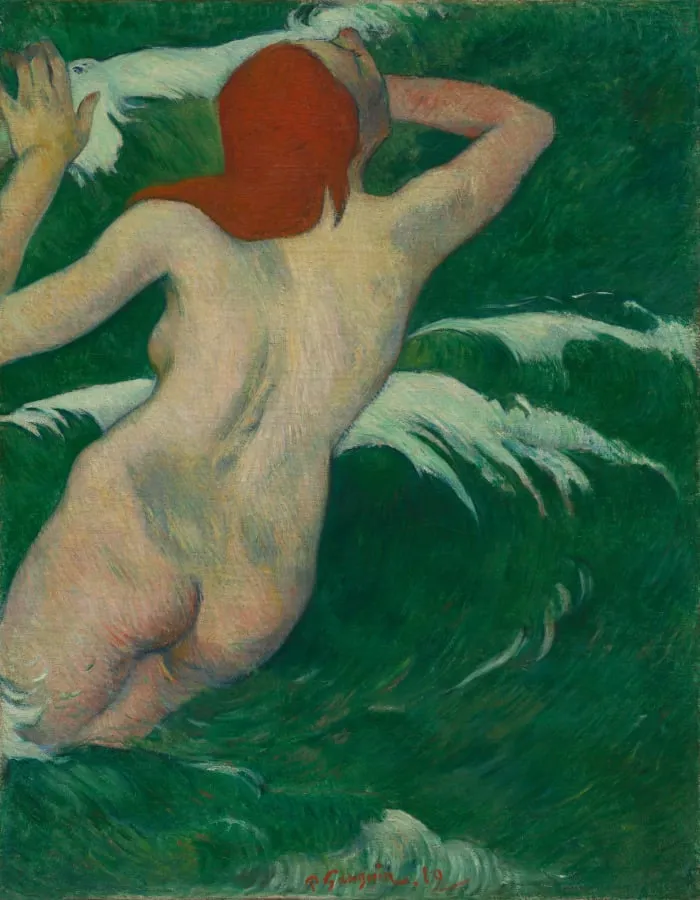
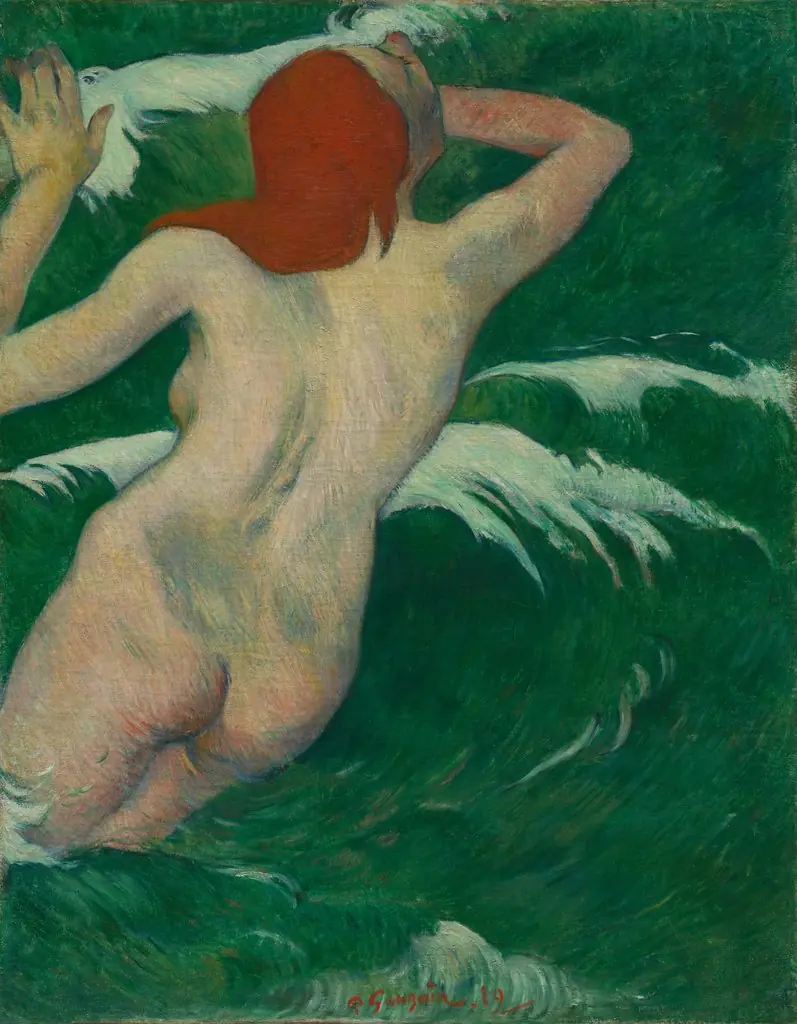
In the Waves (Dans les Vagues) is an unspecified painting by the Impressionist artist Paul Gauguin. It dates from 1889 and is held in the collection of the Cleveland Museum of Art. Painted in 1889 at Pont-Aven, a rural village in Brittany, this work captures a solitary female figure diving into turbulent sea waves.
- Accession no.
- 1978.63
- Credit line
- Gift of Mr. and Mrs. William Powell Jones
About this work
He wanted the scene to suggest something deeper, freedom, instinct, or breaking away from modern life.
A woman dives head-first into choppy green waves, her body glowing orange against the sea. The sky is a flat band of yellow, and the water looks more like swirling paint than real ocean.
Gauguin painted this in a small French village, not from life but from memory and imagination. The bright, clashing colors and bold outlines were meant to feel raw and emotional, not realistic. He wanted the scene to suggest something deeper, freedom, instinct, or breaking away from modern life.
To see how other artists used color this way, look up Paul Gauguin (French, 1848–1903).
Overview
Painted in 1889 at Pont-Aven, a rural village in Brittany, this work captures a solitary female figure diving into turbulent sea waves. Created not from direct observation but from memory and imaginative reconstruction, the scene departs from naturalism. Gauguin used heightened color and flattened forms to evoke inner states rather than external reality, aligning with broader Symbolist aims to express emotion beyond the visible world.
Subject & Meaning
The nude figure, mid-dive, appears to surrender to the sea, suggesting a symbolic break from societal norms and rational modernity. Her motion implies a return to primal instinct, a theme resonant with contemporary interest in non-Western cultures and pre-industrial ways of life. The absence of context or narrative detail invites interpretation as a personal or spiritual release, rather than a literal depiction.
Technique & Style
Gauguin employed bold, unmodulated areas of color, particularly the stark contrast between the figure’s orange skin and the green sea, along with thick, simplified outlines. These choices reflect Synthetism, a style prioritizing emotional expression over optical accuracy. The water and sky are rendered as flat planes, resembling decorative patterns more than natural elements, reinforcing the painting’s departure from realism.
History & Provenance
The painting was first shown in 1889 at the Café Volpini, an exhibition organized by Gauguin and his circle to counter the official Paris Salon. Though not widely seen at the time, its inclusion helped establish Gauguin as a central figure in the Symbolist avant-garde. The work remained in private hands until entering a public collection, where it continues to be studied for its radical aesthetic choices.
Context
Created during Gauguin’s retreat from urban life, the painting reflects broader 19th-century European anxieties about industrialization and cultural decay. Influenced by Breton folklore, Japanese prints, and non-European art, Gauguin sought to revive spiritual meaning through simplified forms and symbolic color. His work here parallels literary Symbolism, which valued suggestion over direct representation.
Legacy
In the Waves contributed to the redefinition of painting as a vehicle for psychological and spiritual expression. Its departure from naturalism influenced later movements such as Expressionism and Fauvism. Though initially obscure, the painting’s bold use of color and symbolic intent secured its place in the evolution of modern art as a turning point away from academic conventions.
Artist & collection
Artist
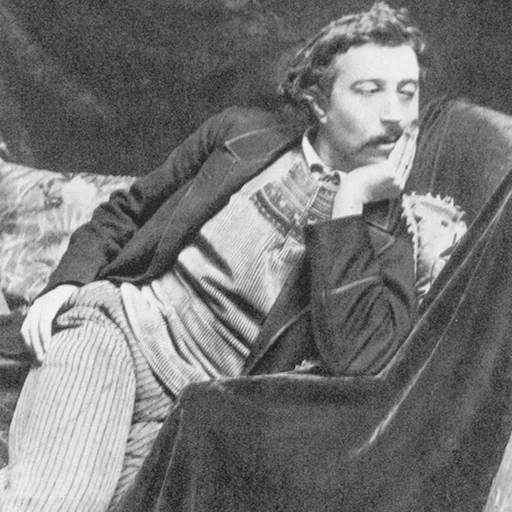
Eugène Henri Paul Gauguin (; French:; 7 June 1848 – 8 May 1903) was a French painter, sculptor, printmaker, ceramist, and writer, whose work has been primarily associated with the Post-Impressionist and Symbolist movements.