Artwork
Diana
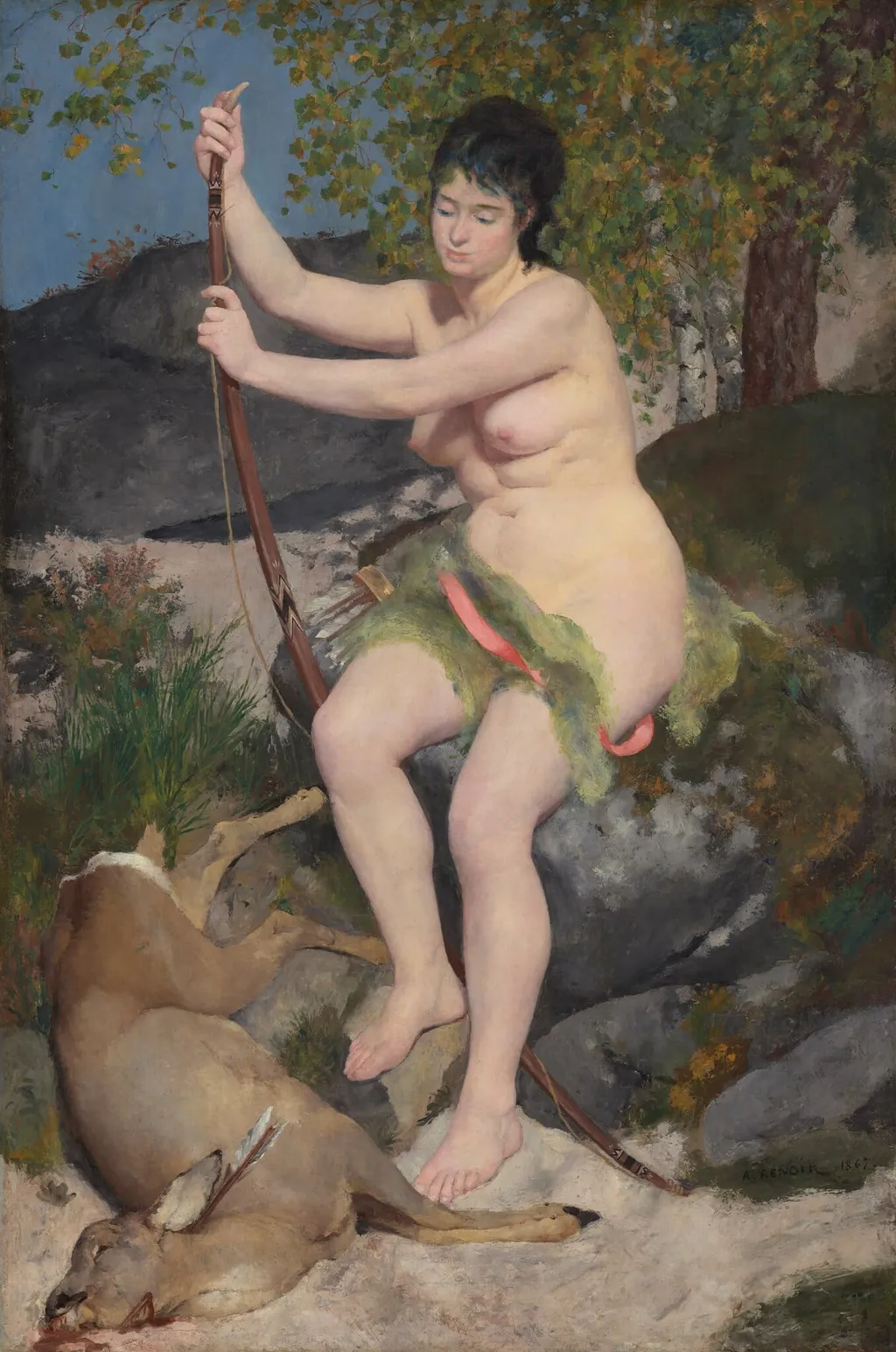
Diana is an oil painting by the Impressionist artist Pierre-Auguste Renoir. It dates from 1867 and is held in the collection of the National Gallery of Art.
- Inscription
- Inscribed:lower right: A. RENOIR 1867
About this work
Subject & Meaning
The painting repurposed a studio nude of Renoir’s mistress, Lise Tréhot, into a mythological subject to mitigate contemporary objections to its eroticism.
Renoir’s Diana (1867) depicts the Roman goddess Diana as a huntress, seated nude on a rock with her bow resting against her outstretched arms and a deer at her feet, pierced by an arrow. The painting repurposed a studio nude of Renoir’s mistress, Lise Tréhot, into a mythological subject to mitigate contemporary objections to its eroticism. The iconography, Diana’s attributes, the dead deer, and the forest setting, aligns with classical representations of the goddess as protector of wild animals and skilled archer.
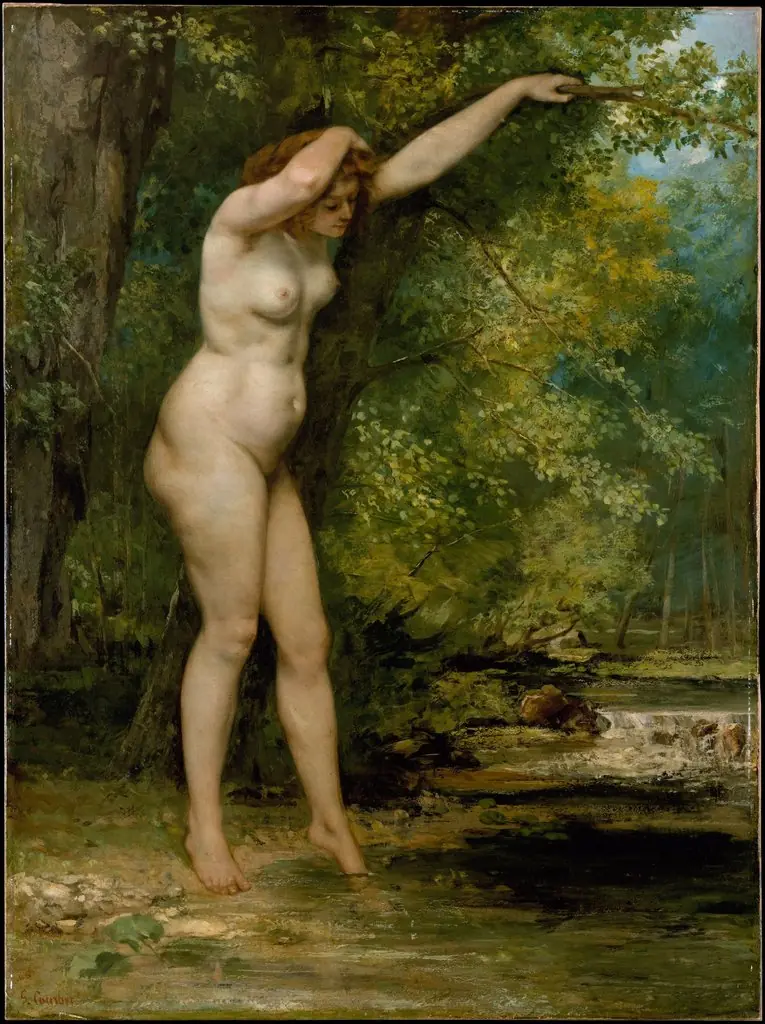
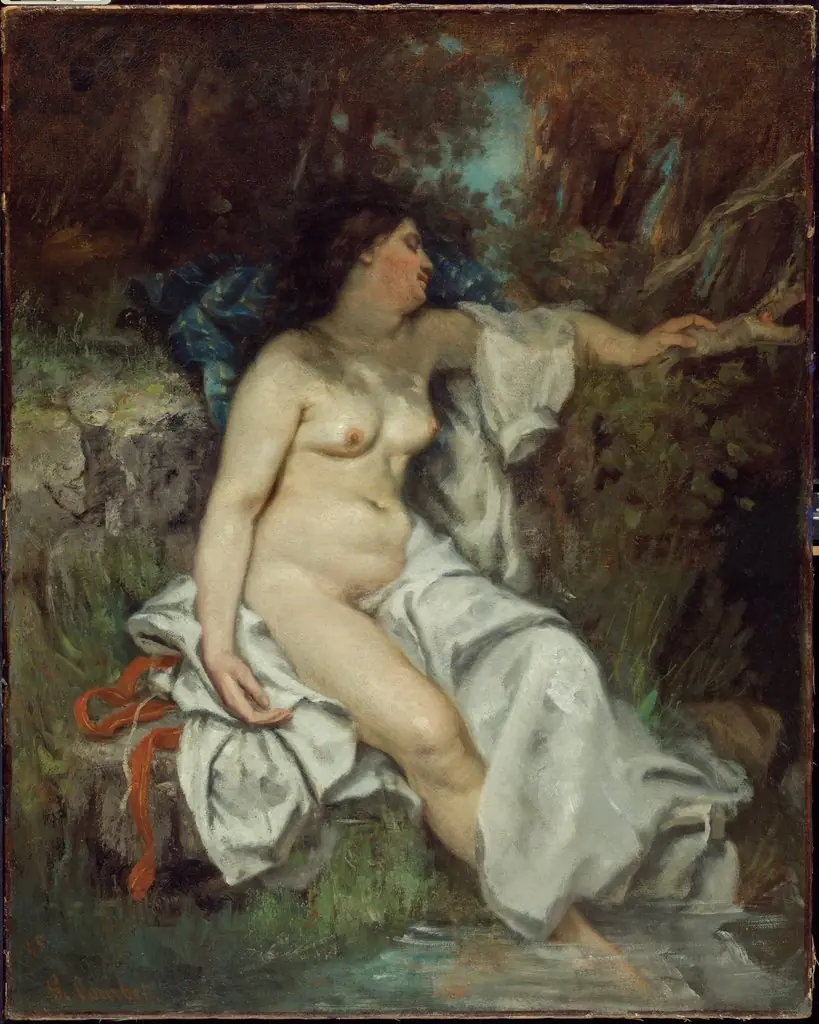
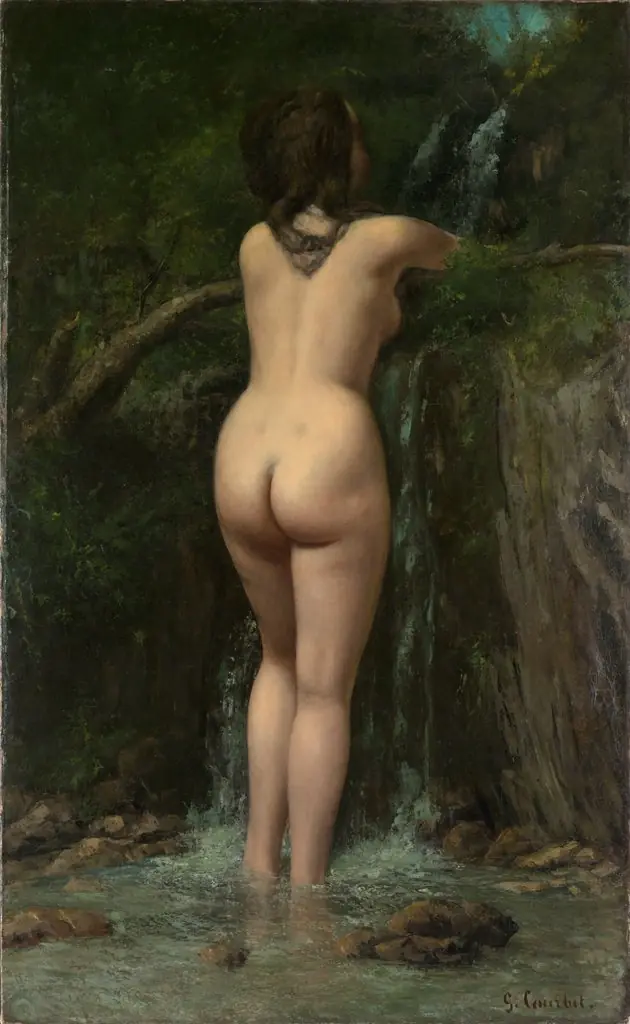
Renoir’s addition of blood and moss, along with his palette-knife technique, reflects Courbet’s Realism, while the vibrant green and red tones anticipate his later Impressionist palette. Critics such as Peter H. Feist emphasized the work’s departure from the era’s idealized, powdered nudes, praising its realism and vitality.
Technique & Style
Executed in 1867, Diana is an oil painting on canvas measuring 199.5 by 129.5 centimeters. Originally conceived as a nude study of a posed model, Renoir transformed the work into a mythological subject to align with academic conventions. The artist employed a palette knife to apply paint, a technique demonstrating the influence of Realist Gustave Courbet, particularly in the textured rendering of moss on the rock and the blood flowing from the deer's mouth.
While the composition adheres to Salon standards of the era, the color palette features bright greens and red accents that foreshadow Renoir's subsequent Impressionist style. The figure sits upon a large stone with an arrow-pierced deer at her feet, combining realistic anatomical detail with mythological attributes.
History & Provenance
Painted by Auguste Renoir in 1867, Diana began as a studio nude study with model Lise Tréhot, later converted into a mythological portrayal of the Roman huntress to meet Salon standards; the work was rejected by the 1867 Salon. Its early ownership traced to Dr. George Viau of Paris, whose 1907 auction (lot 68) placed the canvas with Bernheim‑Jeune, then to Alexandre Berthier, 4th Prince de Wagram. Heirs disposed of it through the Canadeesche Hypothek Bank via Étienne Bignou to Alex Reid & Lefèvre, jointly with M. Knoedler & Co..
Chester Dale acquired the painting in 1933 from Bignou, and in 1963 bequeathed it to the National Gallery of Art.
The painting is held by the National Gallery of Art in Washington, D.C., where it has resided since Chester Dale’s bequest in 1963, entering the museum’s collection as part of the Dale gift. It was first exhibited at the Paris Salon of 1867, where it was rejected, and has remained in the NGA’s permanent holdings. Today the work is on view in the West Building, Main Floor, Gallery 90 of the National Gallery of Art.
Context
Renoir’s Diana (1867), an oil on canvas depicting the huntress goddess, began as a nude study of his mistress Lise Tréhot, whose identity remains debated, Zimmermann (2012) and curator Patry question whether she is the model. To render the study exhibitable, Renoir added Diana’s attributes, noting the original was considered “pretty improper.” The work shows Courbet‑derived realism in the bloodied deer and mossy rock, yet its bright greens and reds anticipate his later Impressionist palette.
Rejected by the 1867 Salon, it entered Chester Dale’s collection and was bequeathed to the National Gallery of Art in 1963. Peter H. Feist praised it as “a beautifully accurate nude, without the coarseness of Courbet’s Bathers” and “far more healthy and realistic” than contemporary idealized nudes.
Legacy
After its initial rejection by the 1867 Salon, Renoir’s Diana entered private collections before Chester Dale acquired it in 1933 and bequeathed the work to the National Gallery of Art in 1963, where it remains on public view in Washington, D.C.. The painting’s reputation evolved from a controversial nude to a celebrated example of Renoir’s synthesis of academic composition and emerging Impressionist color, a shift noted by contemporary critics such as Peter H. Feist, who praised its “beautifully accurate nude” and heightened realism compared with earlier works. Its display in the museum’s West Building, Gallery 90, has contributed to ongoing scholarship on Renoir’s mythological subjects and their role in 19th‑century French art.
Overview
Pierre-Auguste Renoir's 1867 oil painting, "Diana," depicts a serene scene featuring a female figure, understood to be the Roman goddess, situated within a lush, natural landscape. The artwork is characterized by its peaceful ambiance, a quality achieved through the artist's delicate application of light and color. This tranquil approach offers a contrast to some of the more dramatic artistic expressions common during the period of its creation.
Own this work as a print
Artist & collection

Artist
Pierre-Auguste Renoir was a French artist who was a leading painter in the development of the Impressionist style.