Artwork
The Bravo (The Attack on Trebonius)
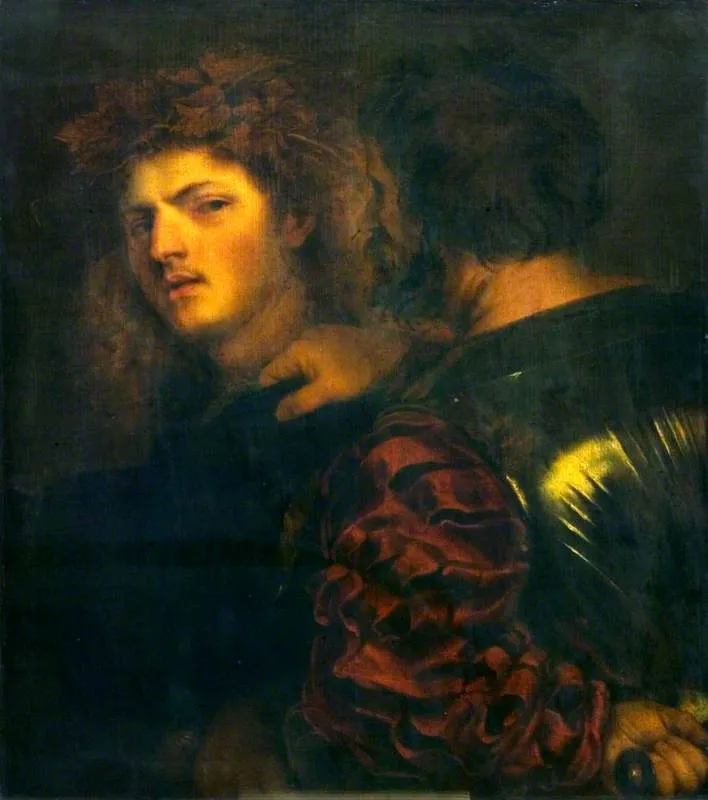
The Bravo (The Attack on Trebonius) is an oil painting by the Early Baroque Italian artist Unknown. It dates from 1600 and is held in the collection of the Victoria and Albert Museum.
About this work
Overview
The Bravo (The Attack on Trebonius) is a sixteenth-century oil on canvas painting depicting two male figures in a compressed, dramatic encounter.
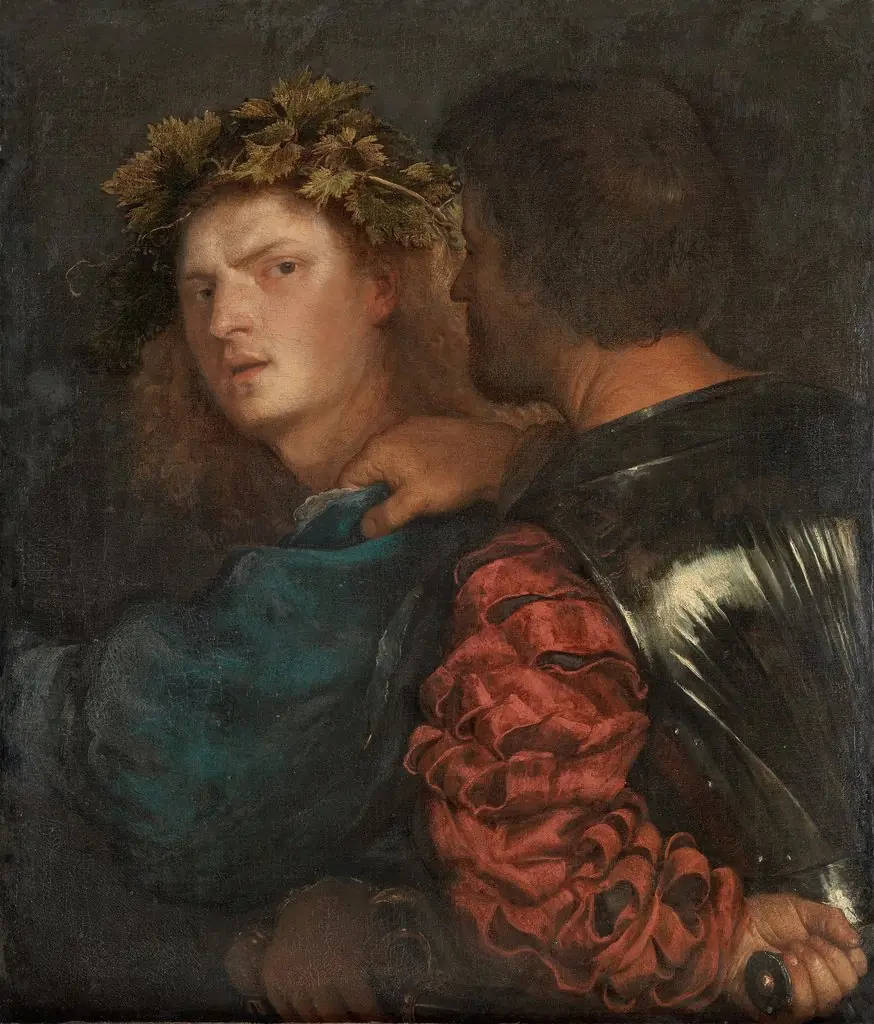
The Bravo (The Attack on Trebonius) is a sixteenth-century oil on canvas painting depicting two male figures in a compressed, dramatic encounter. The composition exists in two primary versions: the original work attributed to Titian, dated circa 1515 to 1523, housed in the Kunsthistorisches Museum in Vienna, and a later sixteenth-century copy held by the Victoria and Albert Museum in London. The Vienna canvas measures 77 by 66.5 centimeters, while the London copy is roughly the same size at 77.5 by 63.5 centimeters. The painting represents a pivotal development in Venetian art, transforming the close-up, half-length genre picture pioneered by Giorgione into a scene of intense psychological and physical drama.
Subject & Meaning
The painting captures a tense, ambiguous moment between two men. A young man with flowing blond hair and a wreath of vine leaves turns sharply toward the viewer, while a shadowy figure behind him grips his shoulder and conceals a dagger or sword. The specific narrative remains debated. One interpretation identifies the scene as an episode from Plutarch's Life of Marius, where Gaius Lusius attacks Trebonius, who then draws his own weapon to kill his assailant. A prominent alternative reads the work as a mythological scene from Euripides' Bacchae and Ovid's Metamorphoses, depicting the arrest of Bacchus or his follower Acoetes by Pentheus, the king of Thebes who opposed the Bacchic cult. The vine-leaf wreath and the youth's blond hair support the Bacchic identification, drawing a visual parallel to Titian's Bacchus and Ariadne. An x-ray of the Vienna version revealed that the armored figure originally wore a crown, a detail that could reinforce the Pentheus interpretation but complicates the historical reading.
Technique & Style
Executed in oil on canvas, the work employs a stark chiaroscuro to heighten the dramatic tension. Light falls sharply from the left, illuminating the face of the laureled youth while casting the bravo into deep shadow, leaving only a polished highlight on the metal breastplate and the vivid red of a voluminous sleeve. The palette is dominated by deep browns and blacks, punctuated by the golden light on flesh and armor and the bright red fabric. The Vienna original demonstrates Titian's luminescent coloring and skilled handling of light, with smooth brushwork on flesh and more textured handling in fabric and hair. In contrast, the Victoria and Albert Museum copy lacks this luminescent quality and careful attention to detail, and it shows differences in the youth's facial expression. Stylistically, the painting belongs to Titian's Giorgionesque phase, fitting within a group of 1510s Venetian half-length portraits where enigmatic interactions between closely cropped figures convey an undercurrent of cruelty.
History & Provenance
The original Vienna painting was likely in the Venetian home of Zuanantonio Venier by 1526 or 1528, described then as two half-figures attacking each other by Titian. It subsequently entered the collection of Bartolomeo della Nave in Venice by 1636 or 1648. That year, it was sold to the Duke of Hamilton, who transported it to London. Following Hamilton's execution, Archduke Leopold Wilhelm of Austria acquired the work in 1659, integrating it into his Brussels gallery and later the Habsburg imperial collection in Vienna, ultimately passing to the Kunsthistorisches Museum. The Victoria and Albert Museum version, accessioned as CAI.97, was likely painted in Venice during the sixteenth century based on the original's presence there. It was bequeathed by Constantine Alexander Ionides in 1901, though it was absent from his own inventory, suggesting it originated from the collection of his father, Alexander Constantine Ionides.
Context
The attribution of the Vienna painting has fluctuated over the centuries. In the seventeenth century, it was attributed to Giorgione, and later to Palma Vecchio, a view championed by art historian John Steer. The Italian art historian Roberto Longhi is credited with reattributing the work to Titian, which remains the prevailing scholarly consensus. The painting's prominence in the Habsburg collection is evidenced by its inclusion in gallery paintings by David Teniers the Younger, who served Archduke Leopold Wilhelm. Teniers also produced an etching of the composition for his Theatrum Pictorium, though the etching notably credited the work to Giorgione. The Victoria and Albert Museum copy is one of several known replicas of the Vienna composition, reflecting the original's popularity and dissemination throughout European collections.
Legacy
The Bravo stands as a significant example of the evolution of the Venetian half-length portrait from Giorgione's intimate genre scenes into a vehicle for concentrated narrative drama. The work's enigmatic subject matter and stark psychological tension anticipated later Baroque interests in dramatic chiaroscuro and ambiguous narrative moments. Titian's broader technique and mastery of light in the original composition, as seen in this work, marked a transition from the meticulous finish of the fifteenth century, exerting a formative influence on major seventeenth-century European painters such as Rubens and Velazquez. The existence of multiple copies, including the Victoria and Albert Museum version, underscores the composition's enduring appeal and its role in disseminating the Venetian style across Europe.
Artist & collection









 Venus and Tannhäuser
 Joseph und Potiphars Weib
 Hubert and Arthur (from Shakespeare's 'King John')
 Continence of Scipio
 Nymph and Hunter
 Portrait of an unknown man
 Rinaldo and the Mirror-Shield
 Kneeling Woman with Child
 Das Liebespaar (Werkstatt)
 Head of a Young Warrior
 Rinaldo și Armida. Pandant: Medoro și Angelica
- The Bravo