Artwork
Christ Crucified
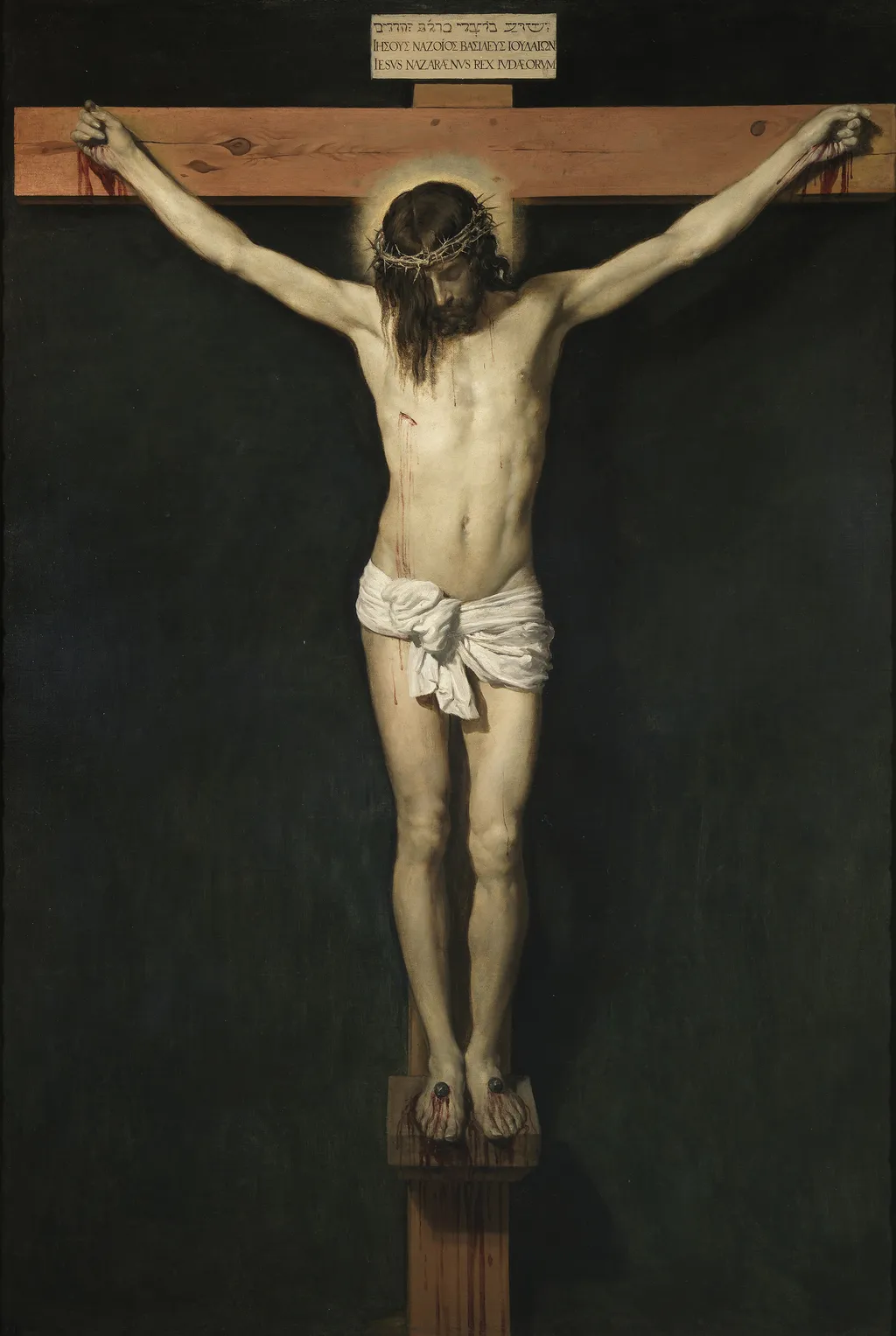
Christ Crucified is an oil painting by the Early Baroque Italian artist Diego Velázquez. It dates from 1632 and is held in the collection of the Museo del Prado.
About this work
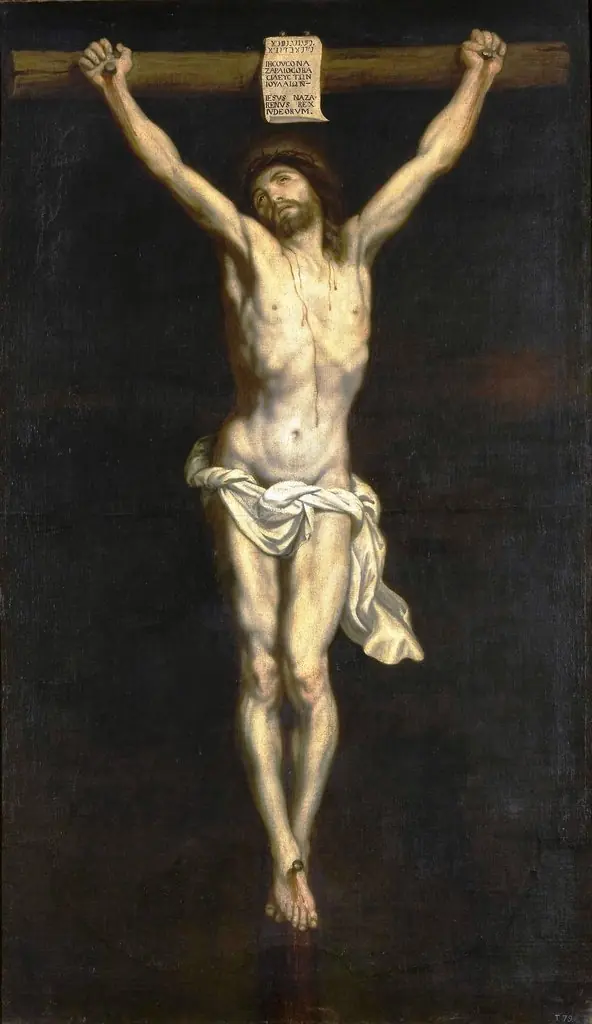
It presents only the figure of Christ on the cross, drawn with careful anatomical proportion.
Christ Crucified is an oil painting by Diego Velázquez, dated 1632. The work shows the Crucifixion of Jesus on a dark green background.
The piece was commissioned by the Benedictine nuns for the Convent of San Plácido in Madrid. It presents only the figure of Christ on the cross, drawn with careful anatomical proportion. Its composition is very simple, with no other figures.
You might also explore works at the Museo del Prado.
Subject & Meaning
The painting depicts the Crucifixion of Jesus Christ, shown alone on the cross with no accompanying figures, set against a dark greenish-gray background. Christ is portrayed in a moment just after speaking the words "It is finished," his head fallen onto his chest, his body anatomically idealized and serene rather than contorted in agony. His wounds are understated, with traces of dried blood visible on the torso and limbs, and a crown of thorns rests on his head.
A narrow halo appears to emanate from the figure itself, and long hair partially veils the face. Above the crossbeam, an inscription in Hebrew, Greek, and Latin reads "IESUS NAZARÆNVS REX IUDÆORVM," the title Pilate ordered placed on the cross according to the Gospel of John.
Velázquez followed the classical iconography codified in seventeenth-century Spain by his teacher and father-in-law Francisco Pacheco. The work shows Christ affixed with four nails, each hand and each foot pierced separately, rather than the three-nail Gothic tradition in which the feet are crossed and pinned with a single nail. The feet are positioned parallel and supported on a small wooden brace, producing a classic contrapposto stance that conveys repose rather than collapse.
This four-nail iconography, defended by Pacheco through appeals to early Christian writers and medieval sources, was promoted as the older and more orthodox model and was enforced under Counter-Reformation norms that required religious art to be clear, devotional, and faithful to biblical narrative.
Technique & Style
Diego Velázquez painted Christ Crucified in 1632 using oil paint on canvas, a religious work reflecting Counter-Reformation norms that emphasized clear biblical narrative and emotional intensity. The composition follows Francisco Pacheco's iconographic standards for crucifixion, depicting Christ with four nails joining the feet on a small wooden support, a loincloth, and a subtle halo, with the head resting on the chest in slight profile. Velázquez employs impasto technique, loosely applied thick paint that is sometimes scratched with the brush tip to create textured effects, particularly around the hair and shoulders, while chiaroscuro lighting from the left highlights the figure against a dark greenish-gray background, creating a luminous effect that suggests Christ emerging from the painting.
The anatomically proportioned body, supported by separated feet, conveys a sense of repose rather than death, and the work demonstrates Caravaggian influence through dramatic contrast between light and shadow.
History & Provenance
Christ Crucified was painted by Diego Velázquez in 1632, following his first trip to Italy (1629–1631), during which he studied the works of Italian masters. The painting was commissioned by Jerónimo de Villanueva, protonotary of Aragon and a secretary to King Philip IV, for the Convent of San Plácido of the Benedictine nuns in Madrid, a convent Villanueva himself had founded in 1623. Art historian Jonathan Brown has linked the commission to an Inquisition investigation involving Villanueva and the convent, suggesting the work may have served as a votive act of penance.
The painting later passed into the collection of Manuel de Godoy, who had it seized, and subsequently to his former wife, María Teresa de Borbón, 15th Countess of Chinchón. After her death in 1828, it was inherited by her brother-in-law Joaquín José de Melgarejo, Prince of San Fernando de Quiroga, who donated it to King Ferdinand VII of Spain. Ferdinand VII transferred it to the Museo del Prado, where it has been housed since 1829.
The painting has been held in the collection of the Museo del Prado in Madrid since 1829. Its path to the museum began when it was seized by Manuel de Godoy, after which it passed to his former wife, María Teresa de Borbón, 15th Countess of Chinchón. Upon her death in 1828, the work was inherited by her brother-in-law, Joaquín José de Melgarejo, Prince of San Fernando de Quiroga, who subsequently gifted it to King Ferdinand VII of Spain.
The monarch then transferred the artwork to the Prado. Prior to these ownership changes, the canvas was commissioned for the Convent of San Plácido in Madrid, likely donated by the convent's founder, Jerónimo de Villanueva.
Context
Christ Crucified was painted by Diego Velázquez in 1632 and is housed in the Museo del Prado in Madrid. The work was commissioned by the Benedictine nuns of San Plácido in Madrid for a votive image, likely donated by the convent founder Jerónimo de Villanueva. Velázquez had studied Italian masters during his first trip to Rome (1629–1631), and his religious paintings, though few, demonstrate a strong ability to convey intense religious feeling.
The painting follows Counter-Reformation norms by depicting Christ with four nails in the feet, a four‑nail iconography defended by Velázquez’s teacher Francisco Pacheco and supported by contemporary theological arguments. The composition shows Christ alone on the cross, with a subtle curvature of the arms, a narrow halo, and a white loincloth, rendered in abundant impasto and chiaroscuro that creates a luminous effect against a dark greenish‑gray background. The anatomical proportions, contrapposto stance, and use of light reflect both classicist influences and Caravaggist chiaroscuro, while the four‑nail detail aligns with Pacheco’s iconographic recommendations and the strict iconographic rules of Spanish Baroque religious art.
Legacy
Velázquez’s Christ Crucified soon became the canonical Spanish image of the crucifixion and remains the most famous religious painting in Spain. Its restrained classicism and anatomical precision shaped later Spanish representations, influencing figures such as Francisco de Zurbarán and Alonso Cano, who adopted its four‑nail iconography and contrapposto repose. The work’s quiet spirituality also inspired literary responses, notably Miguel de Unamuno’s long poem El Cristo de Velázquez (1920), which meditates on the painting’s serene yet solemn evocation of sacrifice.
Since entering the Museo del Prado in 1829, the painting has been treated as a touchstone of Spanish Golden Age religious art, repeatedly cited for its fusion of technical mastery and devotional intensity.
Overview
Diego Velázquez’s oil painting Christ Crucified, completed in 1632, portrays the crucifixion of Jesus on a stark, dark‑green field. The composition is singular, presenting only the nailed figure of Christ on the cross, rendered with precise anatomical accuracy. The work’s austere visual language has made it a central example of Spanish religious art, and it now hangs in Madrid’s Museo del Prado.
Own this work as a print
Artist & collection
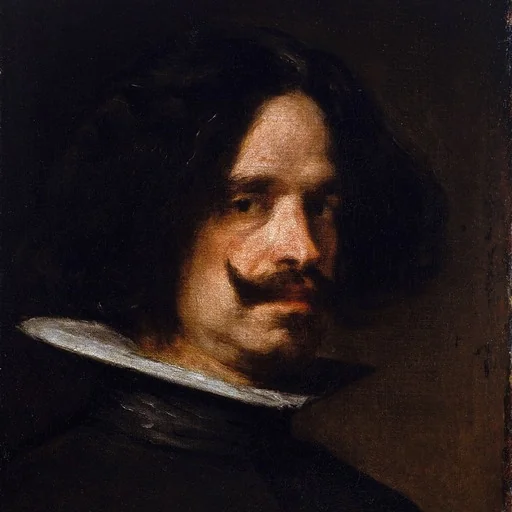
Artist
Diego Rodríguez de Silva y Velázquez was a Spanish Baroque painter, the leading artist in the court of King Philip IV of Spain and Portugal, and of the Spanish Golden Age.