Artwork
St Sebastian
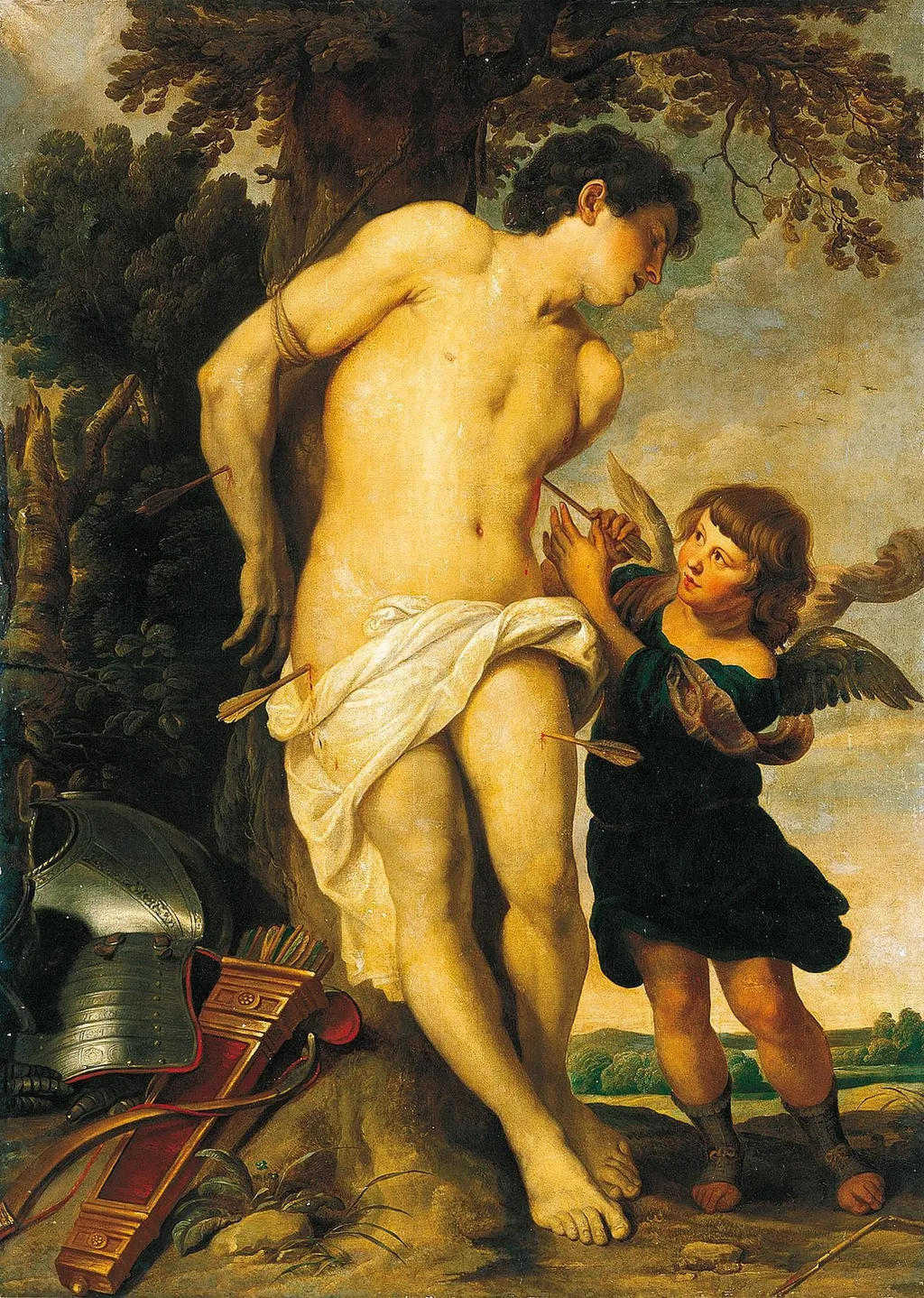
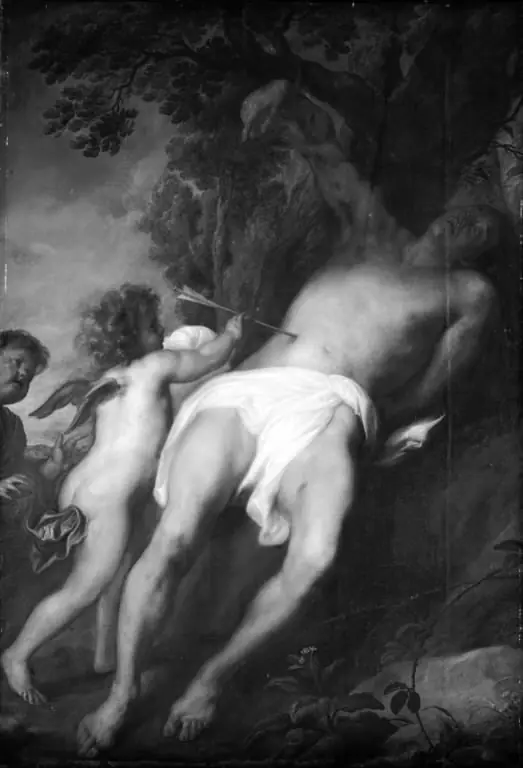
St Sebastian is an oil painting by the Flemish Baroque painting artist Gerard Seghers. It dates from 1640 and is held in the collection of the Hermitage Museum.
About this work
Overview
Executed in oil on canvas, the work measures 200 by 142 centimeters and was made in Flanders.
St Sebastian is a religious painting created in 1640 by the Flemish artist Gerard Seghers. Executed in oil on canvas, the work measures 200 by 142 centimeters and was made in Flanders. It depicts the martyrdom of Saint Sebastian and is currently held in the Hermitage Museum. The painting is a significant example of Seghers's mature output, demonstrating his synthesis of early Caravaggesque influences with the later, more colorful aesthetic of Peter Paul Rubens.
Subject & Meaning
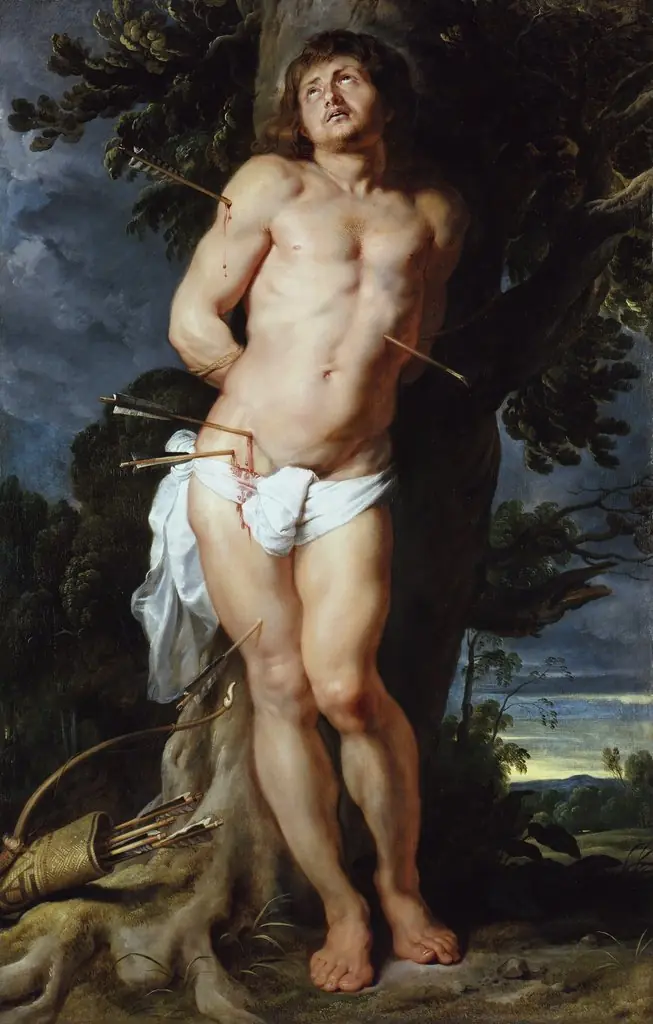
The artwork captures Saint Sebastian after his first martyrdom, bound to a tree with ropes around his upper arms and pierced by arrows in his side and leg. A winged child in dark green clothing, an angel, stands to the right, reaching toward an arrow in the saint's side. This angelic presence shifts the iconography from the traditional narrative where Saint Irene of Rome heals Sebastian, instead presenting the angel as a symbol of the power of faith to survive death. The composition minimizes the gore of the barely visible wounds, focusing on an ideally proportioned nude body as a metaphor for the perfection of the holy soul. A metal helmet and a red and gold bow with a quiver rest on the ground, signifying the weapons of his failed execution.
Technique & Style
Seghers employed oil paint on canvas to construct this composition. The palette relies on warm flesh tones, deep greens, and browns, unified by a golden light. Strong illumination highlights Sebastian's torso against the darker, dense foliage and open sky with soft clouds. The paint surface is smooth overall, though visible brushwork defines the foliage and sky. Stylistically, the work reflects Seghers's evolution away from the tenebroso manner of his Roman period toward the shimmering colors and more classicizing baroque style characteristic of Rubens, which he increasingly adopted around 1645.
History & Provenance
Created in Flanders in 1640, the painting eventually entered the collection of the Hermitage Museum, where it resides today. The composition achieved broader circulation through an engraving by Paulus Pontius, created between 1616 and 1657. Pontius reproduced the work after Seghers's painting, helping to disseminate the design. A later oil on canvas copy from the 17th century Flemish school, based on the Pontius engraving, exists in the Musee d'Archerie Valois, indicating the original composition's reach even if the specific prototype for the Hermitage canvas remains distinct from other known versions.
Context
Gerard Seghers began his career in Antwerp, reportedly trained by Abraham Janssens, before traveling to Italy around 1610. In Rome, he joined Caravaggio's circle and absorbed the tenebroso style, particularly through close contact with Gerrit van Honthorst. After a period in Spain, where he served as court painter to Philip III, he returned to Antwerp after 1620. There, he found it prudent to abandon his Caravaggesque manner, gradually gravitating toward the school of Rubens and Anthony van Dyck. By 1634, Seghers became the official painter for the infant-cardinal Don Fernando, securing his status among the leading Flemish masters of his generation.
Legacy
The 1640 Hermitage composition is part of a broader visual tradition of the subject by Seghers, which includes an earlier painting dated around 1630, currently housed at Petworth House in Sussex. That earlier version is also known through the Pontius engraving and a related preparatory drawing of a male nude posed as Saint Sebastian, which surfaced at auction at Sotheby's in 2009 and was exhibited in Rotterdam in 2002. The existence of the later Hermitage painting and the subsequent copies, such as the one in the Musee d'Archerie Valois, demonstrate the enduring appeal of Seghers's interpretation of the saint, successfully blending his Caravaggesque roots with the refined elegance of the Antwerp school.
Own this work as a print
Artist & collection
Artist
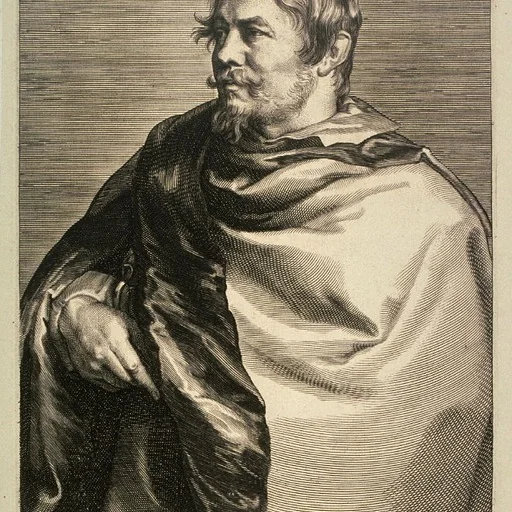
Gerard Seghers (c. 17 March 1591 – 18 March 1651) was a Flemish painter, art collector, and art dealer. After a period of study and residence in Italy, he returned to Flanders where he became one of the leading…