Artwork
Cardinal Pietro Bembo
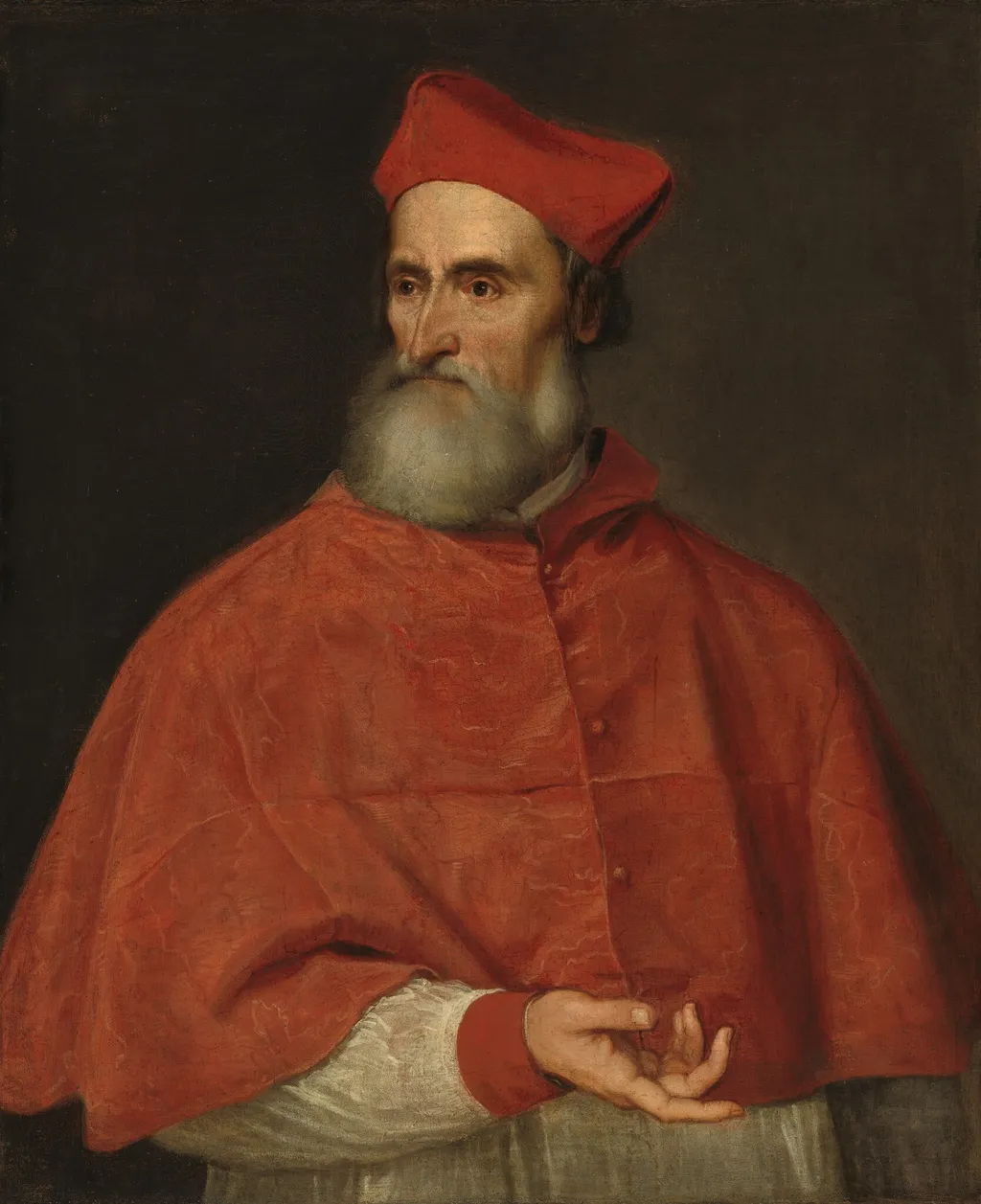
Cardinal Pietro Bembo is an oil painting by the Renaissance artist Titian. It dates from 1540 and is held in the collection of the National Gallery of Art.
About this work
Subject & Meaning
His right hand is raised in a rhetorical gesture, while his alert, dark eyes and concentrated expression convey intellectual acuity and disciplined thought.
The portrait depicts Cardinal Pietro Bembo in half-length, seated against a dark background with his torso turned to the right and face to the left. He wears the official red mozzetta over a white rochet, the black biretta resting on his lap, and a long, softly modeled white beard. His right hand is raised in a rhetorical gesture, while his alert, dark eyes and concentrated expression convey intellectual acuity and disciplined thought.
The pose, with the arm parallel to the frame and cape edge, lends the figure sculptural volume, evoking ancient Roman busts or contemporary works by Alessandro Vittoria, underscoring Bembo’s status as a humanist scholar and high-ranking churchman.
Technique & Style
Titian executed the Portrait of Cardinal Pietro Bembo in oil on canvas, a support typical of Venetian painting in the mid‑16th century. The work measures about 94.5 × 76.5 cm and belongs to the Venetian school, employing a dark, flat background that isolates the half‑body figure. The composition places the sitter’s torso turned to the right while his face looks left; his hand is extended in a rhetorical gesture, and the arm is aligned parallel to the picture edge, giving the portrait a sculptural, bust‑like presence reminiscent of ancient Roman portraiture.
The painter models the beard, facial features and drapery with soft chiaroscuro, producing a vivid, alert gaze and a sense of intellectual rigor. The canvas has been preserved in the National Gallery of Art, Washington, D.C., since its acquisition in 1952.
History & Provenance
Titian's Cardinal Pietro Bembo was likely commissioned by the sitter himself in October 1539, shortly after his March elevation to the cardinalate, possibly to mark the occasion before his move from Venice to Rome. The work is referenced in a letter by Bembo dated May 1540. Following the cardinal's death in 1547, the portrait passed by inheritance to his son, Torquato Bembo.
It subsequently entered the collection of Cardinal Antonio Barberini in Rome by 1636, remaining within the Barberini family holdings until the late 19th century. The dealer Elia Volpi facilitated its sale to P. & D. Colnaghi & Co. in 1905, and it was acquired by New York industrialist Charles M. Schwab in 1906. After Schwab's estate sale in 1942, the painting was purchased for the Samuel H. Kress Foundation and gifted to the National Gallery of Art in Washington, D.C., in 1952.
Titian's portrait of Cardinal Pietro Bembo has been held since 1952 by the National Gallery of Art in Washington, D.C., as part of the Samuel H. Kress Collection. Its exhibition and ownership history traces a long route through European and American collections. After passing through the hands of Leone Galli, the painting was recorded in 1636 in Rome as part of Cardinal Antonio Barberini's collection, subsequently remaining within the Barberini family holdings in Rome until around 1890.
The Florentine dealer Elia Volpi then handled its export, selling it in 1905 through Colnaghi's in London and New York (jointly with M. Knoedler & Co.). In 1906 it was acquired by industrialist Charles M. Schwab of New York; following his estate sale at Parke-Bernet Galleries on 3 December 1942, Stephen Pichetto purchased it for the Samuel H. Kress Foundation, which gifted it to the NGA in 1952.
Context
Titian’s portrait of Cardinal Pietro Bembo (c. 1539–1540) exemplifies the Venetian Renaissance tradition of intellectual portraiture, where the sitter’s authority is conveyed through formal composition and symbolic gesture. The work’s critical reception has emphasized its fusion of classical sculptural form, evoking antique busts or Alessandro Vittoria’s contemporary portraits, with the psychological intensity of Venetian painting, reinforcing Bembo’s reputation as a humanist scholar and statesman. Scholarship has linked the portrait to Bembo’s self-commissioning to commemorate his elevation to cardinal in 1539, situating it within the broader context of Titian’s late-career portraits of Venetian patricians and clergy.
Its provenance, passing through Roman Barberini collections and later entering the National Gallery of Art via the Kress Foundation, underscores its status as a canonical example of High Renaissance portraiture preserved in American institutional holdings.
Overview
Titian's 1540 oil on canvas, Cardinal Pietro Bembo, depicts the renowned humanist and scholar in a three-quarter view, seated in a wooden armchair. The cardinal is dressed in the traditional red robes of his office, with a matching biretta resting on the table beside him. Unlike the rigid, hieratic poses common in earlier ecclesiastical portraiture, Bembo is rendered with a naturalistic ease; his body is turned slightly, and his gaze meets the viewer with a calm, intellectual intensity.
The composition utilizes a dark, neutral background to isolate the figure, allowing the rich textures of the velvet and the subtle modeling of the face to command attention. Titian employs his characteristic Venetian technique, using loose, expressive brushwork to capture the play of light on the cardinal's features and garments. Created shortly before Bembo's death, the work reflects the artist's mature style, moving away from idealized representation toward a profound psychological realism.
This portrait stands as a significant example of mid-16th-century Venetian portraiture, illustrating the shift toward depicting the sitter's inner character and status through a relaxed, yet dignified, presence.

Own this work as a print
Artist & collection
Artist
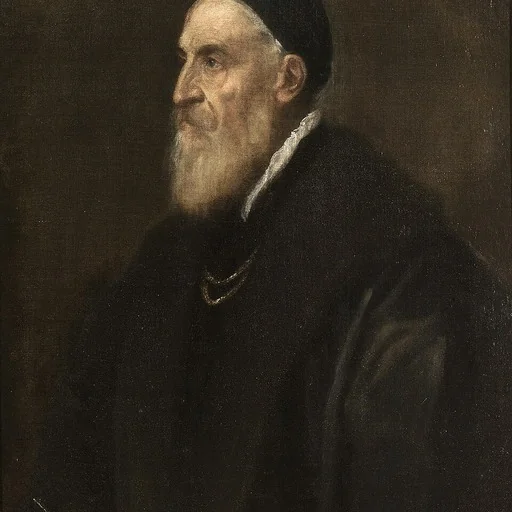
Tiziano Vecellio (Italian:; c. 1488/1490 – 27 August 1576), Latinized as Titianus, hence known in English as Titian ( TISH-ən), was an Italian Renaissance painter. The most important artist of Renaissance Venetian…