Artwork
Diana and Callisto
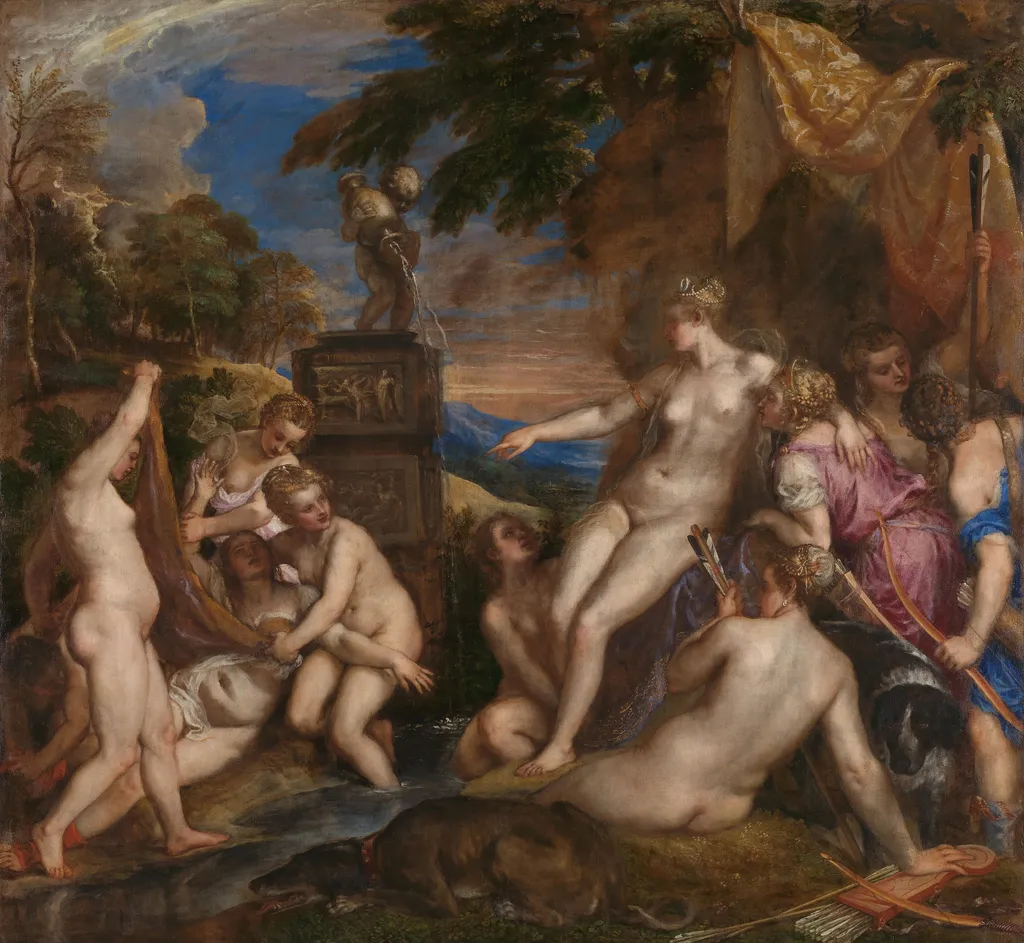
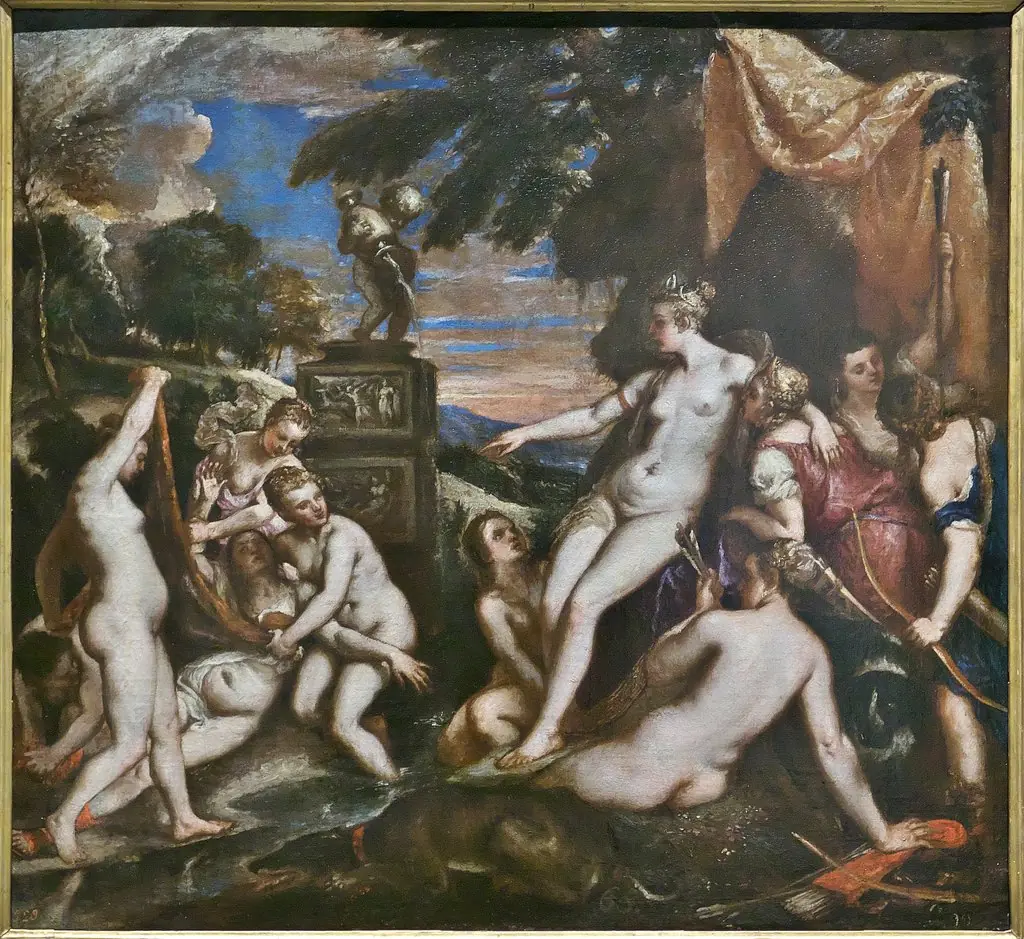
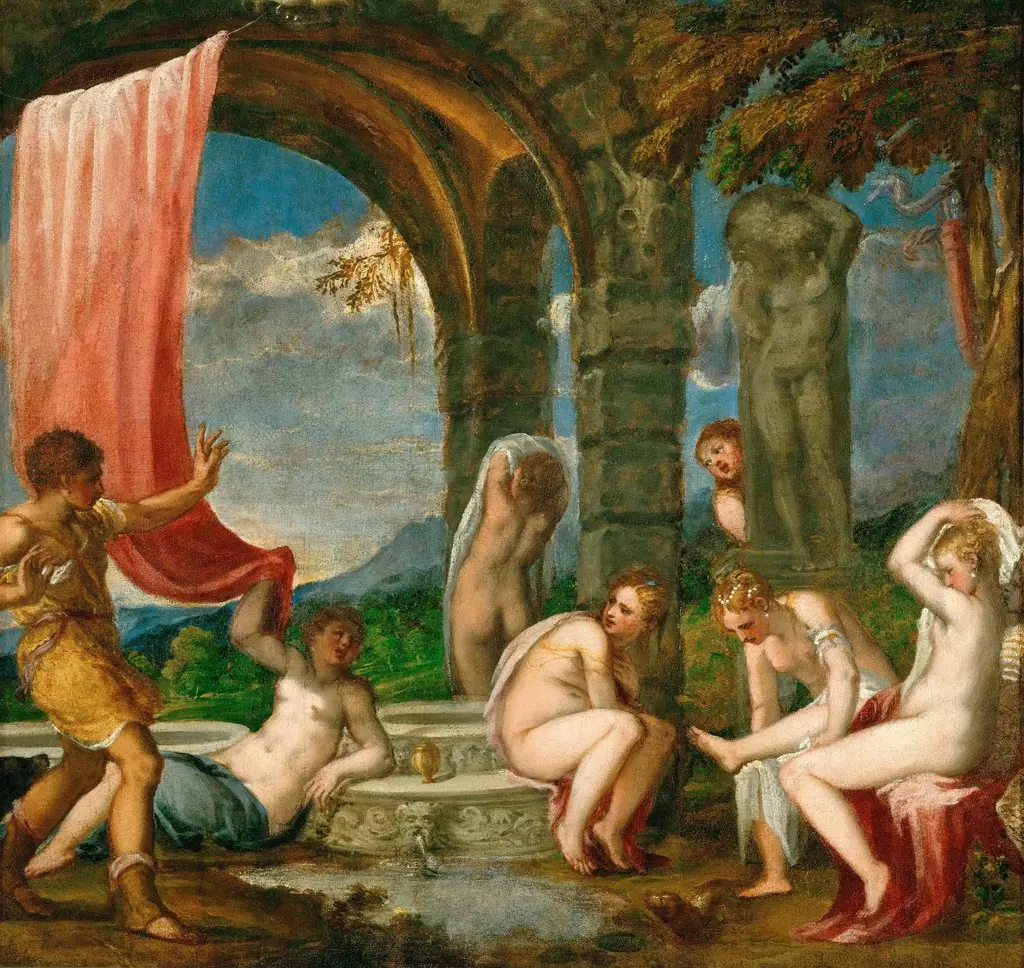
Diana and Callisto is an oil painting by the Mannerist artist Titian. It dates from 1557 and is held in the collection of the National Gallery.
About this work
Subject & Meaning
Titian painted Diana and Callisto between 1556 and 1559 as part of his 'poesie' series for King Philip II of Spain, depicting the mythological moment when the goddess Diana discovers her maid Callisto's pregnancy by Jupiter. The work shows Diana confronting Callisto, who is stripped and exposed before the goddess and her attendant nymphs, symbolizing the punishment of violated chastity. Titian's composition emphasizes dramatic tension through expressive brushwork, dynamic gestures, and chiaroscuro lighting, with the figures arranged to highlight Diana's authority and Callisto's vulnerability.
The painting draws from Ovid's Metamorphoses, reflecting themes of divine retribution and human frailty, and was later acquired jointly by the National Gallery and National Galleries of Scotland in 2012 after a public fundraising campaign.
Technique & Style
Diana and Callisto is executed in oil on canvas, a medium Titian handled with characteristic freedom in his late career.
Diana and Callisto is executed in oil on canvas, a medium Titian handled with characteristic freedom in his late career. The canvas measures 187 × 204.5 cm, with a closely matching variant of 187.5 × 205.5 cm also recorded. Titian's handling is loose and expressive: contours of the figures dissolve as the thinnest of dragged brushstrokes are swept across the surface, generating dynamism and movement.
Voluptuous flesh is suggested through energetic, impasto-like strokes, while the draperies retain carefully observed tactile qualities, rendered in the classicizing tones of blue, red, and yellow despite the rapid application of paint.
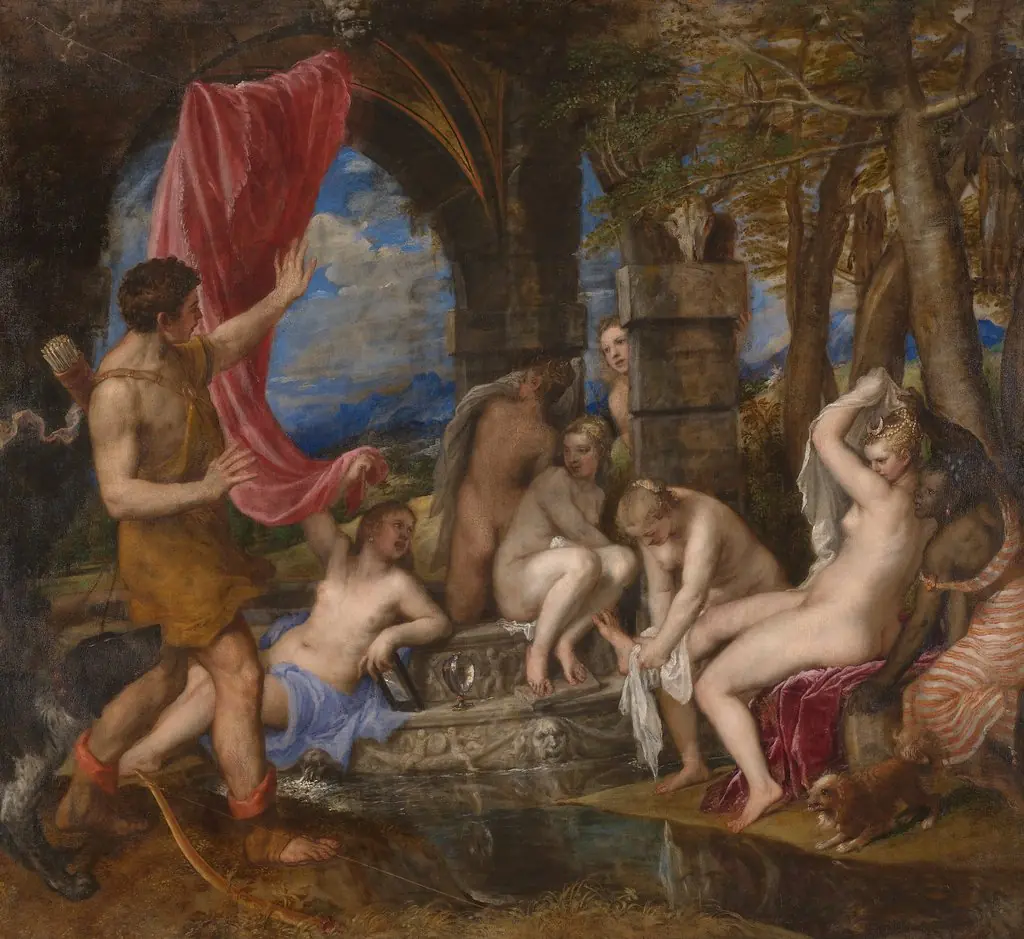
Stylistically, the work belongs to the Venetian school and reflects Titian's Giorgionesque integration of figures into a landscape of green and brown trees, rolling hills, and a distant mountain range beneath a clouded sky. A central fountain topped by a Cupid figure anchors the composition, and the gestures and poses deliberately mirror those of the companion Diana and Actaeon, with which it was designed to be displayed.
History & Provenance
Commissioned by King Philip II of Spain after Emperor Maximilian II declined a similar offer, Titian executed this mythological canvas between 1556 and 1559 as part of a series known as the "poesies." The work remained within the Spanish royal collection until 1704, when Philip V gifted it to the French ambassador. It was subsequently acquired by Philippe II, Duke of Orléans, for his renowned collection.
Following the French Revolution, the painting was sold to a Brussels banker in 1791 and transported to London in 1793. There, Francis Egerton, 3rd Duke of Bridgewater, purchased it through an aristocratic syndicate. Upon Bridgewater's death in 1798, the artwork passed to his nephew, the Earl Gower, initiating the Sutherland family ownership.
Displayed publicly at Bridgewater House for over a century, the collection moved to Scotland in 1939 for safety during the Second World War. In March 2012, the National Gallery and the National Galleries of Scotland jointly acquired the painting for £45 million.
The painting is jointly owned by the National Gallery, London, and the National Galleries of Scotland, Edinburgh, where it is exhibited on an alternating basis between the two institutions.
It is inventoried as NG6616 at the National Gallery, London, with dimensions recorded as 187 × 204.5 cm.
The work was purchased in March 2012 for £45 million through a joint acquisition campaign led by the two galleries, following its sale by the 7th Duke of Sutherland. Prior to 2012 it formed part of the Sutherland (Bridgewater) Loan at the Scottish National Gallery in Edinburgh, where it had been on long-term deposit since 1945 after being moved from London at the start of the Second World War.
In 2020–2021 the painting and its companion Diana and Actaeon were reunited with four other works from Titian’s Poesies series in a touring exhibition that visited the National Gallery, London, the Museo del Prado, Madrid, and the Isabella Stewart Gardner Museum, Boston.
Context
Titian painted Diana and Callisto between 1556 and 1559 as part of a series of mythological canvases known as the "poesies" for King Philip II of Spain. The work depicts the goddess Diana discovering the pregnancy of her maid Callisto, a moment drawn from Ovid’s Metamorphoses. After remaining in the Spanish royal collection, the painting passed through several owners before entering the Bridgewater collection in the late 18th century.
It was displayed publicly at Bridgewater House until the 1930s, then moved to Scotland during World War II and has been on view at the National Galleries of Scotland in Edinburgh since 1945. In 2012 the National Gallery and the National Galleries of Scotland acquired the painting jointly for £45 million, ending a lengthy fundraising campaign. The acquisition was part of a broader effort to keep the two companion paintings, Diana and Callisto and Diana and Actaeon, in the public domain.
The painting’s composition, brushwork, and treatment of light reflect Titian’s mature style and his influence on later artists such as J.M.W. Turner and Lucian Freud. It measures 187 × 204.5 cm and is executed in oil on canvas.
Legacy
The painting's reputation was significantly shaped by its public display in London from the early 19th century, where it inspired figures such as the critic William Hazlitt and artists J. M. W. Turner and Lucian Freud. Freud notably described this work and its companion piece as the most beautiful pictures in the world. The pair remained together throughout their history, moving to Scotland during the Second World War before residing in Edinburgh on loan until 2012.
Their legacy was further cemented by a rare reunion between 2020 and 2021, when they were exhibited alongside four other canvases from the original "poesies" series. This exceptional exhibition traveled to the National Gallery in London, the Museo del Prado in Madrid, and the Isabella Stewart Gardner Museum in Boston, highlighting the enduring influence of Titian's mythological cycle.
Overview
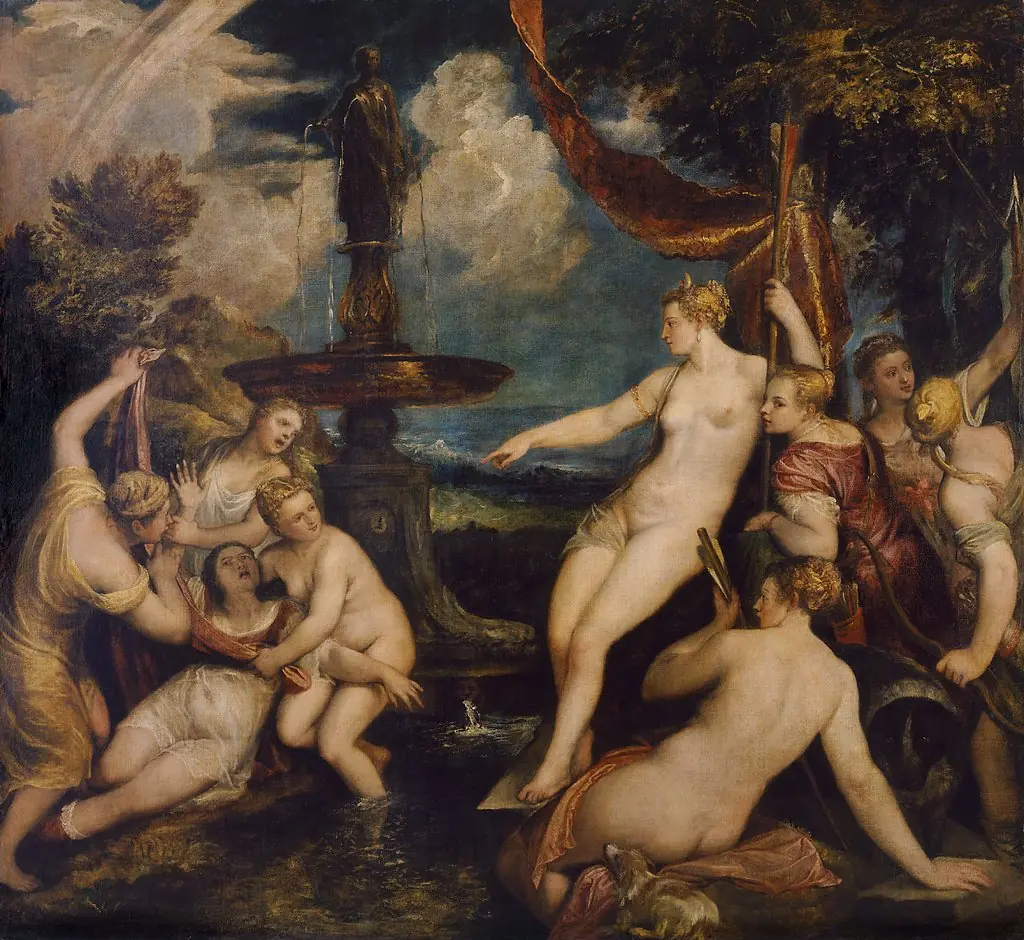
Titian’s oil painting Diana and Callinus was executed between 1556 and 1559, during the later phase of the Italian Renaissance. The work depicts a mythological scene set in a wooded landscape, where the goddess Diana confronts her companion Callisto after learning of Callisto’s pregnancy by Jupiter. The composition balances figures in various poses, with a central nude figure illuminated against a backdrop of trees and a distant statue.
Own this work as a print
Artist & collection

Artist
Tiziano Vecellio (Italian:; c. 1488/1490 – 27 August 1576), Latinized as Titianus, hence known in English as Titian ( TISH-ən), was an Italian Renaissance painter. The most important artist of Renaissance Venetian…