Artwork
Nymph and Shepherd
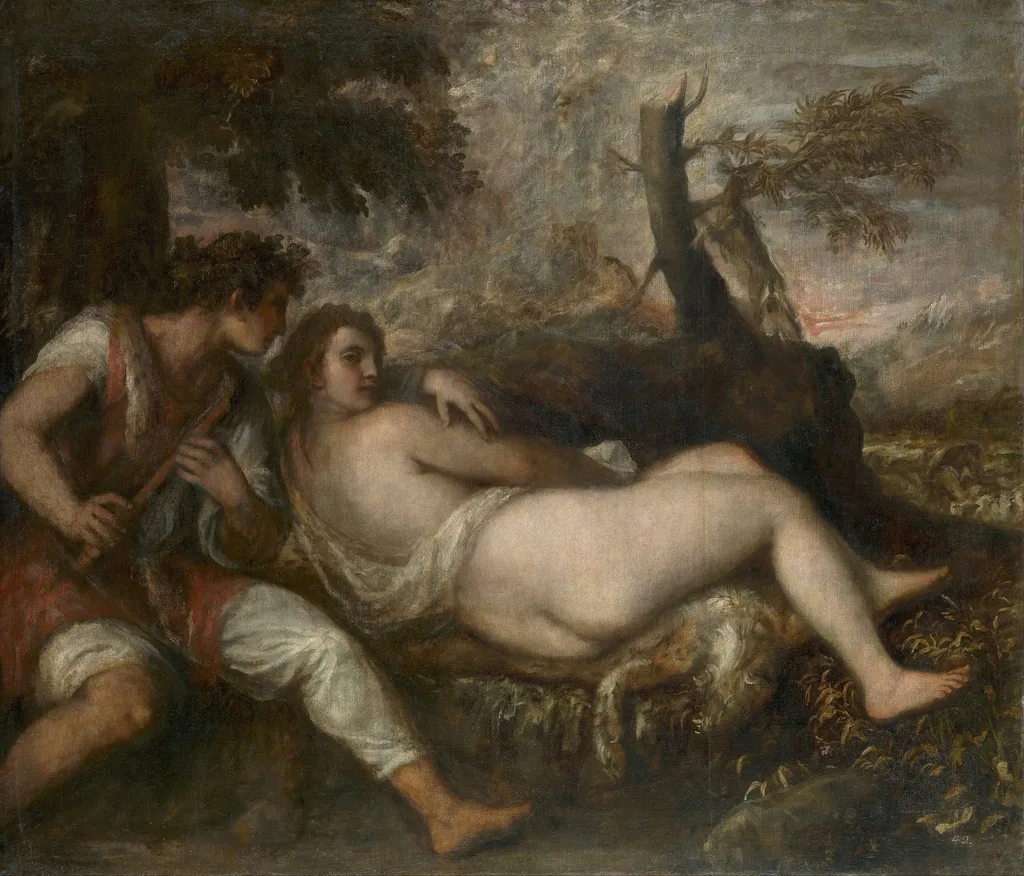
Nymph and Shepherd is an oil painting by the Mannerist artist Titian. It dates from 1570 and is held in the collection of the Kunsthistorisches Museum.
About this work
Subject & Meaning
In this reading, the scene foreshadows their impending separation and forebodes future misfortune, lending the work a melancholic resonance.
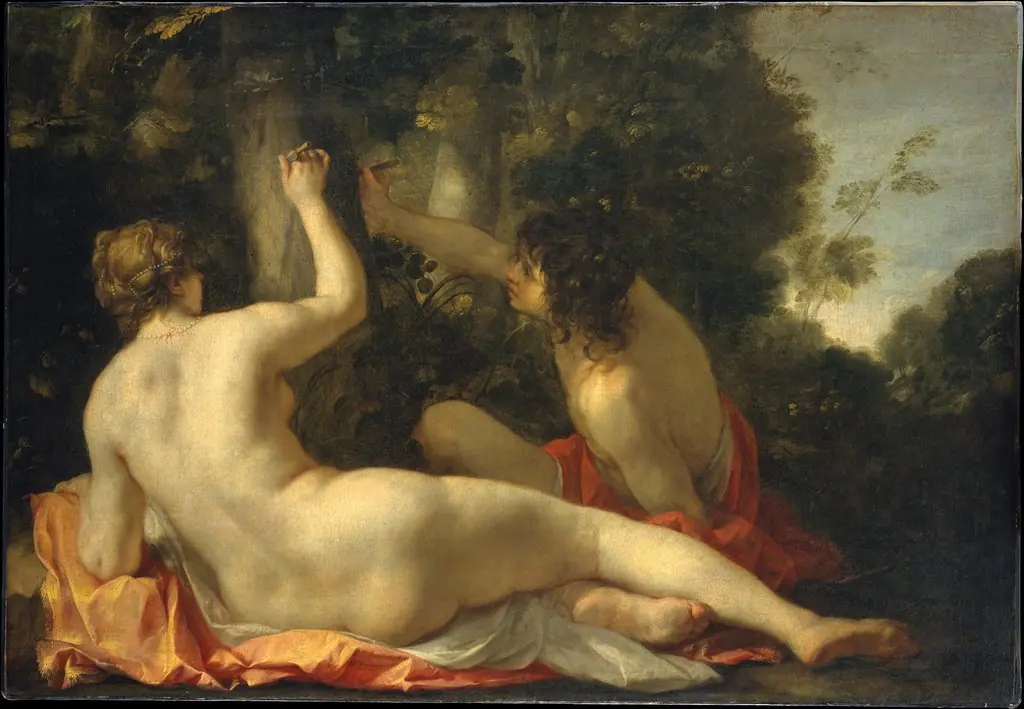
The painting depicts a pastoral scene in which a male shepherd plays a flute while a nymph reclines nude on an animal skin, her back turned to the viewer but glancing back over her shoulder. Set in a wooded landscape, the composition emphasizes an idyllic, if subtly charged, encounter between human and mythic realms.
Scholars have proposed several identifications for the figures. Erwin Panofsky suggested the pair represent Paris and the nymph Oenone, pointing to antique reliefs where Paris is shown in Phrygian dress playing a rustic instrument. In this reading, the scene foreshadows their impending separation and forebodes future misfortune, lending the work a melancholic resonance.
Technique & Style
Executed in oil on canvas around 1570, the painting applies fluid, visible brushwork typical of Titian’s late mannerist style, with long strokes and tactile impasto that emphasize the materiality of the support. The composition features a reclining female nude, a nymph, seated on an animal skin, her back turned to the viewer yet glancing over her shoulder, while a shepherd sits nearby playing a rustic flute. In the background, a goat climbs a tree stump, grounding the scene in a pastoral landscape.
Condition reports from the 2002–2007 restoration note the artist’s varied use of brushes and even his fingers to apply paint, revealing a deliberate texturing of the surface that prefigures later painterly freedoms. The palette is muted, aligning with the subdued tonality of Titian’s late works, and the overall effect merges mythological subject with atmospheric handling, characteristic of Venetian Renaissance practice.
Scholarly discussion has focused on the identities of the figures, with some proposing Paris and Oenone based on iconographic parallels such as the shepherd’s Phrygian-style garment and the nymph’s melancholic posture.
History & Provenance
Titian executed this oil on canvas around 1570. The work entered the documented historical record in 1636 within the Venetian collection of Bartolomeo della Nave. Two years later, it passed to James Hamilton, 1st Duke of Hamilton, who retained ownership until 1649.
By 1660, the painting had been acquired by Archduke Leopold Wilhelm of Austria. It subsequently became part of the holdings of the Kunsthistorisches Museum in Vienna, where it remains today.
The painting Nymph and Shepherd is held in the Kunsthistorisches Museum in Vienna. It entered the collection through several notable owners: it was first recorded in 1636 in the collection of Bartolomeo della Nave in Venice, then belonged to James Hamilton, 1st Duke of Hamilton, from 1638 to 1649, and was later owned by Archduke Leopold Wilhelm of Austria in 1660. The work was acquired by the Kunsthistorisches Museum and has remained in its collection ever since.
It has been exhibited as part of the museum’s permanent display of European paintings, though specific exhibition titles are not detailed in the sources provided.
Context
Critical reception of Nymph and Shepherd highlights its significance within Titian’s later oeuvre and the broader art historical discourse. The painting is frequently discussed in scholarly literature for its stylistic evolution, particularly its muted palette and visible brushwork, which scholars note as anticipatory of later movements such as Impressionism. Erwin Panofsky interpreted the figures as possibly representing Paris and Oenone, linking the work to mythological narratives and Renaissance symbolic traditions.
The work has been part of major museum collections, including the Kunsthistorisches Museum in Vienna, where it has been studied for its provenance and technical execution, including restorations between 2002 and 2007 that revealed Titian’s varied brush techniques. Its inclusion in academic studies, such as those by Gronau and Ricketts, underscores its place in the Venetian school and its influence on the development of mythological painting in the late Renaissance.
Legacy
The work is recognized for shaping later pastoral and mythological painting through its synthesis of Venetian colorism with Mannerist compositional tension. Its depiction of a reclining nude nymph beside a flute-playing shepherd informed 17th-century reinterpretations of mythic intimacy, particularly in works engaging eroticized solitude. The painting's visible brushwork and material emphasis on canvas were cited by 20th-century scholars as anticipating Impressionist surface treatment, though this connection remains interpretive rather than direct influence.
Its inclusion in Paul Veyne's imagined museum underscores its symbolic role in redefining museum narratives around mythological subjects in European art history.
Overview
Titian’s oil work titled Nymph and Shepherd, created circa 1570, portrays a youthful pair in a pastoral setting. The composition shows a reclining woman in a loosely draped white garment beside a seated man in a red tunic, who holds a flute. A tranquil landscape of trees and a cloud‑filled sky frames the intimate scene, which now belongs to the Kunsthistorisches Museum in Vienna.
Own this work as a print
Artist & collection
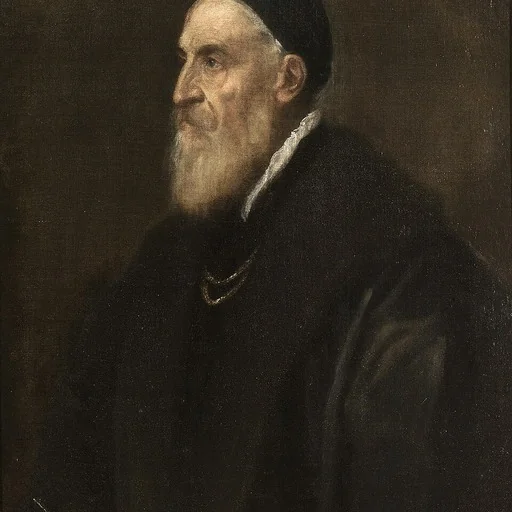
Artist
Tiziano Vecellio (Italian:; c. 1488/1490 – 27 August 1576), Latinized as Titianus, hence known in English as Titian ( TISH-ən), was an Italian Renaissance painter. The most important artist of Renaissance Venetian…