Artwork
Apollo and the Muses
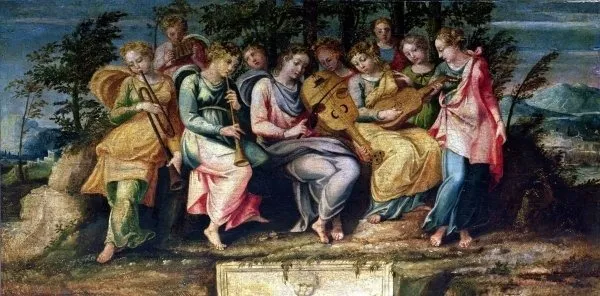
Apollo and the Muses is an oil painting by the Early Baroque Italian artist Unknown. It dates from 1600 and is held in the collection of the Kunsthistorisches Museum.
About this work
Overview
6 centimeters and depicts the god Apollo surrounded by the Muses in a mythological scene.
Apollo and the Muses is an oil painting on canvas dated to 1600, attributed to an unknown artist of the Upper Italian school and held in the collection of the Kunsthistorisches Museum in Vienna. The work measures 29.6 by 58.6 centimeters and depicts the god Apollo surrounded by the Muses in a mythological scene. Its compact horizontal format and polished finish exemplify the continued appeal of classical subject matter among late Renaissance and early Baroque patrons in northern Italy, while its presence in one of Europe's major imperial collections underscores its sustained art-historical significance.
Subject & Meaning
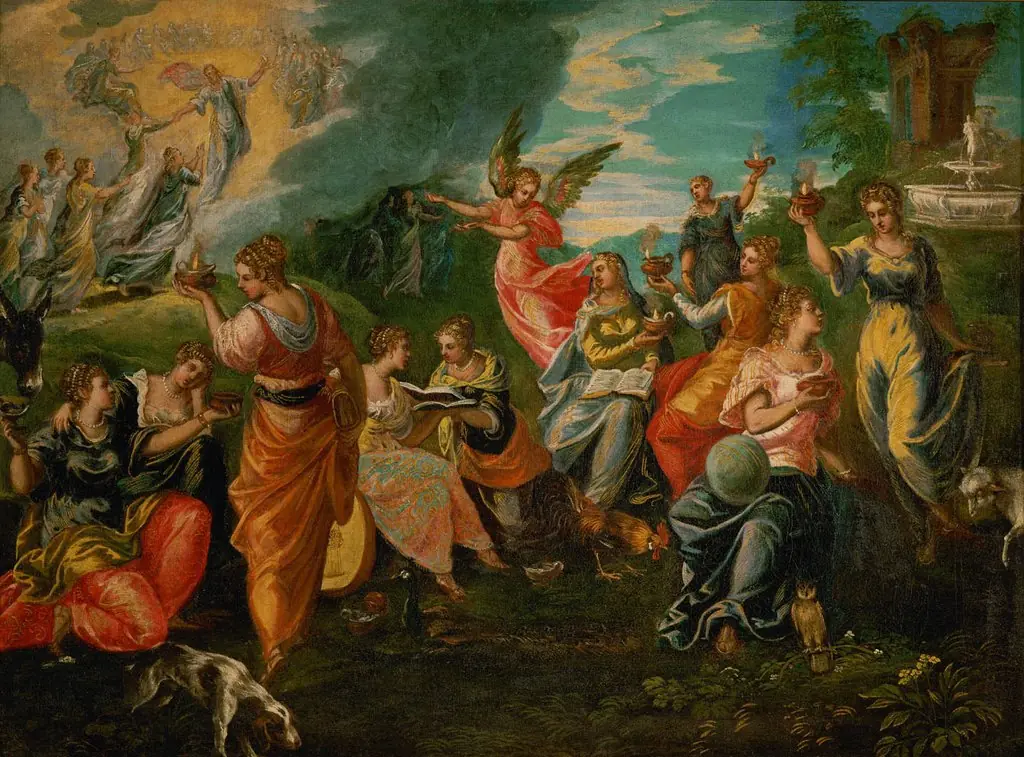
The painting presents Apollo as a central seated male figure holding a large stringed instrument, encircled by eight standing female figures arranged in a semicircle. Several of these figures play musical instruments including a lute, a flute, and a trombone-like wind instrument. The iconography draws upon the classical tradition of Apollo Musagetes, the leader of the Muses, who as daughters of Zeus and Mnemosyne personified the arts and sciences and were believed to inspire human creativity. The semicircular grouping evokes the ancient choros, or dance circle, associated with the Muses' collective identity as both multiple and unified deities. All figures are barefoot, suggesting an idealized, pastoral setting removed from everyday reality. The raised stone platform with its rectangular base elevates the scene literally and symbolically, distinguishing the divine musicians from the terrestrial viewer. Behind them, trees frame a distant blue landscape of hills, sky, and a small town or structure at the far left, creating a spatial depth that locates the mythological gathering within a plausible, if idealized, natural world.
Technique & Style
The painting is executed in oil on canvas, a support that allowed for the smooth, finished surface evident in the work. The brushwork is polished and even, with no visible impasto, and careful attention to the modeling of faces, hands, and fabric folds. Soft, even light illuminates the figures with gentle shadows beneath them, creating a sense of volume without dramatic chiaroscuro. The palette consists of warm yellows, pinks, greens, and blues in the drapery, with lighter flesh tones and a pale blue sky with soft clouds. The horizontal, balanced composition places the central figure as the focal point, while the surrounding figures create rhythmic movement across the canvas. This handling aligns with the refined, finished aesthetic associated with northern Italian workshops of the late sixteenth and early seventeenth centuries, where smooth surfaces and harmonious color relationships were prized.
History & Provenance
The painting's attribution remains uncertain. It is catalogued as by an unknown artist, though the Wikidata record associates it with the broad designation Oberitalienisch, or Upper Italian. The work entered the collection of the Kunsthistorisches Museum, where it remains today, though the precise circumstances of its acquisition are not specified in the available sources. Its modest dimensions, 29.6 by 58.6 centimeters, suggest it may have been conceived as a cabinet picture or part of a larger decorative scheme, though no commission record survives.
Context
The subject of Apollo and the Muses enjoyed remarkable longevity across European art, from classical antiquity through the Renaissance and beyond. In the visual arts, the theme appeared on more than three hundred known Roman sarcophagi, in Renaissance paintings by artists such as Jacopo Tintoretto, and in later reinterpretations including a 1921 painting by John Singer Sargent. The Kunsthistorisches Museum painting belongs to a period when mythological subjects were increasingly collected by Habsburg patrons and other European elites as expressions of cultivated learning and classical allegiance. The work's polished technique and balanced composition reflect the international diffusion of Italian Renaissance ideals into northern European collecting circles. Scholarly attention to such works has focused on questions of attribution and the broader function of mythological imagery in early modern court culture.
Legacy
The painting's legacy is inseparable from its institutional home. As part of the Kunsthistorisches Museum's holdings, it contributes to one of the world's most important collections of Old Master paintings, where it continues to represent the persistent fascination with classical mythology among early modern artists and patrons. The subject itself retained its currency for centuries, demonstrating how Apollo and the Muses served as a flexible emblem of artistic and intellectual aspiration across radically different historical moments. The work's current scholarly interest lies primarily in its value as an example of anonymous but accomplished late Renaissance mythological painting, and in what it reveals about the circulation of artistic ideas and the market for classical subjects in early seventeenth-century Italy.
Artist & collection