Artwork
Buffoon with books, formerly known as portrait of "el Primo"
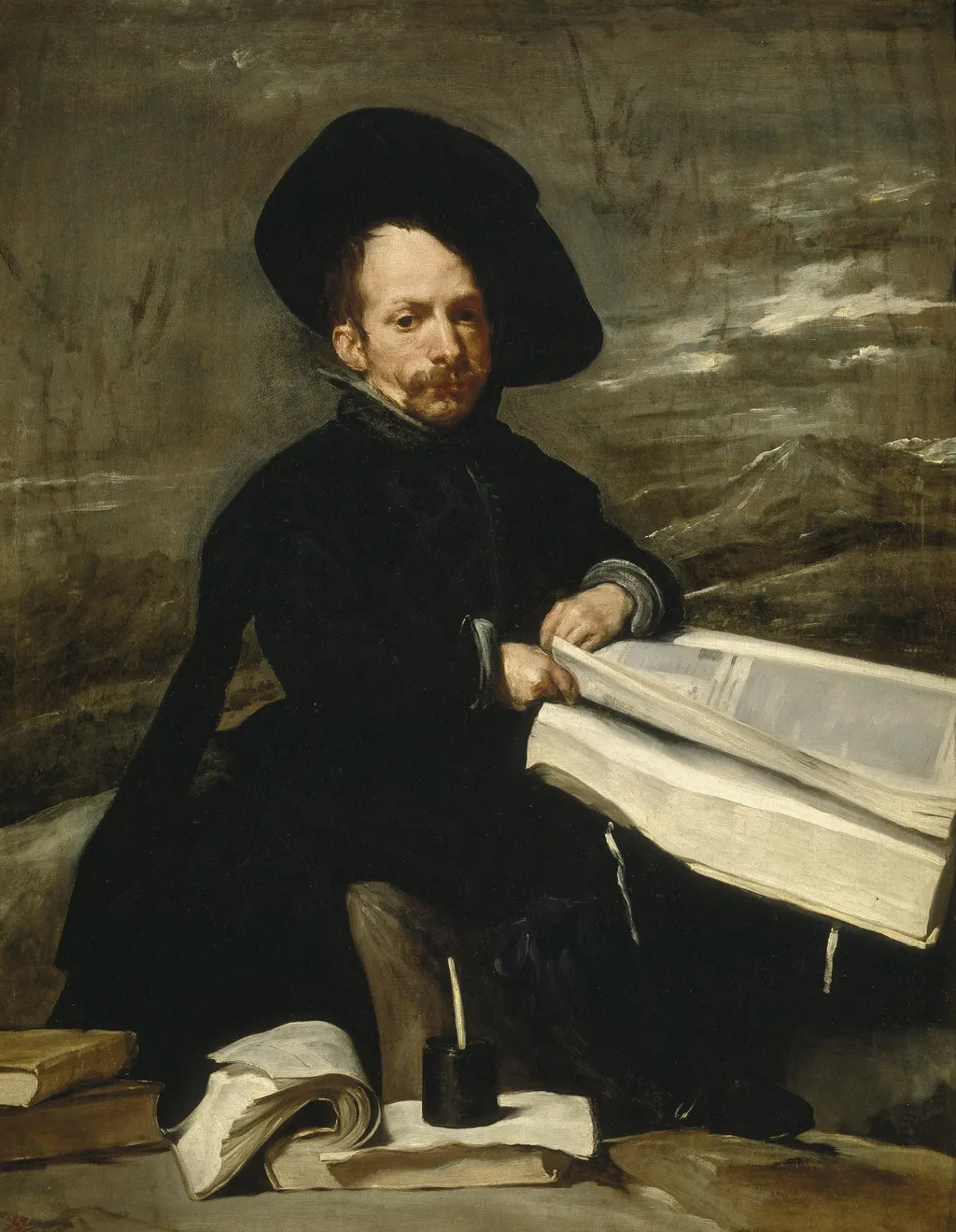
Buffoon with books, formerly known as portrait of "el Primo" is an oil painting by the Early Baroque Italian artist Diego Velázquez. It dates from 1640 and is held in the collection of the Museo del Prado.
About this work
Subject & Meaning
His high forehead and steady gaze suggest intelligence, while the muted palette and austere costume frame his dignified presence.
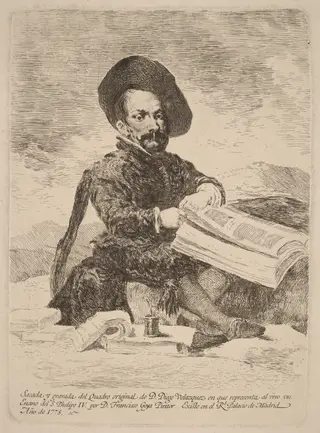
The painting depicts Diego de Acedo, a court official nicknamed “el Primo,” seated on the ground dressed in black and holding an open book in his lap, with additional books and an inkwell at his feet. The oversized volume and writing implements emphasize his small stature and scholarly guise, countering the expectation of mindless entertainment associated with court jesters. His high forehead and steady gaze suggest intelligence, while the muted palette and austere costume frame his dignified presence.
The backdrop’s indistinct mountain view aligns with other works commissioned for the Torre de la Parada, underscoring the informal yet carefully observed character study rather than a mere satire.
Technique & Style
The work is an oil on canvas measuring 107 × 82 cm. Velázquez employs a restrained palette dominated by blacks, whites, and silvery greys, which isolates the figure and creates a cool, restrained atmosphere. The composition is anchored by a large folio open on the sitter’s lap, its white pages catching light against the dark garments; the heavy book visually underscores the subject’s small stature. Radiographic examination reveals minor adjustments and pentimenti, including the repositioning of a large hat in the upper area, while the background landscape appears thinly brushed and left unfinished, suggesting a foggy rendering of the Guadarrama sierra.
History & Provenance
The painting was commissioned by Philip IV of Spain for the hunting lodge Torre de la Parada, where it was installed by 1701 alongside other court dwarf portraits.
It is first documented in the 1701 inventory of the Torre de la Parada as a "portrait of a jester dressed as a studying philosopher," and was moved to the Royal Palace of El Pardo in 1714. By 1772 it was in the Royal Palace in Madrid, inventoried as no. 932, and later described in 1814 as a "philosopher with a book in hand." In 1819 the work entered the Museo del Prado, where it was first identified in 1872 by Pedro de Madrazo as a portrait of Diego de Acedo, nicknamed "el Primo."
Stylistic analysis places its execution between 1636 and 1638, aligning with Velázquez’s work for the Torre de la Parada series, and technical examination confirms minor adjustments in the composition.
The painting is held in the collection of the Museo del Prado in Madrid, having entered the museum upon its opening in 1819. Prior to this, the work was recorded in the 1701 inventory of the Torre de la Parada and moved to the Palace of El Pardo in 1714. It subsequently entered the Royal Palace, where it was cataloged as number 932 before 1772 and described in 1814 as a portrait of a philosopher holding a book.
The work has been included in significant exhibitions such as El Siglo de Oro. The Age of Velázquez and Rembrandt-Velázquez. Additional material regarding the painting was featured in the exhibition catalog Velázquez published by The Metropolitan Museum of Art.
Context
The painting known as Buffoon with books, formerly identified as a portrait of "el Primo", has been interpreted as a sophisticated court portrait rather than a mere jest. Contemporary inventories from the Torre de la Parada (1701) list it among other ‘subjects and dwarfs’ and later descriptions link it to a ‘philosopher‑studying’ figure, a designation that persisted until the 19th‑century identification of the sitter as Diego de Acedo, nicknamed ‘el Primo’. Scholars such as López‑Rey and Brown argue that the work belongs to a series of portraits of jesters and dwarfs commissioned by Philip IV for decorative purposes, reflecting Velázquez’s nuanced treatment of court entertainers who, despite their physical deformities, were rendered with dignity and intellectual presence.
Radiographic analysis reveals only minor revisions, and the composition’s low viewpoint aligns with its original function as an overdoor panel. The attribution to 1640–1645, its placement in the Museo del Prado since 1819, and the documented provenance from Ferdinand VII’s collection underscore its significance within Velázquez’s oeuvre and the broader Baroque fascination with the intersection of humor, intellect, and visual representation.
Legacy
The painting known as Buffoon with books, formerly identified as Portrait of "el Primo", has been recognized as a key example of Velázquez’s portrayals of court jesters that blend realism with dignity. Contemporary scholarship emphasizes that the work helped shift the perception of such figures from mere entertainers to individuals of intelligence and social relevance, influencing later artists who depicted marginalized subjects with psychological depth. Its legacy is evident in the way later portraitists adopted Velázquez’s nuanced treatment of light, space, and the symbolic use of books to convey erudition, a motif that recurs in Baroque and later realist traditions.
The painting’s inclusion in major exhibitions, such as El Siglo de Oro. The Age of Velázquez, and its continued presence in the Prado’s collection have reinforced its status as a reference point for studies of court culture and the representation of disability in art.
Overview
Diego Velázquez’s oil on canvas, created in 1645, portrays the dwarf court jester Don Diego de Acedo, known as “el Primo.” Measuring roughly 106 × 83 cm, the work resides in Madrid’s Prado Museum. The figure sits on the ground, surrounded by books and writing tools, his gaze directed toward the viewer.
Own this work as a print
Artist & collection
Artist
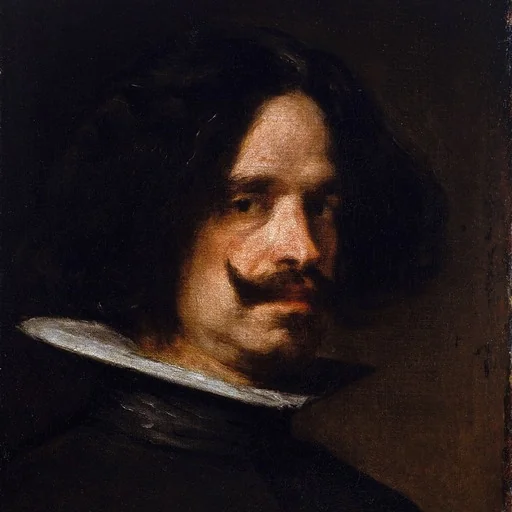
Diego Rodríguez de Silva y Velázquez was a Spanish Baroque painter, the leading artist in the court of King Philip IV of Spain and Portugal, and of the Spanish Golden Age.