Artwork
The Waterseller of Seville
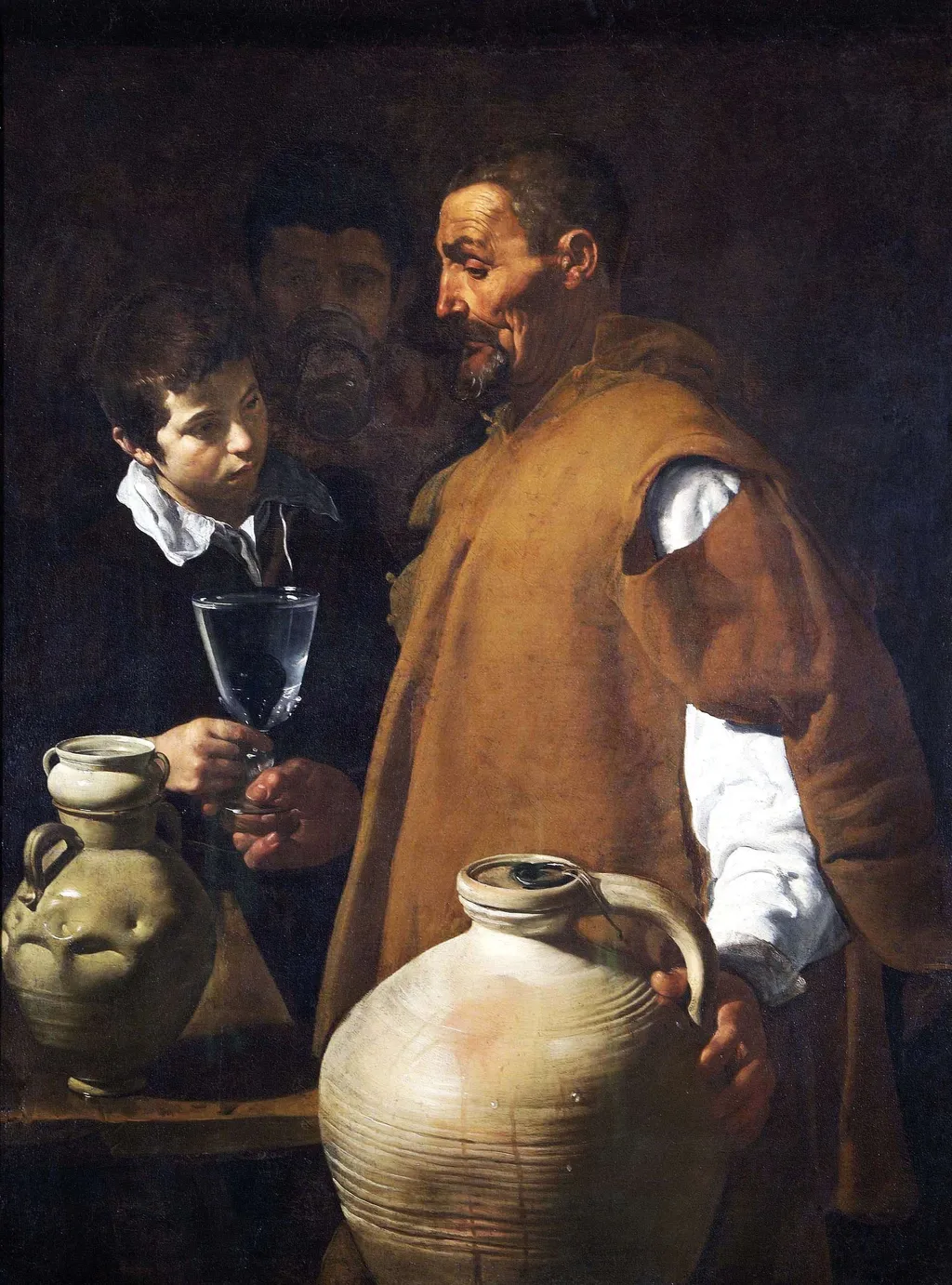
The Waterseller of Seville is an oil painting by the Baroque artist Diego Velázquez. It dates from 1620 and is held in the collection of the Victoria and Albert Museum.
About this work
The Waterseller of Seville is an oil painting by the Spanish artist Diego Velázquez, created around 1620.
The Waterseller of Seville is an oil painting by the Spanish artist Diego Velázquez, created around 1620. It belongs to his early Seville period, when he was still in his late teens or early twenties. The work shows an older man offering water to a young boy, while a bystander stands in the background; none of the figures make eye contact with each other or with the viewer. For a closer look at the artist’s early style, check out the museum: Victoria and Albert Museum.
Technique & Style
Executed in oil on canvas, *The Waterseller of Seville* exemplifies the *bodegón* genre through its realistic depiction of humble subjects and still objects. Velázquez employs a limited color palette and controlled lighting entering from the left to create strong modeling and emphasize tactile qualities. This technique highlights the glistening water droplets on the ceramic jars, the dampness of the vessels, and the specific textures of the figures' clothing and skin. The composition utilizes dramatic foreshortening, particularly in the old man's left arm and the large water jar, which appear to project beyond the picture plane into the viewer's space. This handling of volume and light demonstrates a meticulous study of natural imitation, moving beyond simple representation to analyze optical effects and human perception with scientific precision.
History & Provenance
The Waterseller of Seville was painted by Diego Velázquez during his late Seville period, with scholarly dating oscillating between 1618 and 1622; Jonathan Brown has even suggested it may have been executed in Madrid in 1623. According to Jon Moffitt, the work was not a commissioned piece. The painting passed by gift or sale to Juan de Fonseca, a Sevillian cleric and schoolmaster summoned to Philip IV's court by the Count-Duke of Olivares, who was also Velázquez's first court protector. On 28 January 1627, Velázquez himself appraised the canvas at 400 reales in Fonseca's posthumous inventory, describing it simply as "a painting of a waterseller by the hand of Diego Velázquez." It was then acquired at auction by Gaspar de Bracamonte for 330 reales to settle debts, subsequently passing to Cardinal-Infante Ferdinand before entering the Palacio del Buen Retiro, where a 1700 inventory first called its subject "el corzo de Sevilla." It later moved to the Royal Palace of Madrid, where Antonio Ponz saw it and Goya etched it. In 1813 the Duke of Wellington seized it from Joseph Bonaparte's baggage after the Battle of Vitoria; Ferdinand VII of Spain later presented it to Wellington, and it has remained at Apsley House since.
The original version of *The Waterseller of Seville* is held in the Wellington Collection at Apsley House in London. The painting was transferred to English Heritage in 2004, having previously been part of the Victoria and Albert Museum’s collection (accession number WM.1600-1948).
Its provenance traces back to the Spanish Royal Collection, where it was housed in the Buen Retiro Palace and later the Royal Palace of Madrid. During the Napoleonic Wars, it was taken by Joseph Bonaparte before being acquired by the Duke of Wellington. In 1813, Ferdinand VII of Spain gifted the work to Arthur Wellesley in recognition of his role in Spain’s liberation from French occupation, securing its permanent place in Apsley House.
Context
Velázquez’s Seville-period Waterseller marks a pivotal moment in the artist’s formation and in the early development of Spanish Baroque genre painting. Painted when Velázquez was still in his late teens or early twenties, the work exemplifies his commitment to a naturalistic idiom that rejected idealization in favor of close observation of humble subjects. Critics and contemporaries such as Francisco Pacheco praised the canvas for elevating bodegón practice by rendering quotidian figures and objects with unprecedented fidelity, a quality later recognized by Anton Raphael Mengs at the Buen Retiro. Scholars note the painting’s Caravaggisti affinities, particularly the sharply focused lighting and unflinching realism that extend beyond still-life conventions to capture tactile surfaces and human presence. Antonio Palomino’s early account, though containing inaccuracies, underscores the work’s status as an exemplar of Velázquez’s early genre scenes. Documented in the Spanish royal inventories and later transferred to Apsley House, the painting’s itinerary, from Seville to Madrid, thence to London, mirrors Velázquez’s own journey from provincial training to court patronage.
Legacy
By the mid-eighteenth century The Waterseller of Seville had become a touchstone for Spanish genre painting, cited by Antonio Palomino as emblematic of Velázquez’s early mastery of unidealized realism. Its reputation grew through royal and critical praise: Anton Raphael Mengs admired the work at the Buen Retiro Palace, and it was engraved by Goya, embedding the composition in broader visual culture.
The painting’s later trajectory tied it to national memory. After being taken by Joseph Bonaparte during the Napoleonic Wars, it was recovered and presented by Ferdinand VII to Arthur Wellesley in gratitude for British support in Spain’s liberation, entering the Wellington Collection at Apsley House where it remains. Its status as a foundational bodegón ensured its continued veneration among nineteenth- and twentieth-century writers, who read it as a manifesto of Velázquez’s technical ambition and social empathy.

Own this work as a print
Artist & collection
Artist
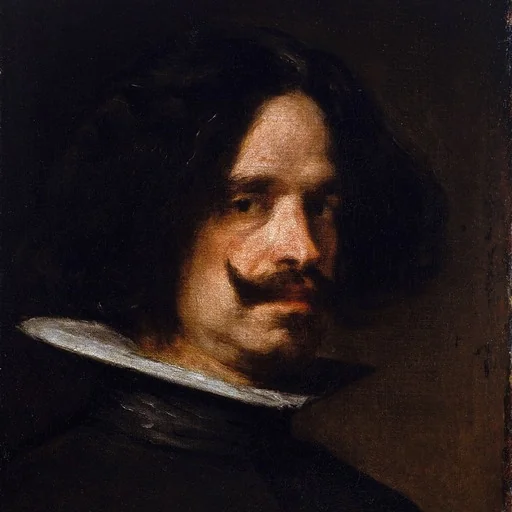
Diego Rodríguez de Silva y Velázquez was a Spanish Baroque painter, the leading artist in the court of King Philip IV of Spain and Portugal, and of the Spanish Golden Age.