Artwork
Patagon Chief, His Brother, and Daughter
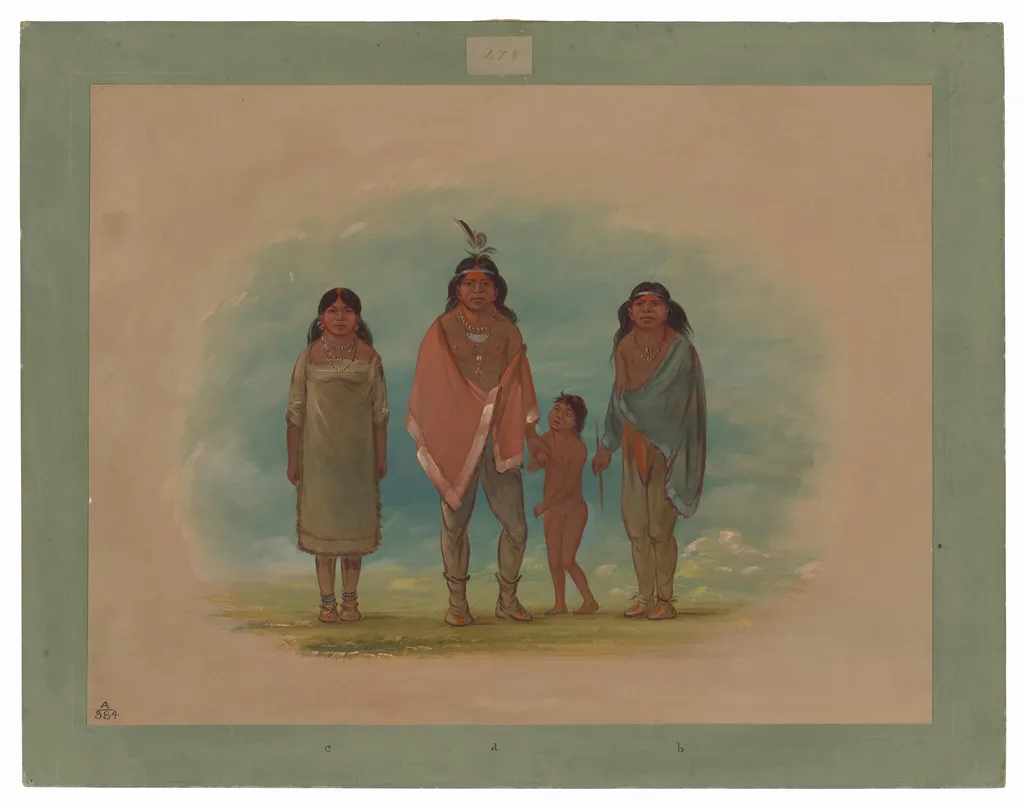
Patagon Chief, His Brother, and Daughter is an oil painting by the Impressionist artist George Catlin. It dates from 1862 and is held in the collection of the National Gallery of Art.
About this work
Overview
It depicts four figures, three adults and a child, identified as members of a Patagonian family group.
Patagon Chief, His Brother, and Daughter is an oil painting by American artist George Catlin, dated 1856/1869, though the National Gallery of Art also records a date of 1874 in its corpus data. The work measures 45.8 by 60.5 cm (18 1/16 by 23 13/16 inches) and is executed in oil on card mounted on paperboard. It depicts four figures, three adults and a child, identified as members of a Patagonian family group. The painting is held in the collection of the National Gallery of Art in Washington, D.C., acquired in 1965 as part of a major gift from Paul Mellon. The work belongs to Catlin's second body of work, the Cartoon Collection, which he created during the 1850s and 1860s to replicate and expand upon his original Indian Gallery of the 1830s. It stands as a significant document of Catlin's sustained project to record indigenous peoples of the Americas, extending beyond his North American subjects to include South American peoples encountered during his travels.
Subject & Meaning
The painting portrays three named individuals and a child, identified in Catlin's 1871 catalogue for the Cartoon Collection exhibition. At center stands Yal-kok-tsá-me (The Big Gun), also called Cannon, chief of a Patagonian band. To his left is Paw-in-o-renk (The Flying Cloud), identified as the chief's younger brother. To the right stands Coche (The Blue Sky), the chief's daughter, and between the chief and his daughter a small naked child looks upward and touches the central figure's blanket. Catlin's catalogue entry describes the subjects as belonging to a numerous and warlike tribe in Patagonia. The iconography follows Catlin's established conventions for indigenous portraiture: all adult figures wear headbands and multiple necklaces, with the chief distinguished by a feathered headband and a pinkish-red blanket draped over his shoulders. The child, unclothed and positioned between the adults, introduces an informal, familial note that softens the otherwise formal presentation. The catalogue specifies that the daughter was painted in Pickett Harbor, Straits of Magellan, in 1856, indicating that Catlin based this later studio work on observations and sketches from his South American travels. The painting thus functions simultaneously as portrait, ethnographic record, and document of imperial encounter, reflecting Catlin's ambition to create a comprehensive visual archive of indigenous American peoples.
Technique & Style
The painting is executed in oil on card mounted on paperboard, a support characteristic of the Cartoon Collection works, which were produced under more constrained circumstances than the original Indian Gallery. Visually, the composition arranges four figures in a horizontal row on a narrow strip of green ground, set against a hazy atmospheric sky of blue-gray and warm beige tones. The brushwork is smooth and detailed on the figures, with looser, more diffuse handling in the background. Light falls evenly from the left, casting soft shadows to the right of the figures. The palette is dominated by earthy greens, warm browns, soft blues, and muted coral, with the chief's pinkish-red blanket providing a focal point of warmer color. The background sky swirls with indistinct cloud forms, creating a shallow, stage-like space that emphasizes the figures as the primary subject. The work is mounted on a green paper border with handwritten numbers and letters at top and bottom edges, reflecting the serial, catalogue-based presentation that Catlin employed for his collections. This border format allowed works to be displayed and identified by number, consistent with the salon-style hanging of the Indian Gallery and its successor collections.
History & Provenance
The painting's creation history involves Catlin's South American travels of the 1850s, during which he visited Patagonia and recorded subjects including those depicted here. The work was painted sometime between 1856 and 1869, with the National Gallery's corpus also recording 1874. Catlin exhibited the Cartoon Collection in New York in 1871, publishing a catalogue that included this work as Cart. No. 478. Following Catlin's death in 1872, the painting descended to his three daughters: Clara Gregory Catlin, Louise Catlin Kinney, and Elizabeth Wing Catlin. In 1912, the American Museum of Natural History purchased the work from Elizabeth Wing Catlin, acquiring a substantial portion of the Cartoon Collection. The museum deaccessioned these works in 1959, and this painting was sold through Kennedy Galleries in New York to Paul Mellon of Upperville, Virginia. Mellon, a major collector of American art, gave the work to the National Gallery of Art in 1965 as part of a gift of 351 works from the Cartoon Collection. The accession number is 1965.16.252. The painting has been reproduced in the National Gallery's catalogues of American paintings in 1970, 1980, and 1992.
Context
George Catlin (1796-1872) was a self-taught artist who abandoned law practice in 1821 to pursue painting, becoming the first major artist to travel beyond the Mississippi to paint Native Americans. His initial Indian Gallery, comprising more than 500 works from the 1830s, represented an unprecedented effort to document indigenous life and culture. Financial pressures forced him to sell this collection in 1852, and he spent the remaining two decades of his life attempting to recreate and expand his archive. The Cartoon Collection, numbering more than 600 works, was the result of this effort, with many works based on outlines and sketches from his earlier travels. Catlin's South American travels from 1852 to 1857 extended his project to include indigenous peoples of Central and South America, reflecting his ambition to document what he saw as a vanishing way of life across the continent. The critical reception of Catlin's work during his lifetime included praise from figures such as Charles Baudelaire, who remarked on the artist's ability to capture the proud and free characters of indigenous chiefs. Catlin's broader significance lies in his role as painter, ethnographer, and entrepreneur, creating a body of work that has shaped subsequent understanding of nineteenth-century indigenous American life while also raising questions about the politics of representation and the colonial gaze.
Legacy
The painting's afterlife is inseparable from the institutional history of the Cartoon Collection. The American Museum of Natural History's 1912 acquisition preserved a significant portion of this second collection, though the 1959 deaccession dispersed many works into private hands. Paul Mellon's 1965 gift to the National Gallery of Art ensured the survival and public accessibility of 351 works from the collection, including this painting. The work's place in Catlin's oeuvre reflects both the strengths and limitations of his project: the dedication to documentary accuracy and the simultaneous reduction of complex cultures to visual types. As part of the National Gallery's collection, the painting continues to serve as a resource for scholars of American art, indigenous studies, and the history of ethnographic representation. The catalogue raisonné reproductions in 1970, 1980, and 1992 indicate its sustained place in the scholarly record. The work also exemplifies the broader fate of Catlin's project: divided between institutions, subject to changing valuations of its ethnographic and aesthetic merits, and perpetually recontextualized by shifting understandings of the colonial encounter it documents.
Own this work as a print
Artist & collection

Artist
George Catlin ( KAT-lin; July 26, 1796 – December 23, 1872) was an American lawyer, painter, author, and traveler, who specialized in portraits of Native Americans in the American frontier.

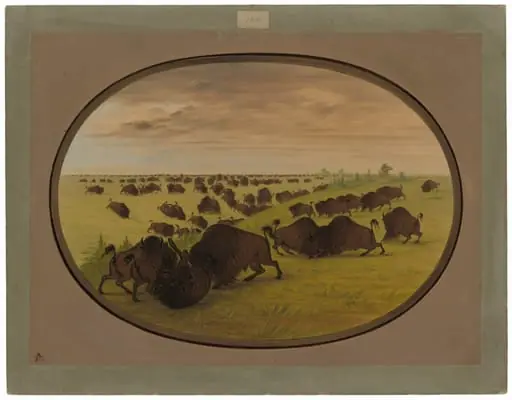 Bulls Fighting
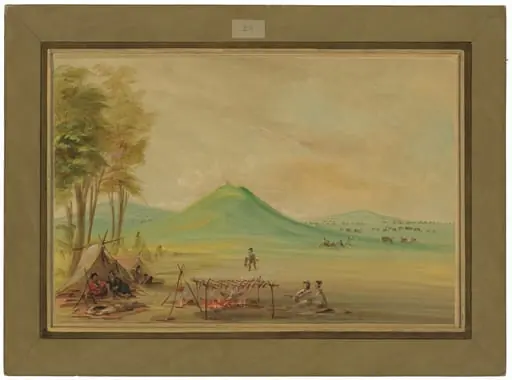 Expedition Encamped on a Texas Prairie. April 1686
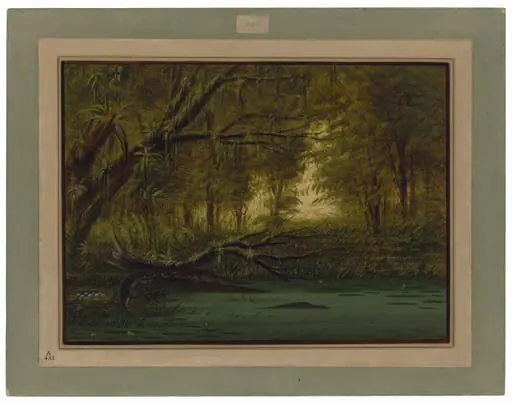 An Alligator's Nest
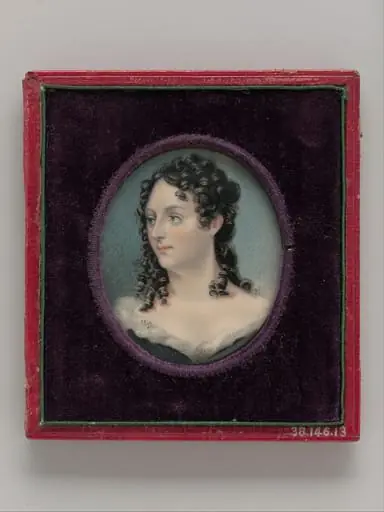 Mrs. George Catlin (Clara Bartlet Gregory)
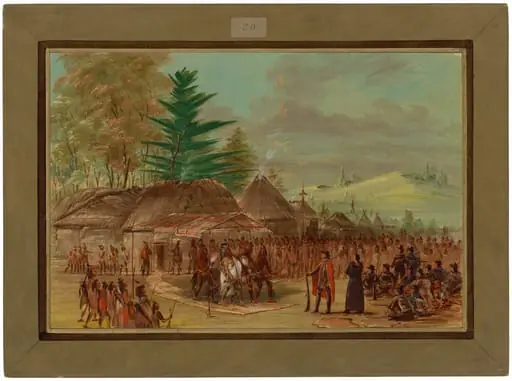 Chief of the Taensa Indians Receiving La Salle. March 20, 1682
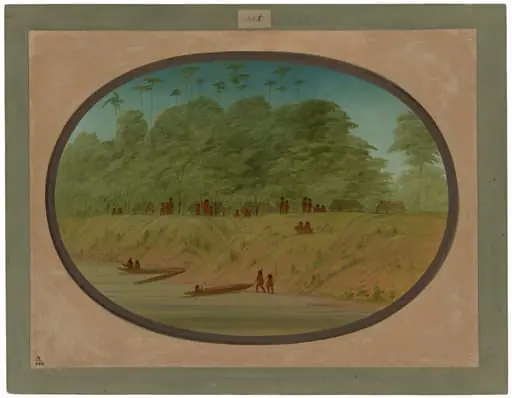 A Small Village - Payaguas Indians
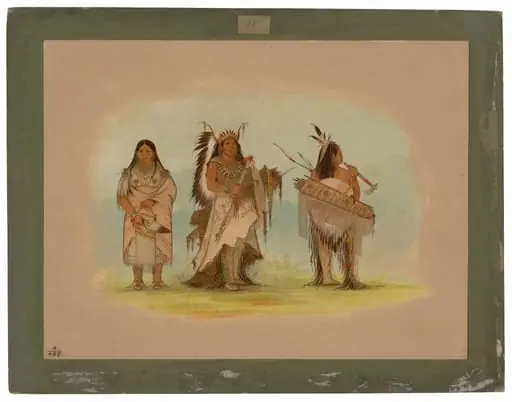 Omaha Chief, His Wife, and a Warrior
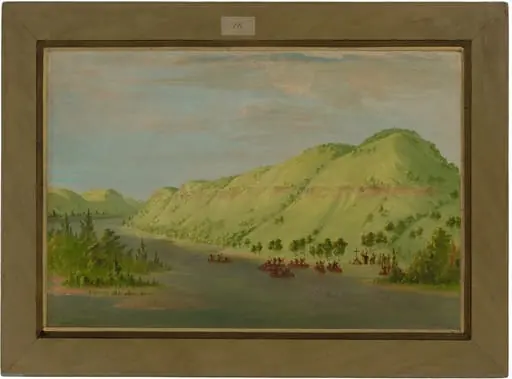 Father Hennepin Leaving the Mississippi to Join La Salle. May 8, 1680
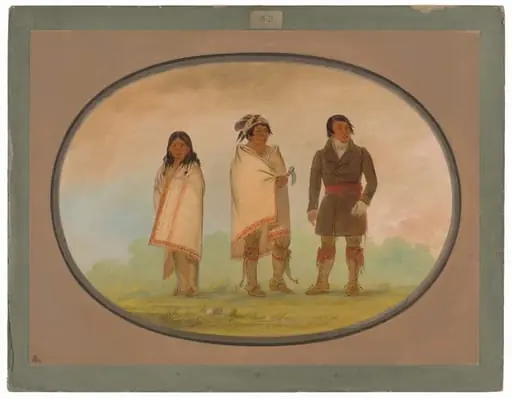
- Oneida Chief, His Sister, and a Missionary
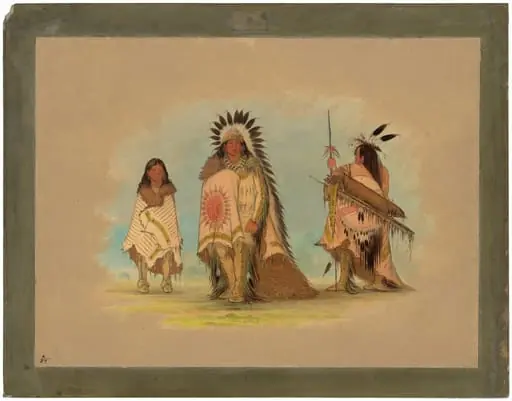 A Sioux Chief, His Daughter, and a Warrior
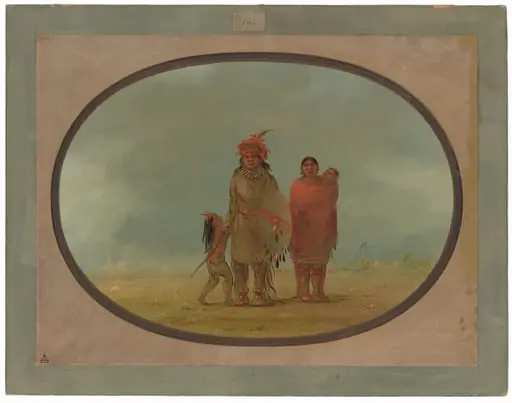 Copper Chief, His Wife, and Children
 A Yuma Chief, His Daughter, and a Warrior
 Menomonie Chief, His Wife, and Son
 Pawneepict Chief, Two Daughters, and a Warrior
 Ottowa Chief, His Wife, and a Warrior
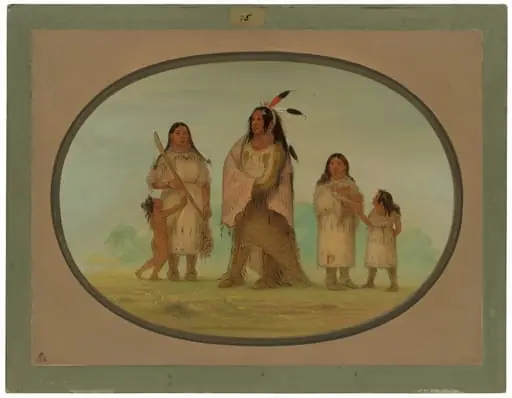 Assinneboine Warrior and His Family
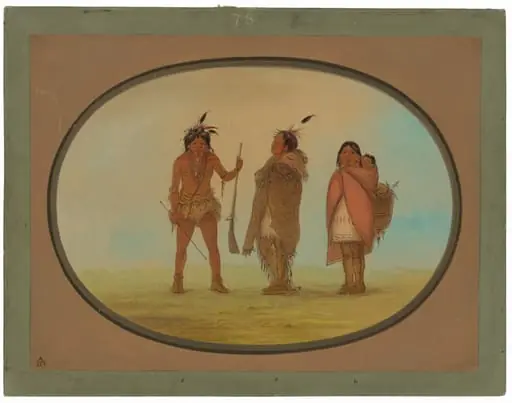 Arapaho Chief, His Wife, and a Warrior
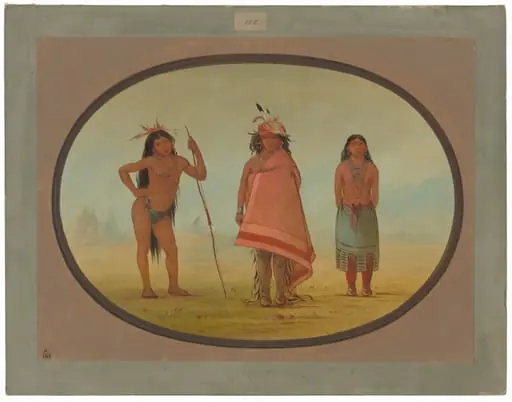 Cochimtee Chief, His Wife, and a Warrior
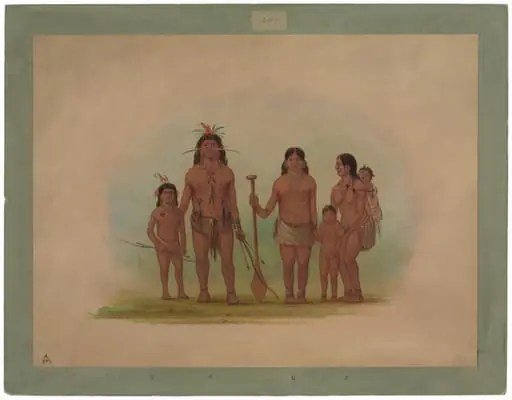 Orejona Chief and Family