Artwork
The Conversion of Saint Paul
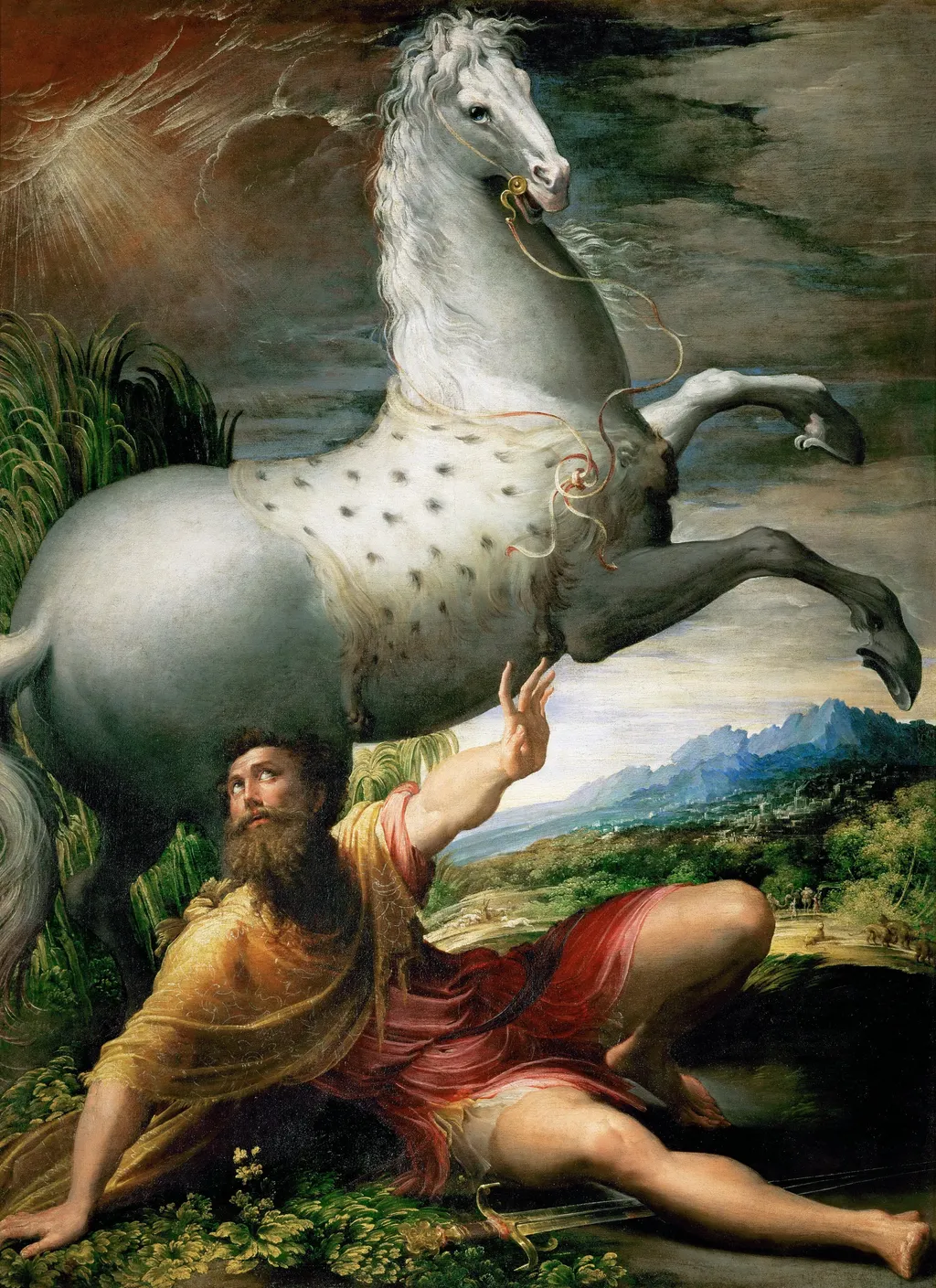
The Conversion of Saint Paul is an oil painting by the High Renaissance artist Parmigianino. It dates from 1527 and is held in the collection of the Kunsthistorisches Museum.
About this work
Overview
The Conversion of Saint Paul is an oil painting on canvas executed in 1527 by the Italian artist Parmigianino (Francesco Maria Mazzola, 1503-1540).
The Conversion of Saint Paul is an oil painting on canvas executed in 1527 by the Italian artist Parmigianino (Francesco Maria Mazzola, 1503-1540). Measuring 177.5 by 128.5 cm, the work is held in the collection of the Kunsthistorisches Museum in Vienna, where it has been since the eighteenth century and was first exhibited to the public in 1912. The painting is a significant example of Parmigianino's mature style, produced shortly after his return from Rome, and occupies an important position in the transition from High Renaissance ideals to Mannerist aesthetics. It depicts the dramatic moment of Saul's transformation into the apostle Paul, rendered with the elongated proportions, dynamic poses, and heightened emotional intensity that characterize the artist's contribution to early Mannerism.
Subject & Meaning
The painting illustrates the biblical episode from the Acts of the Apostles in which Saul, a persecutor of Christians, is struck by a blinding light while traveling to Damascus and falls to the ground, initiating his conversion to Christianity. Parmigianino depicts Saul as a bearded man in a golden tunic and red drapery, sprawled on the ground with his right arm raised toward a rearing white horse that dominates the center of the composition. His face turns upward toward a radiant burst of light in the upper left corner, which cuts through dark swirling clouds, while his sword lies abandoned on the grassy ground nearby, signifying his renunciation of violence and his former life. The horse, wearing an ornate gold bit with red reins, rises on its hind legs with front hooves extended, sharing in the moment of spiritual ecstasy. The background reveals a detailed landscape with blue mountains, a river valley, scattered buildings, and tiny figures on a road. The iconography emphasizes not merely the physical fall but the interior transformation: Saul's gaze is ecstatic, fixed upon the divine source, and the composition as a whole conveys the simultaneity of human and animal response to miraculous intervention.
Technique & Style
The work is executed in oil on canvas, a medium that allowed Parmigianino the flexibility to achieve both smooth blended brushwork and textured effects. The surface shows fine craquelure throughout, with particular care devoted to the rendering of flesh, while foliage and sky receive more vigorous handling. The color palette is saturated in the foreground with deep greens, golds, and crimson reds, receding into cooler blues and grays in the distance. Stylistically, the painting exhibits the hallmarks of Parmigianino's post-Roman manner: elongated proportions, swollen limbs (notably the calves and thighs), and contorted poses that reflect Michelangelo's influence yet are reconfigured into something more original and self-consciously artificial. The horse itself displays distinctly anti-naturalistic qualities, with a swollen neck, small and narrow head, and reins reduced to a capricious filament, while an ermine-fur saddle adds a note of luxurious ostentation. The golden highlights across the surface contribute to a decorative abstraction that departs from Renaissance naturalism. The landscape, with its leafy trees, hills, and mountains, has been linked to the modes of Dosso Dossi and northern Italian painting, while the dark, leaden sky with reddish tones around the divine emanation suggests northern influences. The overall effect is one of deliberate distortion and refined invention, emblematic of the Mannerist sensibility.
History & Provenance
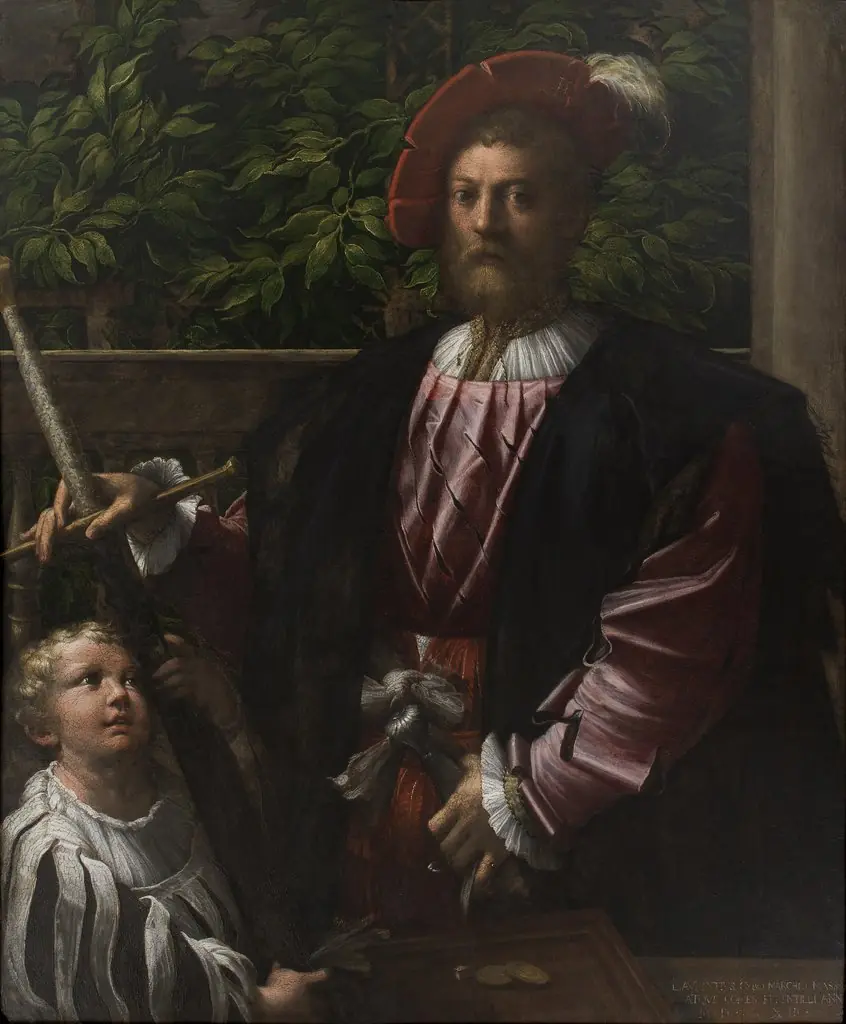
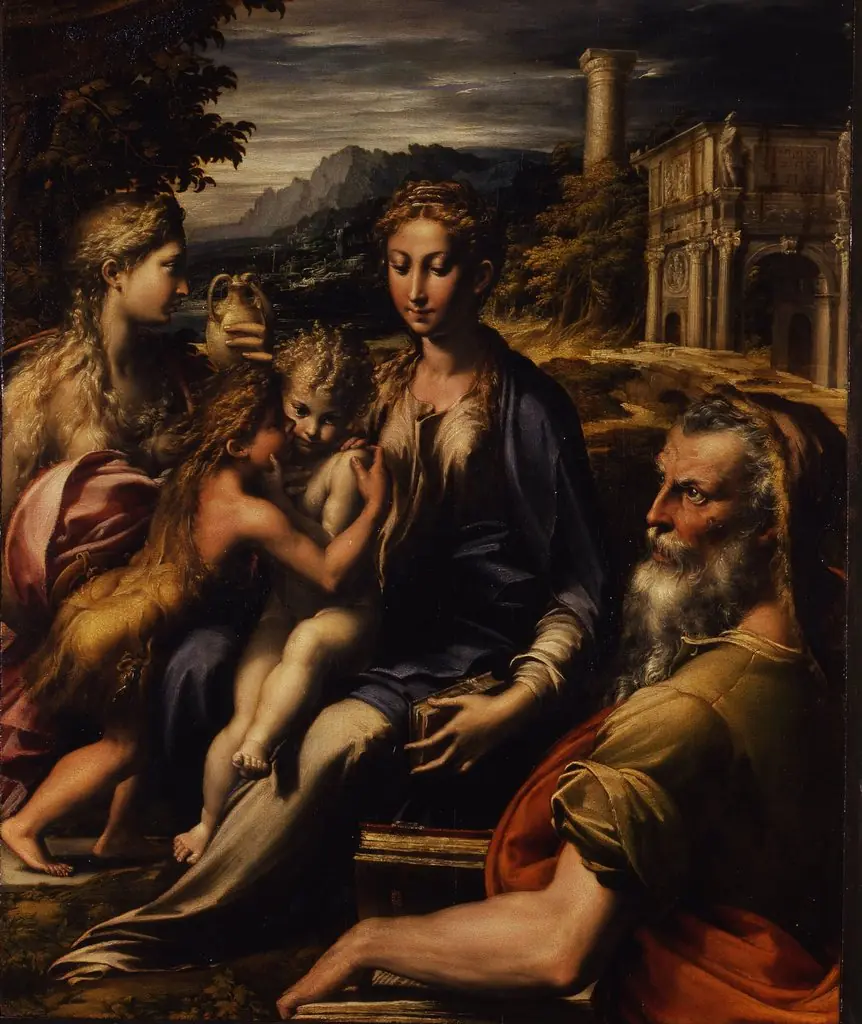
The painting was commissioned by Giovanni Andrea Albio, also known as Giovanni Andrea Bianchi, a prominent figure from Parma who served as professor of anatomy at the University of Bologna from 1523 and later as physician to Pius IV. Vasari, in his 1550 edition of the Lives, and Lamo, in 1560, both recorded seeing the work in Albio's house. Albio, who like Parmigianino had a reputation as an alchemist, was a significant patron of the arts who had also commissioned Niccolò dell'Abate to paint a complex facade fresco for his residence. Following Albio's death in 1566, the painting left Parma and by 1608 had entered the collection of the sculptor Pompeo Leoni in Madrid, as documented in an inventory of that year. The work was transferred to Vienna in the eighteenth century, eventually entering the Kunsthistorisches Museum, where it was assigned inventory number 2035 in the Gemäldegalerie. It was first exhibited to the public in 1912. The dating of the painting is generally placed immediately after the Saint Roch with a Donor, confirming Vasari's indication, and has been associated with Parmigianino's period in Bologna following his flight from the Sack of Rome in 1527.
Context
The Conversion of Saint Paul emerges from a critical juncture in Parmigianino's career. The artist had fled Rome in 1527 during the Sack and established himself in Bologna, where he produced this work alongside the Saint Roch with a Donor. The painting reflects his absorption of the Roman maniera moderna, particularly through reference to Raphael's Expulsion of Heliodorus from the Temple in the Vatican Stanze, which informs the torsion of the fallen body, and to Giulio Romano's Battle of Constantine, which influenced the muscularity of the horse. The existence of preparatory studies, including two variant drawings at the Courtauld Institute Galleries and an old copy in the Seilern collection in London, attests to the care with which Parmigianino developed the composition. The Courtauld drawings, executed in pen and ink with brown wash and white highlighting and dated 1527-1530, show the artist exploring different moments of the narrative and demonstrate his preferred medium during both his Roman and Bolognese periods. These studies may also have been intended as modelli for engravings, given Parmigianino's collaboration with Antonio da Trento in Bologna. The painting has occasionally been attributed to Niccolò dell'Abate, reflecting the complex interrelationships among Emilian artists of this generation.
Legacy
The Conversion of Saint Paul stands as a defining statement of Parmigianino's mature style and of the broader Mannerist project to transcend High Renaissance equilibrium in favor of subjective invention and emotional intensity. The work's reputation has been sustained by its early documentation in Vasari and its continuous provenance from a significant patron through major European collections. Its public exhibition beginning in 1912 at the Kunsthistorisches Museum secured its place in the canon of sixteenth-century Italian painting. For art historians, the painting exemplifies the paradox at the heart of Mannerism: the simultaneous depiction of transformative stasis and vivid motion, achieved through deliberate distortion of natural form in service of heightened spiritual expression. The preparatory drawings at the Courtauld Institute have become important objects of study in their own right, illuminating Parmigianino's working methods and the role of disegno in the maniera moderna. The painting continues to be recognized as a touchstone for understanding the evolution of Italian art in the 1520s, the dispersal of Roman artistic ideals following the Sack of 1527, and the emergence of a self-consciously artificial style that would influence subsequent generations of European painters.
Own this work as a print
Artist & collection

Artist
Girolamo Francesco Maria Mazzola (11 January 1503 – 24 August 1540), also known as Francesco Mazzola or, more commonly, as Parmigianino (UK: US: Italian:; "the little one from Parma"), was an Italian Mannerist painter…