Artwork
Venus and Adonis
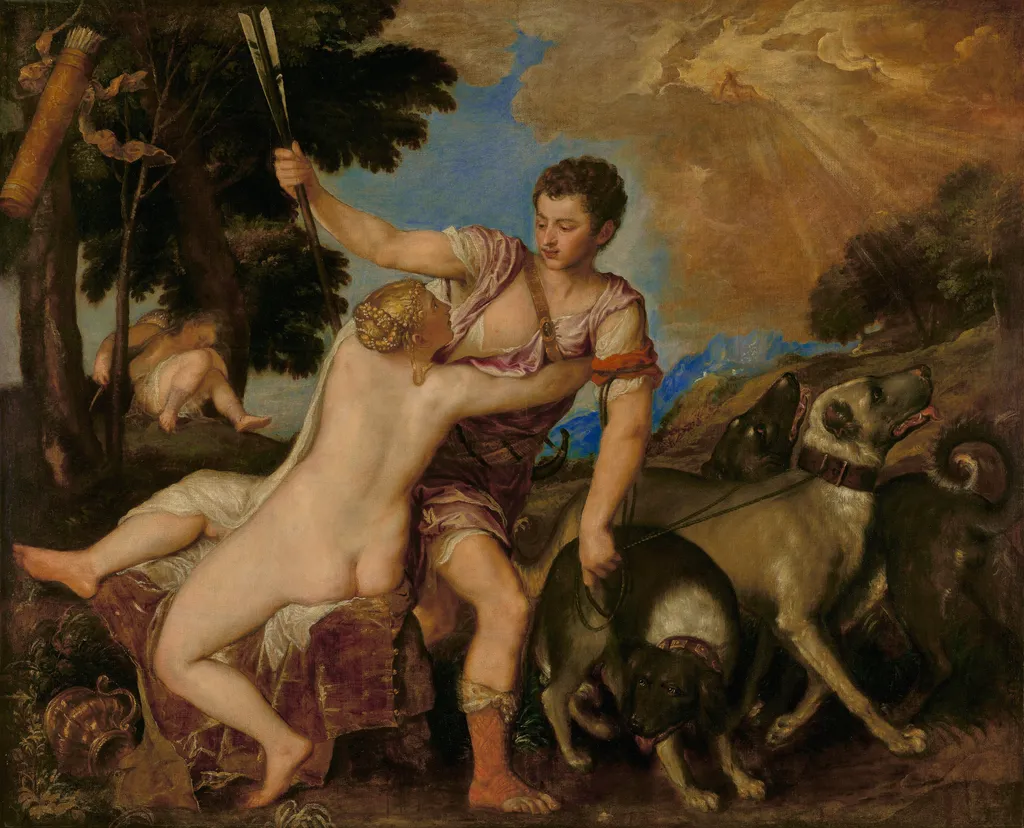
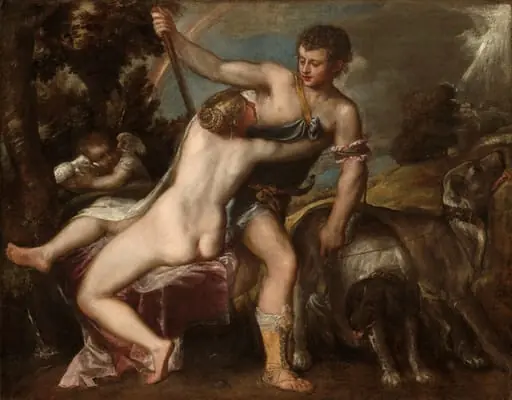
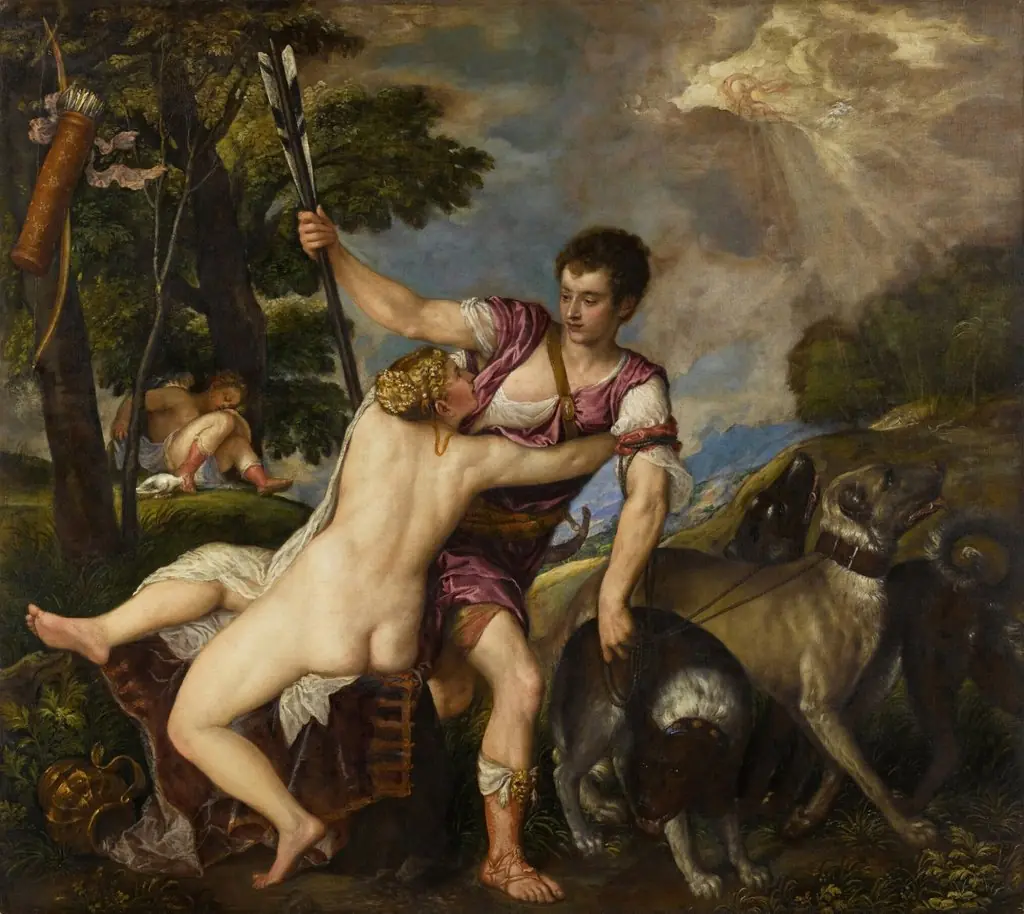
Venus and Adonis is an oil painting by the Mannerist artist Titian. It dates from 1557 and is held in the collection of the J. Paul Getty Museum.
About this work
Subject & Meaning
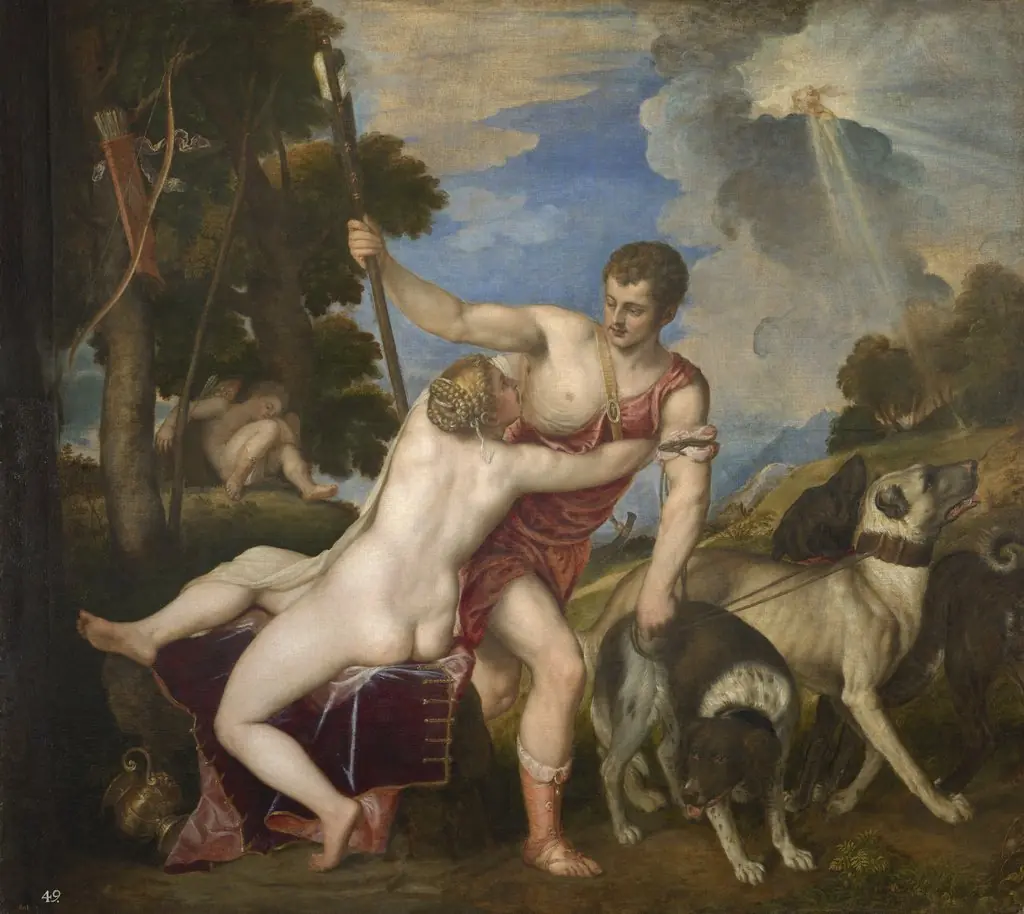
A chariot figure in the sky, likely Venus herself or a dawn personification, foreshadows her later, futile arrival after Adonis is killed by a boar.
Titian's painting depicts the mythological lovers Venus and Adonis at the moment of parting, drawn from Ovid's Metamorphoses. Venus, seated nude on a richly draped cloth, physically restrains the clothed young hunter as he turns away toward the hunt. Adonis carries a feathered spear, a horn at his belt, and the leashes of his hounds wound around his arm, while Cupid sleeps beneath a nearby tree, signaling that this is not a moment for love.
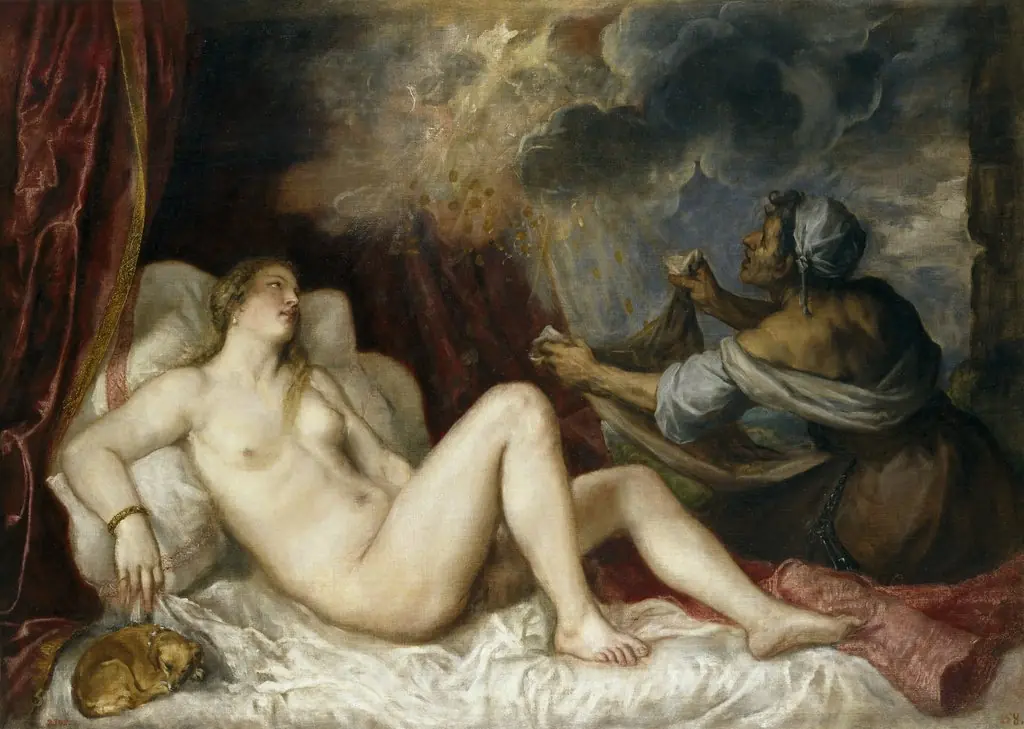
A chariot figure in the sky, likely Venus herself or a dawn personification, foreshadows her later, futile arrival after Adonis is killed by a boar. The composition collapses the story's beginning and end into one image, transferring Venus's grief at Adonis's death onto his departure. Titian intended the work as one of his "poesie" for Philip II of Spain, pairing it with Danaë to offer contrasting views of the nude goddess.
Contemporary viewers found the seated Venus's posture exceptionally erotic, and the painting reflects Titian's pessimistic view of mortal-divine relationships, in which humans inevitably suffer.
Technique & Style
Executed in oil on canvas (160 × 196 cm), the Los Angeles version adheres to Titian’s late Venetian technique: thick, luminous paint applied in layered, translucent glazes to model flesh and atmosphere, while opaque impastos heighten the tactile quality of drapery and accessories. The composition emphasizes a diagonal recession from the reclining Venus at left to Adonis’s tense departure at right, a dynamic rhythm reinforced by the sweeping curve of Venus’s back and the foreshortened hounds. Formal qualities include the pronounced contrapposto of Venus’s seated figure, whose compressed buttocks and intergluteal cleft draw attention to the body’s material presence, and the contrasting taut musculature of Adonis as he disengages.
The scene’s dawn setting, evoked by the chariot in the upper sky and storm clouds, contrasts erotic intimacy with impending loss, aligning with Ovid’s narrative. The handling shows characteristic Venetian bravura in passages such as the feathered spear and Cupid’s slumber, rendered with delicate precision against broader, atmospheric passages.
History & Provenance
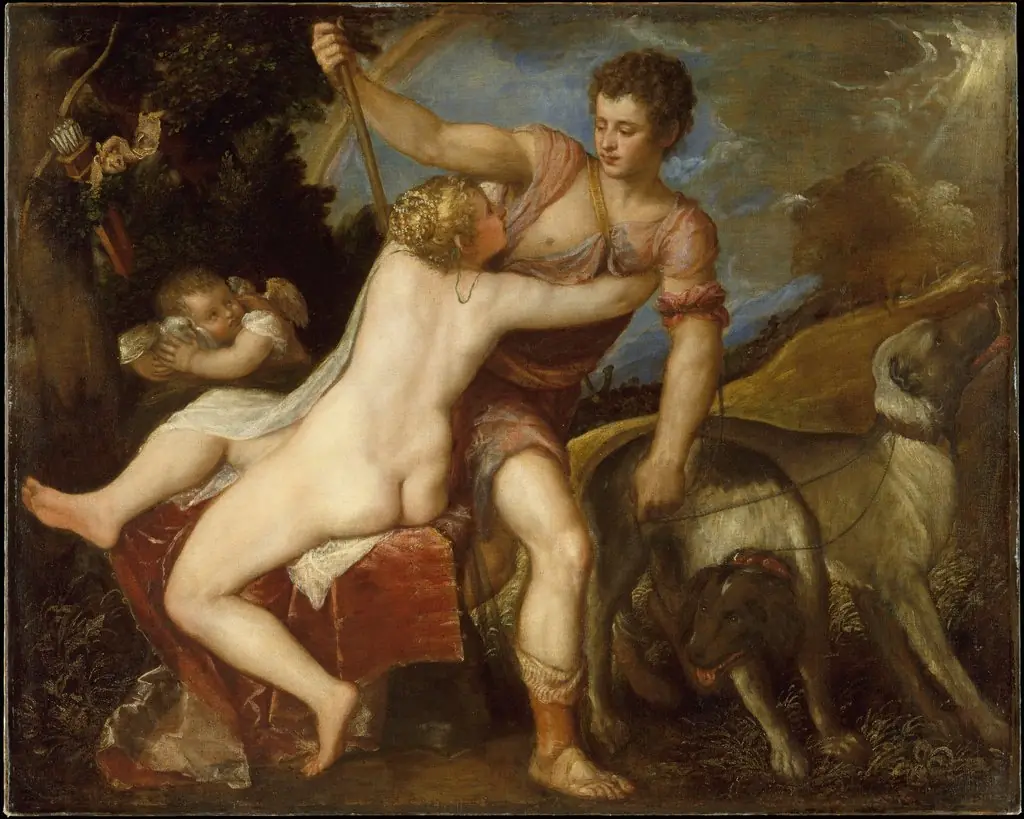
Executed circa 1557, this oil on canvas represents a version of Titian's popular mythological composition. While the prime variant was dispatched to Philip II of Spain in 1554, the Getty painting belongs to the 'Prado' type group and was likely produced between 1555 and 1560. The work's extensive provenance begins with Giovanni Vincenzo Imperiale and Francesco Maria Balbi, later entering the collection of Christina of Sweden.
It subsequently passed through the Odescalchi family to Pierre Crozat and the Dukes of Orléans. Following the French Revolution, ownership transferred to British collectors including Jeremiah Harman and the Dukes of Sutherland and Bridgewater, before residing with the Earls of Normanton. After appearing at auction through Hazlitt, Gooden & Fox, the painting was sold at Christie's London in 1991 and acquired by the J. Paul Getty Museum in 1992.
The painting is held by the J. Paul Getty Museum in Los Angeles, where it forms part of the museum's collection of Venetian works. It was acquired by the Getty in 1992, having been sold the previous year at Christie's in London. The canvas measures 160 by 196 cm and is dated between 1555 and 1560.
The work belongs to the "Prado" compositional type, placing it closer to the earliest surviving version of the subject, now in the Museo del Prado in Madrid, rather than to the tighter "Farnese" type derived from a lost Farnese-family canvas. No specific exhibition history beyond the 1991 Christie's sale and the 1992 Getty acquisition is documented in the available sources.
Context
Titian executed Venus and Adonis in 1557 as an oil on canvas mythological painting. The work belongs to the series of “poesie” he created for King Philip II of Spain, a group of large-scale mythological canvases intended to rival sculpture. Contemporary observers noted its daring eroticism; the Venetian critic Lodovico Dolce praised the lifelike rendering of Venus’s seated form and the palpable tension of her attempt to retain Adonis.
Scholars such as Harold Wethey have distinguished two compositional types, the Prado type, exemplified by the Getty’s version, and the smaller Farnese type. Debates persist over the original version and the extent of Titian’s hand in surviving copies. The Getty’s canvas, acquired in 1992, exemplifies the Prado type and reflects Titian’s role in shaping Venetian mythological painting for imperial patronage.
Overview
Titian, a prominent Venetian Renaissance painter, created the composition "Venus and Adonis," which exists in numerous iterations. Approximately thirty versions from the 16th century attest to its widespread appeal, likely due to the depiction of Venus. Determining the primary version and the extent of Titian's personal involvement in each remains a subject of scholarly discussion.
Own this work as a print
Artist & collection
Artist
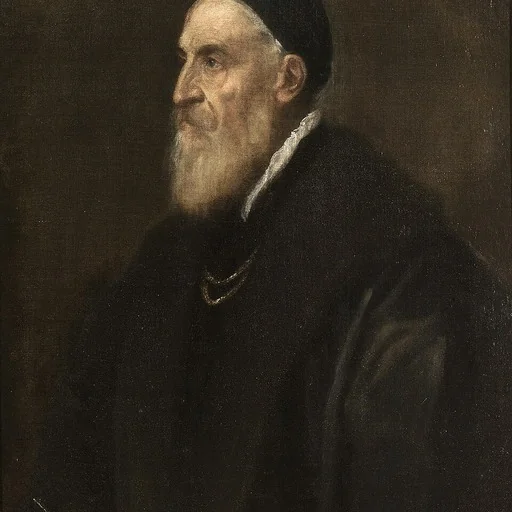
Tiziano Vecellio (Italian:; c. 1488/1490 – 27 August 1576), Latinized as Titianus, hence known in English as Titian ( TISH-ən), was an Italian Renaissance painter. The most important artist of Renaissance Venetian…