Artwork
The merchant Mansur departs on a sea voyage, leaving his wife behind, from a Tuti-nama (Tales of a Parrot): Seventeenth Night
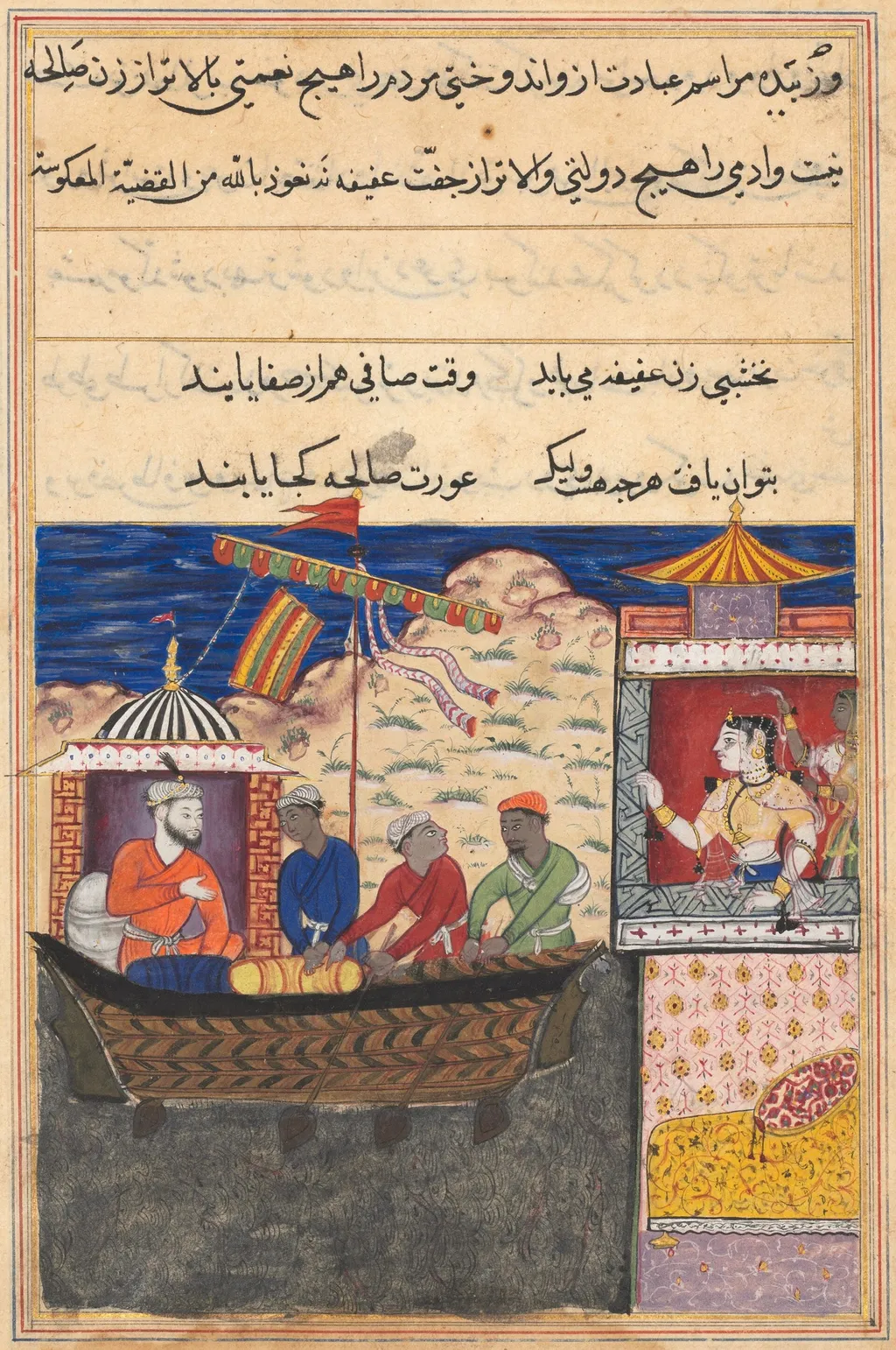
The merchant Mansur departs on a sea voyage, leaving his wife behind, from a Tuti-nama (Tales of a Parrot): Seventeenth Night is an unspecified painting. It dates from 1560 and is held in the collection of the Cleveland Museum of Art.
About this work
Subject & Meaning
The scene shows the merchant Mansur setting out on a sea voyage while his wife remains on shore, a moment drawn from the seventeenth night of the Tuti-nama.
The scene shows the merchant Mansur setting out on a sea voyage while his wife remains on shore, a moment drawn from the seventeenth night of the Tuti-nama. In Mughal painting this episode functions as a visual allegory for separation and the transience of worldly endeavors, with the departing merchant symbolizing the pursuit of trade and adventure away from domestic stability. The composition emphasizes the emotional tension between the traveling figure and his waiting spouse, underscoring themes of longing and the uncertainties of maritime commerce.
History & Provenance
The painting is dated to circa 1560 and was produced in the Mughal Empire, likely as part of a manuscript of the Tuti-nama. Its commission and earlier ownership are not recorded in the available sources. The work entered the Cleveland Museum of Art in 1962, where it is catalogued as accession number 1962.279.125.b and remains in the museum’s collection. No further details about its provenance or subsequent transfers are provided by the sources.
The painting depicting the Seventeenth Night of the Tuti-nama, where the merchant Mansur departs on a sea voyage, is held in the collection of the Cleveland Museum of Art. The work is cataloged under the accession number 1962.279.125.b. Created around 1560 within the Mughal Empire, the piece remains part of the museum's holdings in Cleveland.
Context
The painting, created in 1560 within the Mughal imperial workshop, illustrates the narrative moment from the Tuti-nama where the merchant Mansur departs on a sea voyage, leaving his wife behind. Executed in tempera and ink on paper, it measures 31.1 cm × 20.4 cm and is housed in the Cleveland Museum of Art. Scholarly attention often situates this work within the broader tradition of 16th‑century Persian miniature painting, noting its role in the diffusion of Mughal visual culture across the Indian subcontinent.
The piece exemplifies the narrative focus and delicate naturalism characteristic of the period, reflecting both courtly patronage and the transregional exchange of artistic techniques.
Overview
The work illustrates a departure scene from the Persian illustrated manuscript known as the Tuti‑nama, or Tales of a Parrot, specifically the episode titled “Seventeenth Night.” A wooden vessel on a calm waterway carries four robed figures, while a woman on shore waves farewell. The composition is framed by a flag, a tent, and modest hills, and Arabic calligraphy arches across the upper margin.
Technique & Style
Executed with flat, saturated pigments, the painting employs bold color blocks, orange, blue, red, and green, to delineate clothing and surroundings. The lack of chiaroscuro creates a stylized, two‑dimensional effect typical of Persian miniature art, while the precise line work of the Arabic inscription adds a decorative textual element to the visual narrative.
Artist & collection

- The merchant Mansur departs on a sea voyage, leaving his wife behind, from a Tuti-nama (Tales of a Parrot): Seventeenth Night
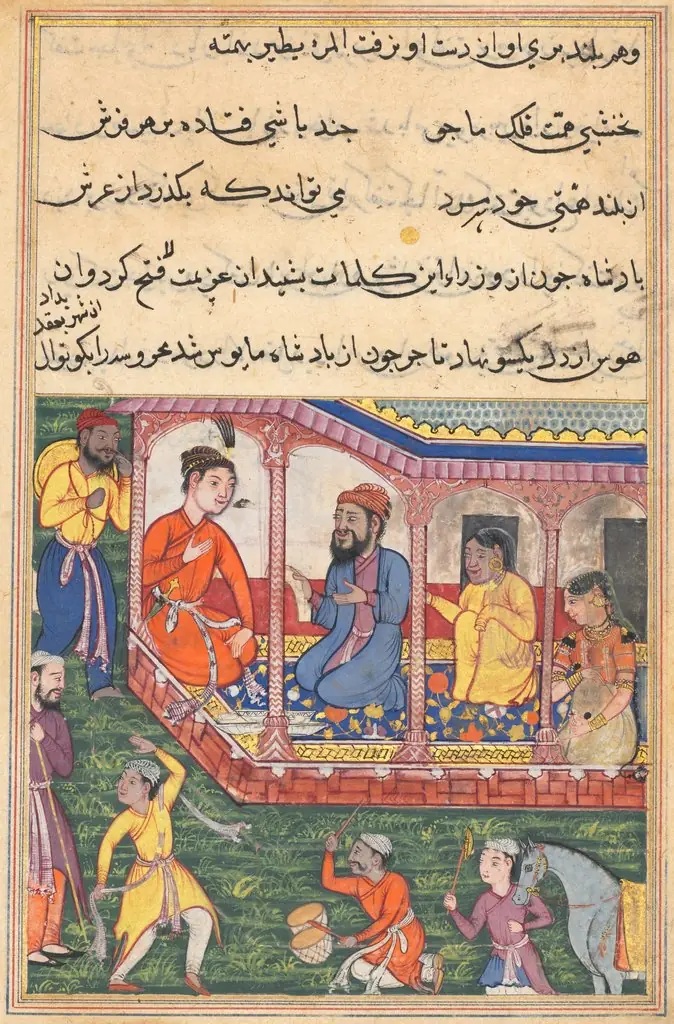 Mahrusa’s marriage to the prefect of the city, from a Tuti-nama (Tales of a Parrot): Thirty-sixth Night
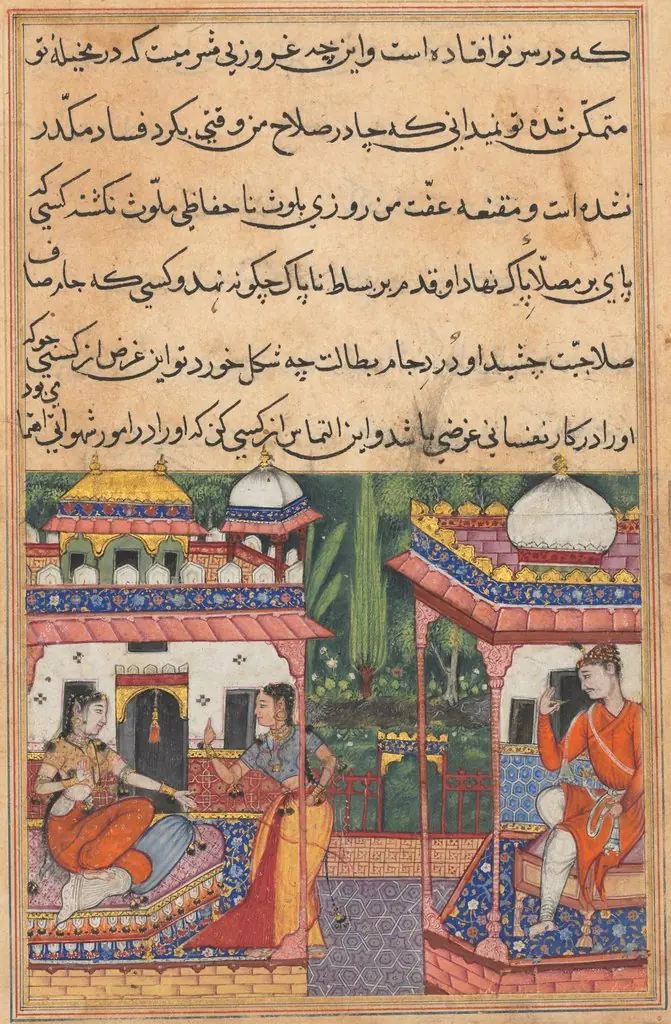 Kaiwan sends a message of love to Khurshid, wife of his brother Utarid who is away on a journey, from a Tuti-nama (Tales of a Parrot): Thirty-second Night
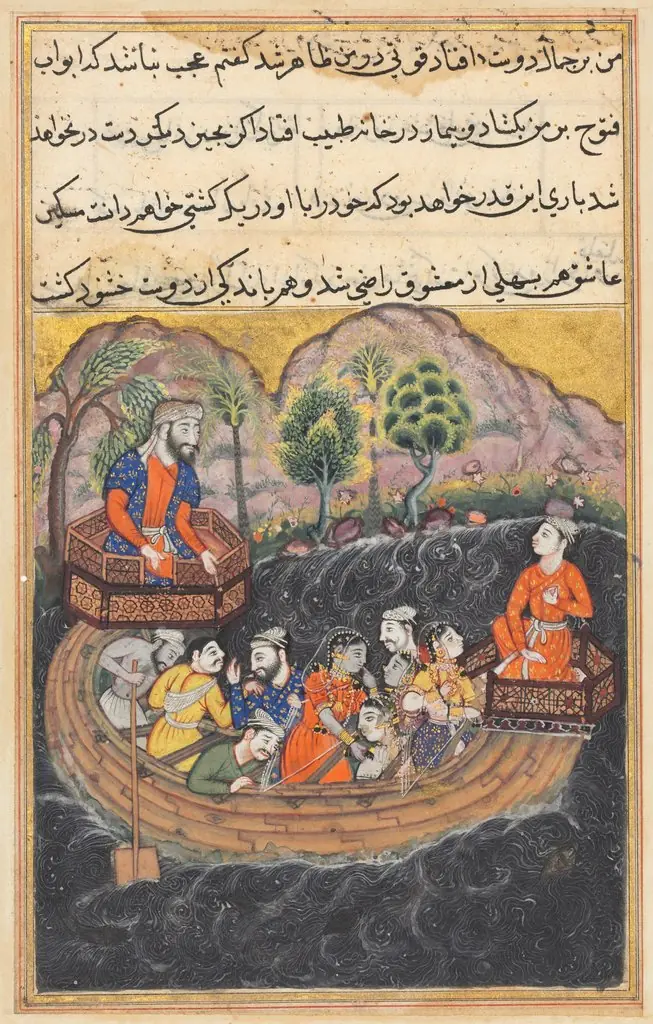 The young man of Baghdad joins the Hashimi’s boat as a sailor to find his slave-girl on board, from a Tuti-nama (Tales of a Parrot): Forty-eighth Night
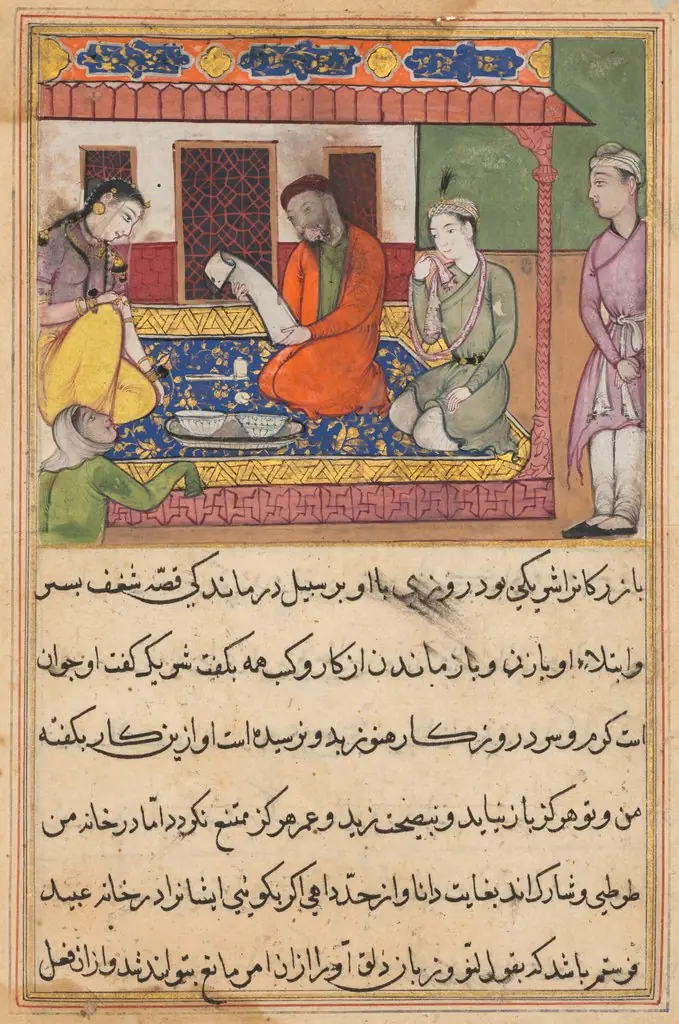 The marriage of ‘Ubaid, son of a merchant of Tirmiz, from a Tuti-nama (Tales of a Parrot): Forty-second Night
 The young man of Baghdad joins the Hashimi’s boat as a sailor to find his slave-girl on board, from a Tuti-nama (Tales of a Parrot): Forty-eighth Night
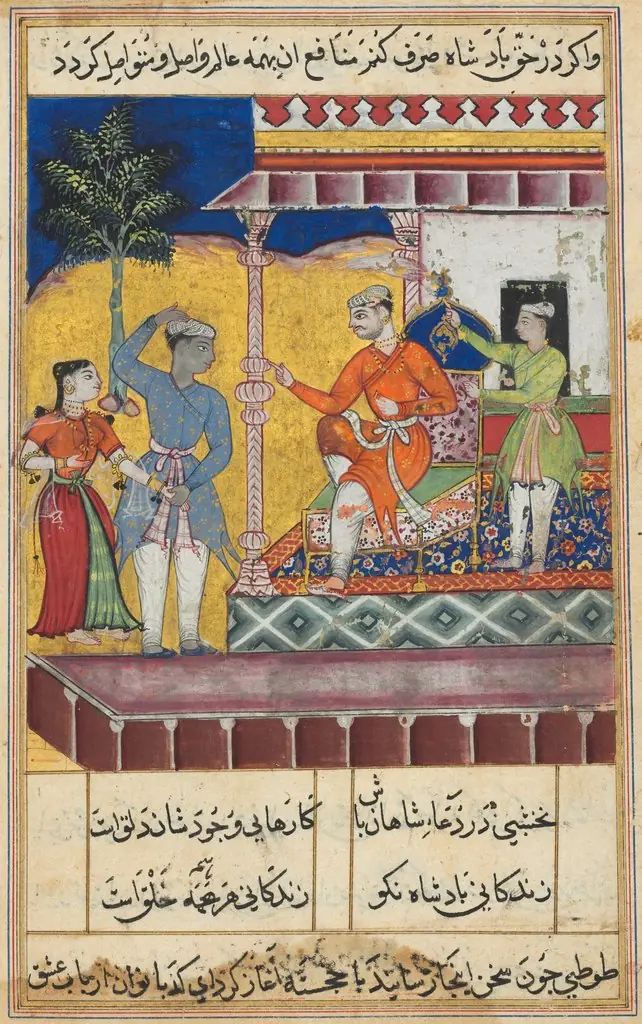 The rejuvenated old man and the daughter of the king of the jinns take leave of the King of Kings, from a Tuti-nama (Tales of a Parrot): Seventh Night
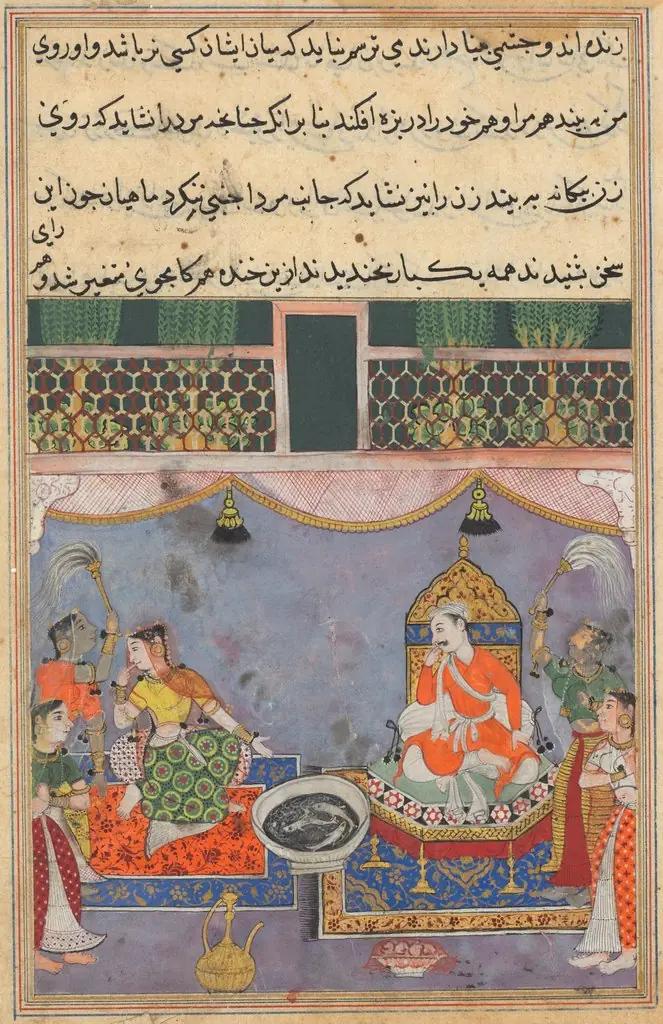 Kamjuy, the wife of the Raja, averts her face from the fishes, from a Tuti-nama (Tales of a Parrot): Twenty-third Night
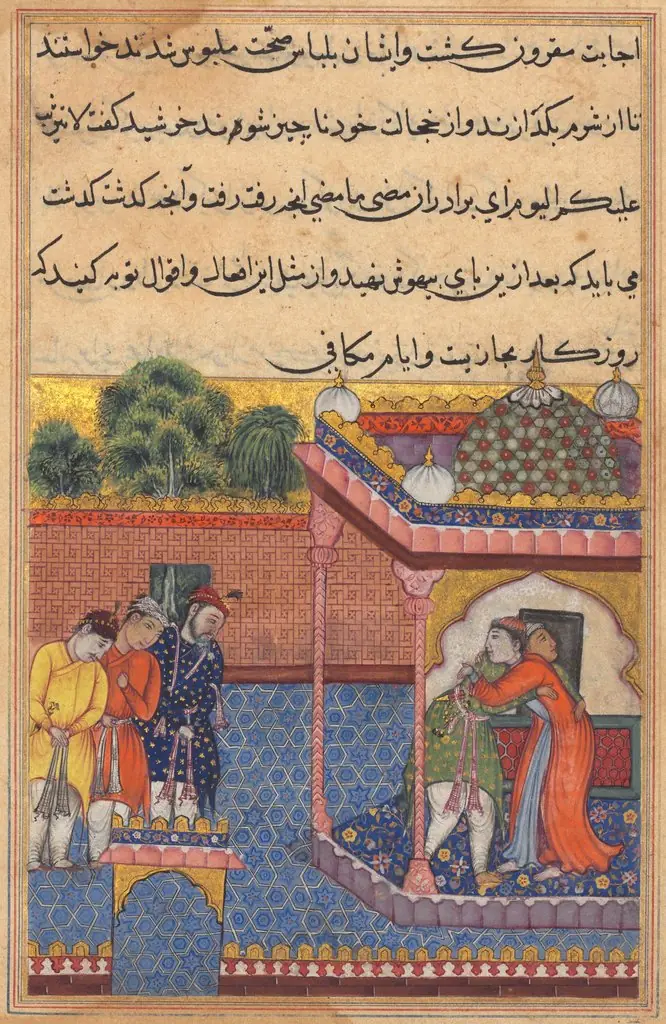 Khurshid reunited with her husband Utarid, from a Tuti-nama (Tales of a Parrot): Thirty-second Night
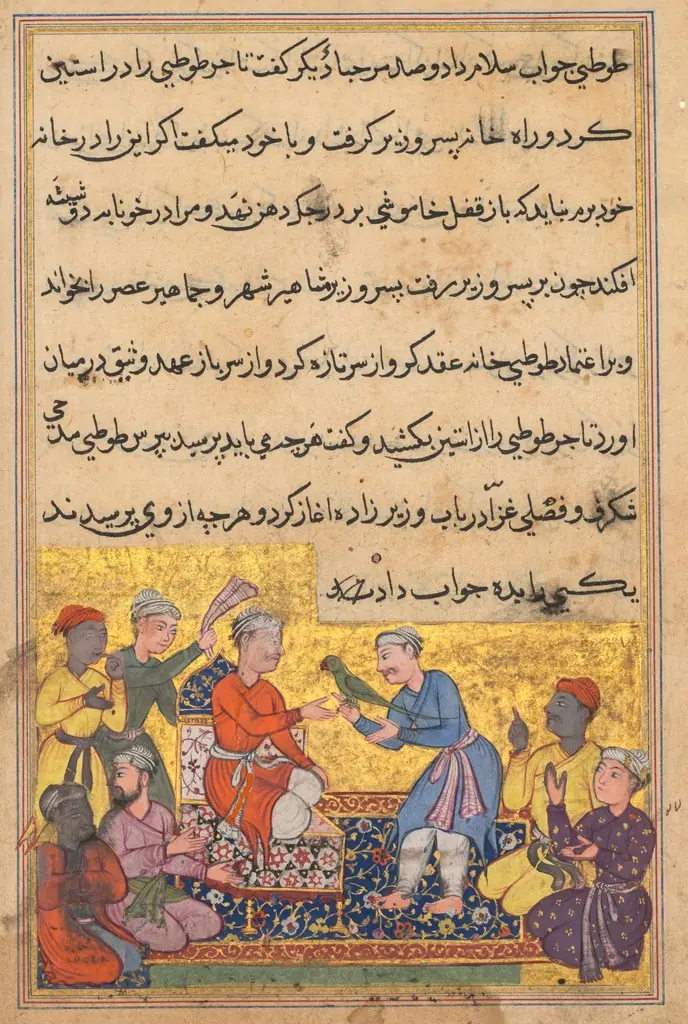 The magic parrot of the merchant talks to the vizier’s son, from a Tuti-nama (Tales of a Parrot): Tenth Night
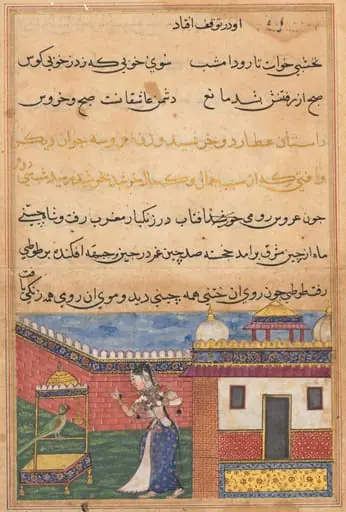 The parrot addresses Khujasta at the beginning of the thirty-second night, from a Tuti-nama (Tales of a Parrot)
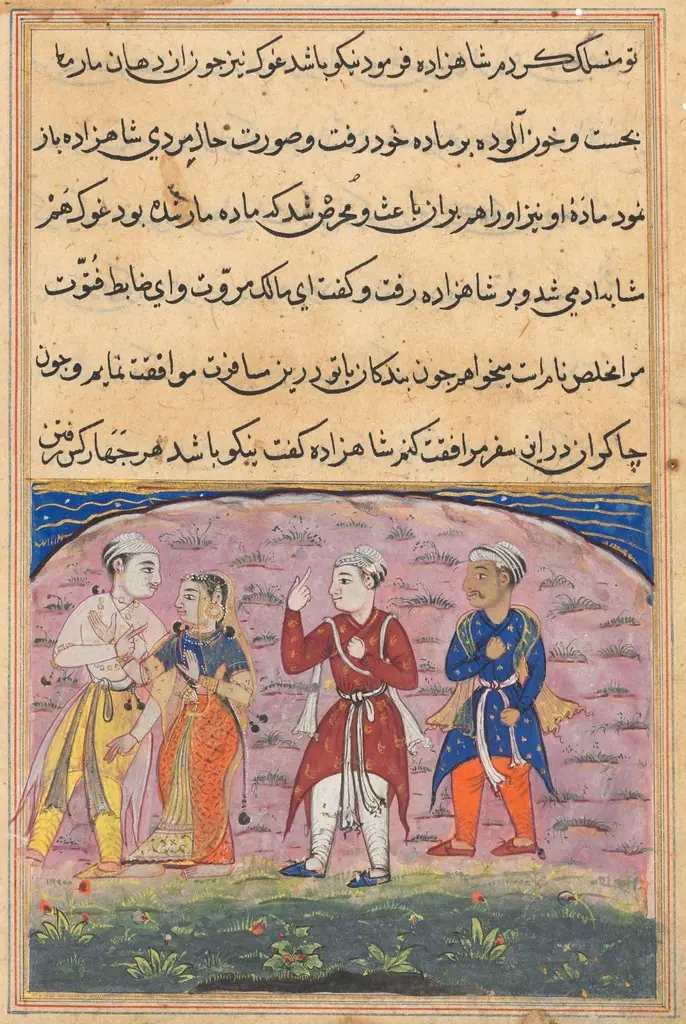 The prince and Nikfal are joined by Khalis and the Mukhlis who are the grateful snake and frog in human form, from a Tuti-nama (Tales of a Parrot): Eighteenth Night
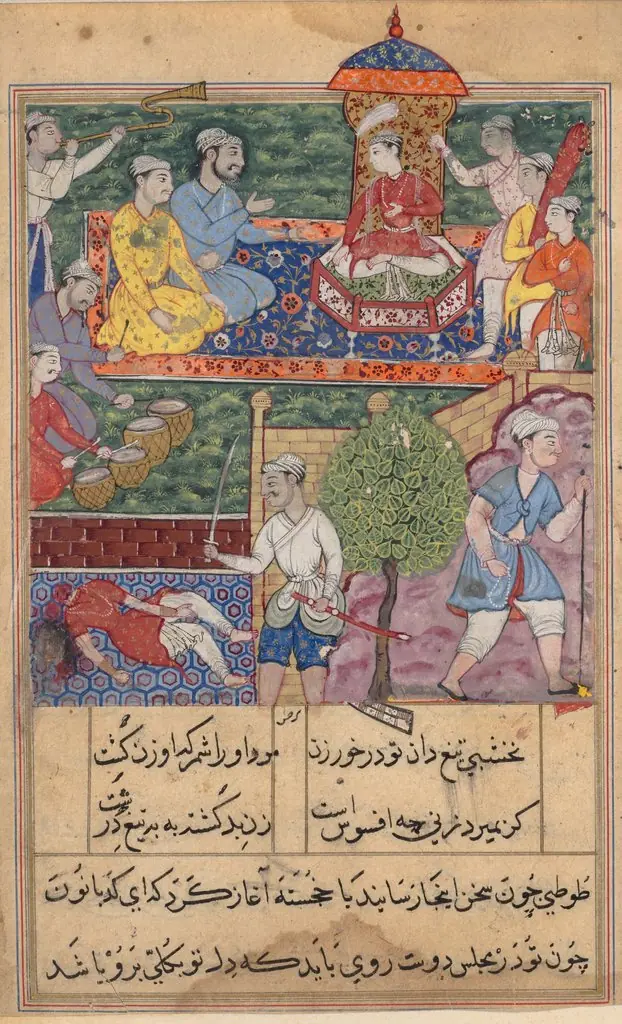 Page from Tales of a Parrot (Tuti-nama): text page
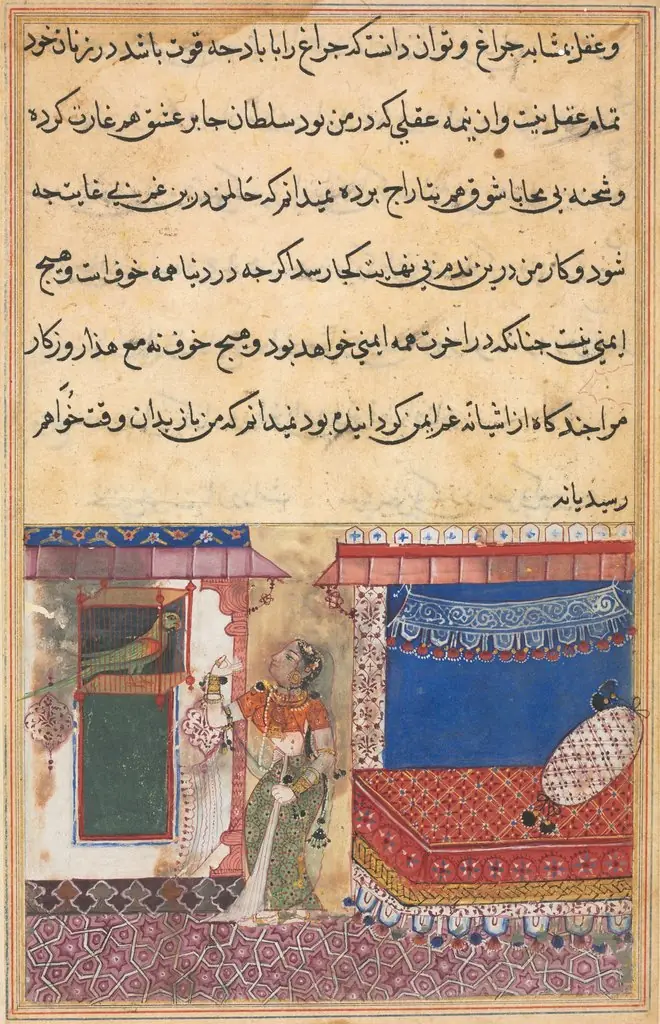 The Parrot Addresses Khujasta at the Beginning of the Eighteenth Night, from a Tuti-nama (Tales of a Parrot)
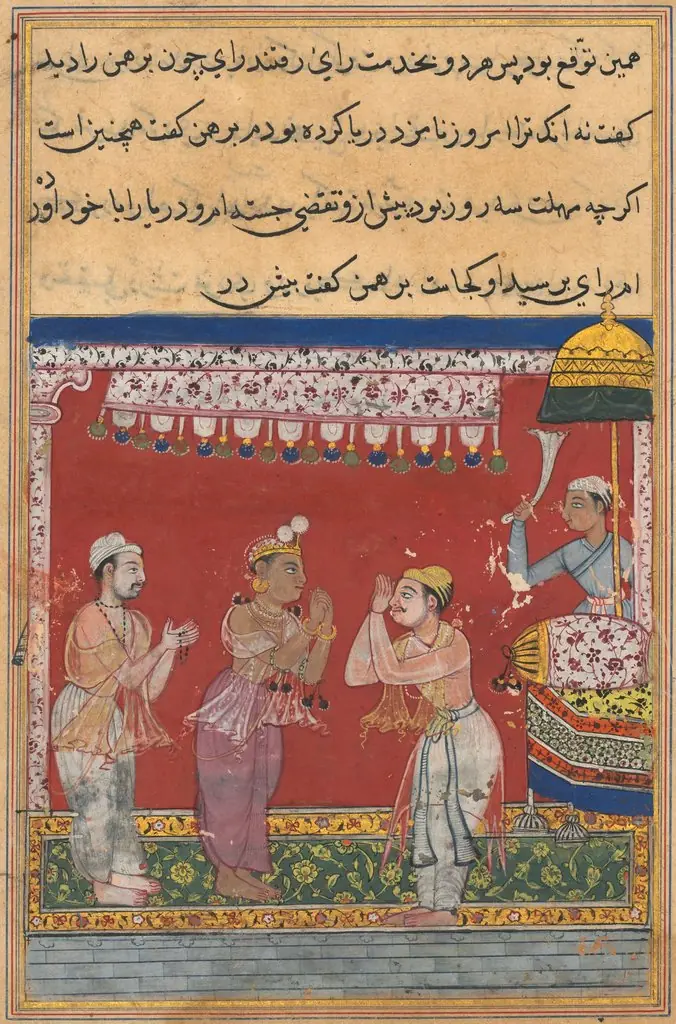 The king of the Ocean, having assumed human form, arrives at the court of the Raja, from a Tuti-nama (Tales of a Parrot): Eleventh Night
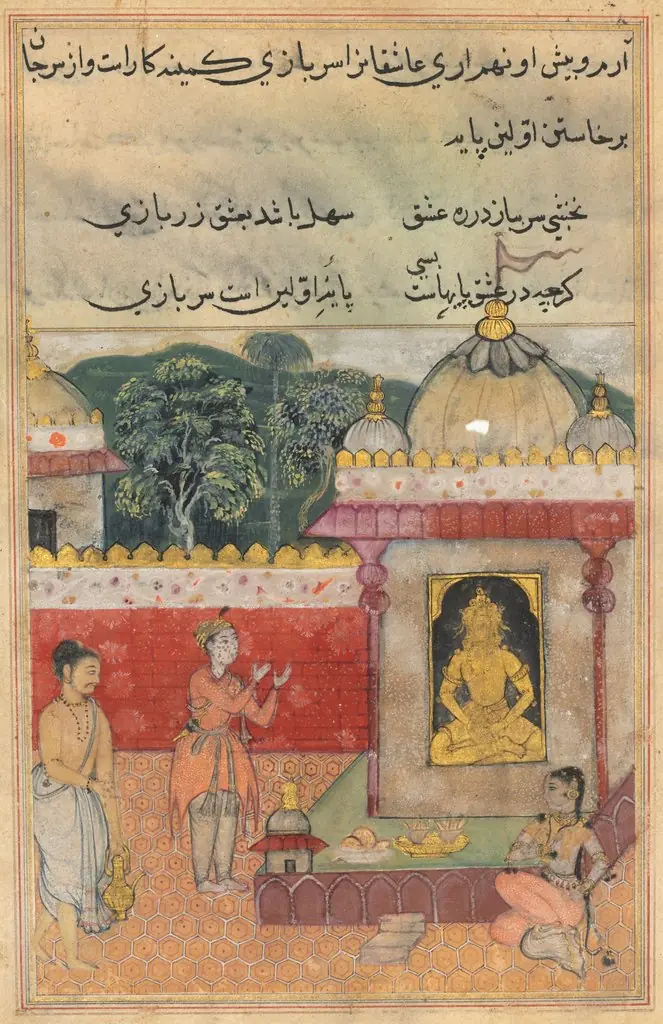 The Raja’s son vows to sever his head and offer it to the image if he is united with the princess he has seen in the temple, from a Tuti-nama (Tales of a Parrot): Thirty-fourth Night
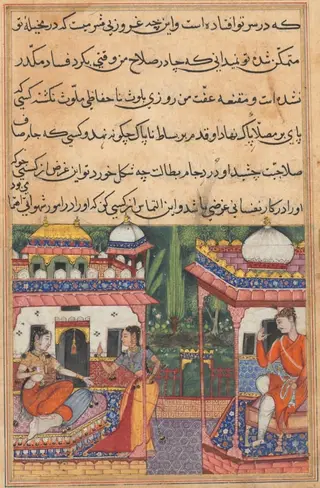 Kaiwan sends a message of love to Khurshid, wife of his brother Utarid who is away on a journey, from a Tuti-nama (Tales of a Parrot): Thirty-second Night
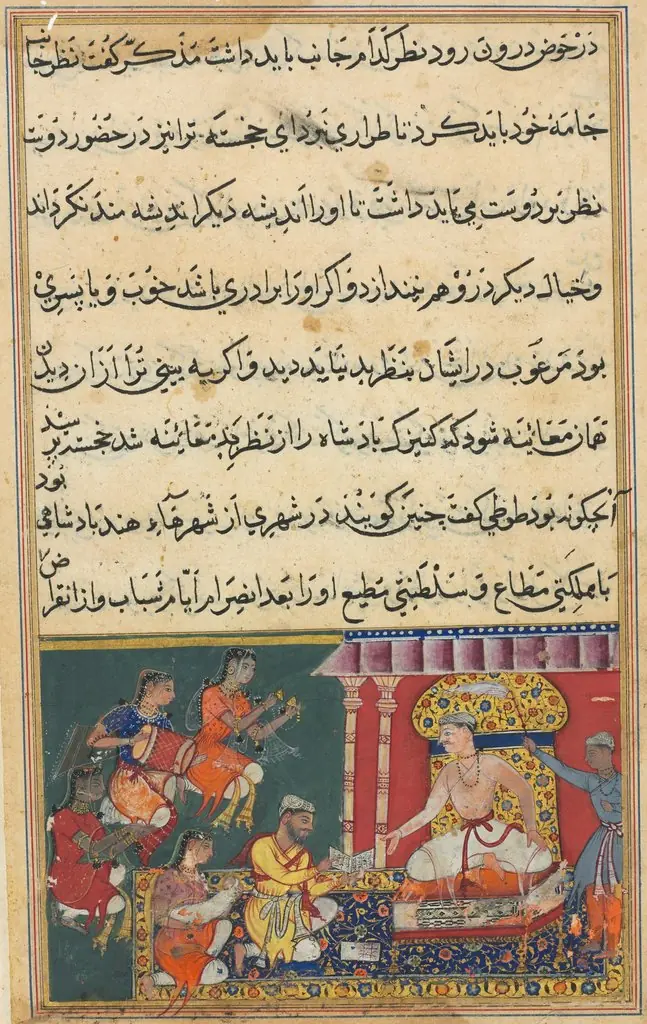 The astrologer predicts a calamity for the newly born prince in his thirteenth year, but one which he would be able to overcome, from a Tuti-nama (Tales of a Parrot): Eighth Night