Artwork
Emilia di Spilimbergo
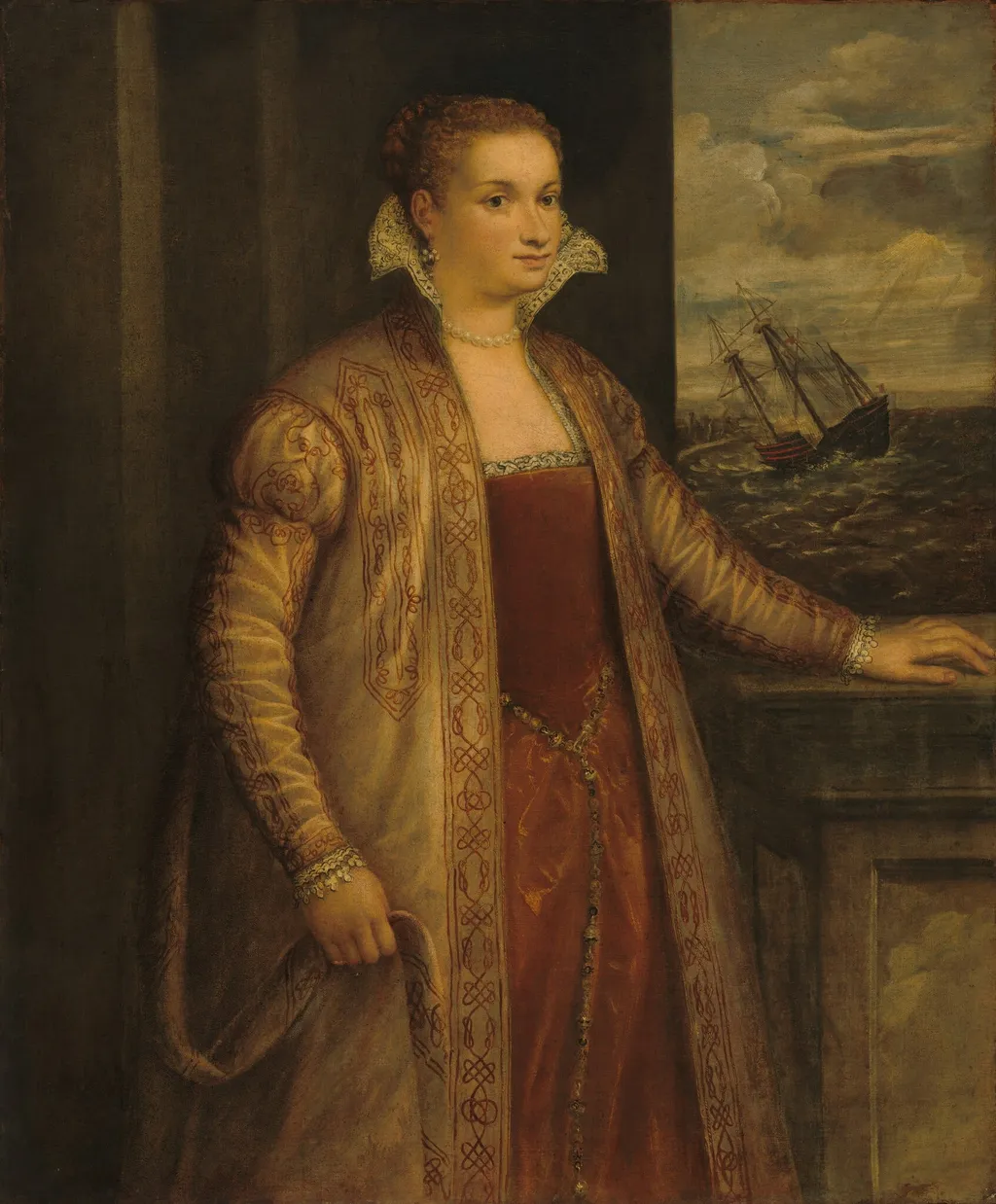
Emilia di Spilimbergo is an oil painting by the Renaissance artist Titian. It dates from 1560 and is held in the collection of the National Gallery of Art.
About this work
Technique & Style
The painting functions as a formal portrait, adhering to the conventions of the genre during the mid-sixteenth century.
Executed in 1560, this portrait is rendered in oil paint on a canvas support. The work measures 122 cm in height by 106.5 cm in width. While historically attributed to Titian, modern scholarship identifies the creator as Gian Paolo Pace.
The painting functions as a formal portrait, adhering to the conventions of the genre during the mid-sixteenth century. The application of oil medium on canvas was a standard technique for portraits of this scale and period, allowing for the specific textural qualities associated with the Venetian school.
History & Provenance
The portrait of Emilia di Spilimbergo was commissioned by the Spilimbergo family of Spilimbergo, Italy, around 1560 and executed in oil on canvas. After remaining in the family, it passed by inheritance to Count Giulio di Spilimbergo at Domanins, documented by 1819. Subsequent inheritances transferred the work to Count Niccolò d'Attimis Maniago in Florence by 1904 and then to his brother Count Enrico d'Attimis Maniago, who held it until 1909.
The painting was then acquired by Florentine dealer Elia Volpi, who sold it later that year to Duveen Brothers; Duveen sold it in October 1909 to American collector Peter A.B. Widener of Elkins Park, Pennsylvania. Following Widener’s death, the piece entered the Widener collection and was eventually given to the National Gallery of Art in Washington, D.C., where it resides today.
The painting Emilia di Spilimbergo, attributed to Titian and dated 1560, belongs to the National Gallery of Art in Washington, D.C., where it is recorded under accession number 1942.9.83. Its provenance follows a chain from the Spilimbergo family in Italy through several Venetian aristocrats to Peter A. B. Widener, whose estate transferred it to the museum in 1909. Exhibition history for the work is not noted in the available documentation.
Context
The portrait of Emilia di Spilimbergo, attributed to Titian and painted circa 1560, exemplifies late Venetian portraiture through its nuanced modeling and aristocratic subject matter. Scholarship identifies the work as a key example of Titian’s engagement with individual identity, situating it within the broader tradition of elite portraiture in Renaissance Italy. Its provenance, commissioned by the Spilimbergo family, passing through several Venetian nobles, sold by Duveen Brothers in 1909, and acquired by Peter A. B. Widener, highlights its movement into American collections.
Contemporary criticism, notably Corrado Ricci’s 1929 assessment, praised its “tizianeschi” character, reinforcing its standing in art‑historical narratives of the period.
Legacy
The painting remained in the Spilimbergo family until the early twentieth century, passing through several Venetian nobles before its sale to Duveen Brothers in 1909 and subsequent acquisition by Peter A. B. Widener; the work then entered the National Gallery of Art, Washington, D.C., where it is catalogued as a Titian portrait from circa 1560 (1,2). Its inclusion in a national collection has sustained scholarly interest, notably in Corrado Ricci’s 1929 analysis of ‘tizianeschi’ portraits, which underscores its role in mapping Titian’s influence on later European portraiture (1). The piece continues to inform studies of Venetian aristocratic representation and the evolution of oil portraiture.
Overview
Titian's Emilia di Spilimbergo, an oil on canvas from approximately 1560, exemplifies Venetian Renaissance portraiture. This work showcases the artist's renowned ability in capturing individual likeness, alongside his sophisticated command of color and compositional structure. It stands as a testament to his prominent role in the artistic developments of his era.
Subject & Meaning
The painting depicts a woman, presumably Emilia di Spilimbergo, adorned in a vibrant red dress and an elaborately patterned beige cloak. Her pearl necklace, earrings, and refined updo suggest a person of considerable social standing or nobility. She is positioned by a railing, gazing towards a distant seascape where a ship is visible, adding depth to the composition.
Own this work as a print
Artist & collection

Artist
Tiziano Vecellio (Italian:; c. 1488/1490 – 27 August 1576), Latinized as Titianus, hence known in English as Titian ( TISH-ən), was an Italian Renaissance painter. The most important artist of Renaissance Venetian…









 Female Portrait
 Portrait of a Young Lady
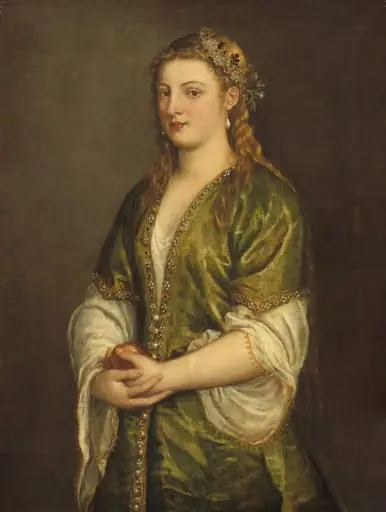 Woman Holding an Apple
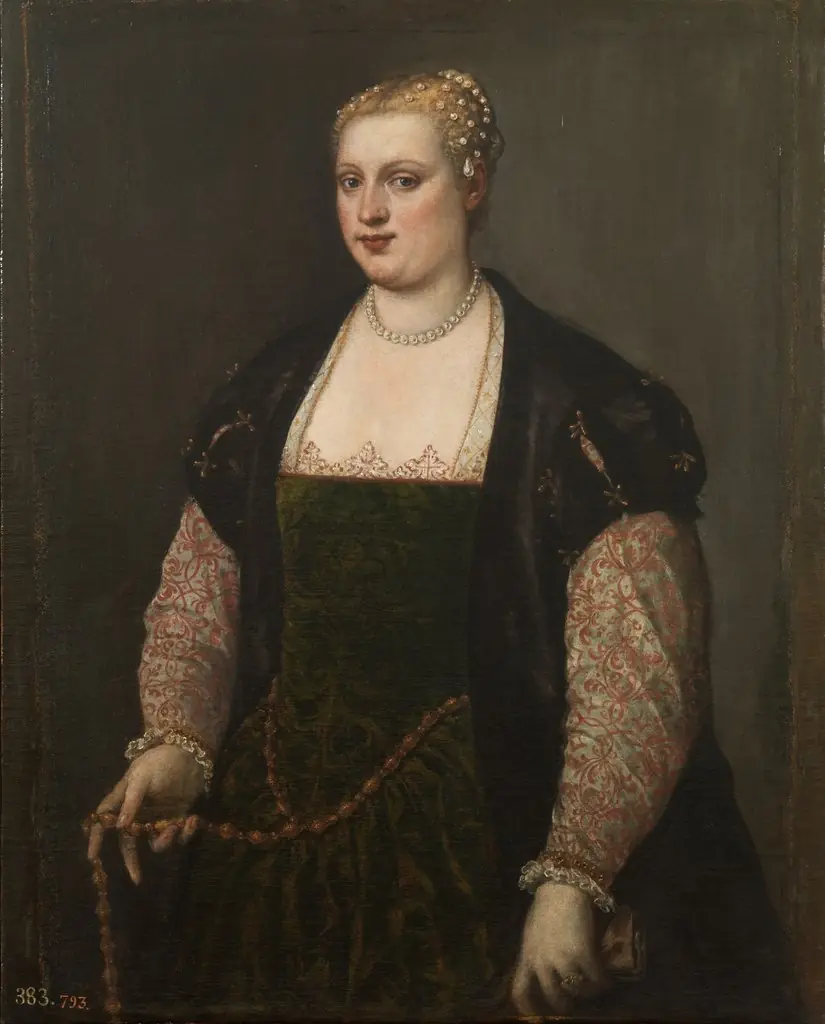 Portrait of a Woman
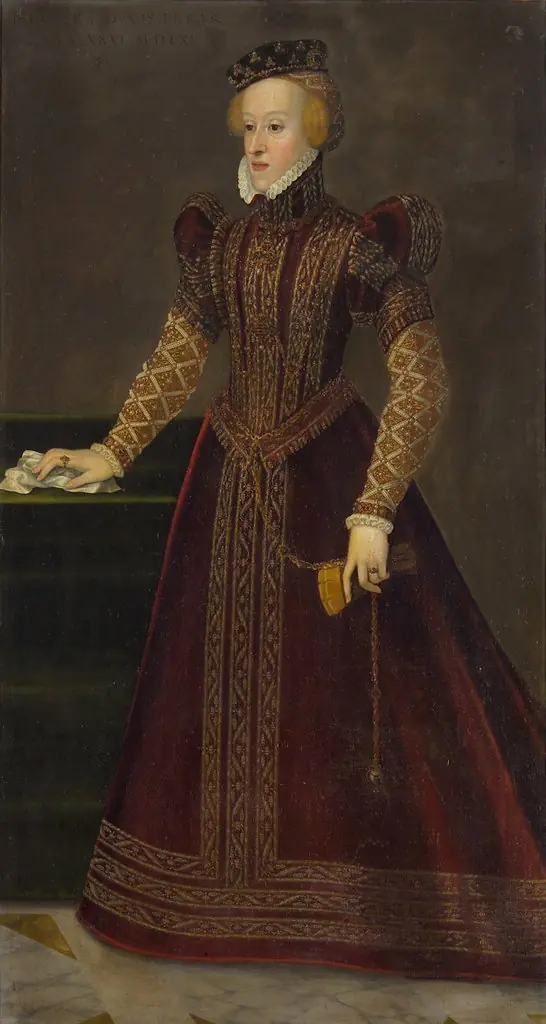 Erzherzogin Barbara (1539-1572), Herzogin von Ferrara in ganzer Figur
 Portrait of Isabella of Portugal
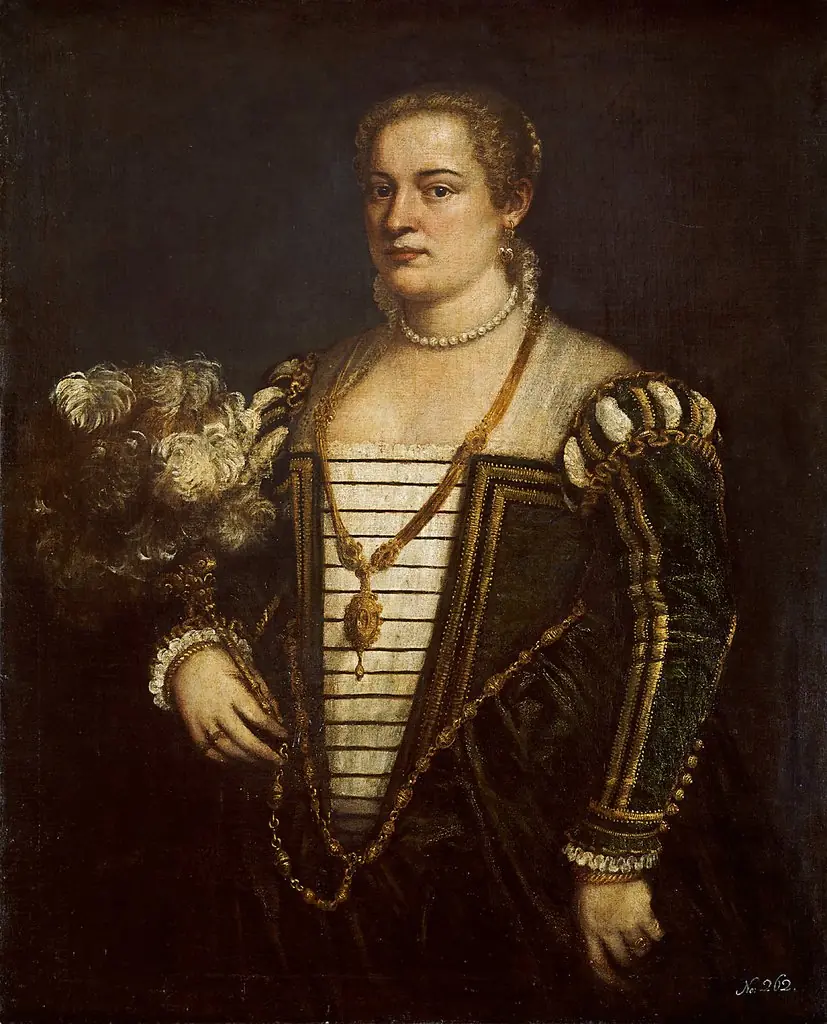 Portrait of the Artist's daughter Lavinia
 Portrait of a woman, traditionally identified as Isabella Brant
 Margaret, Duchess of Parma
 Livia Colonna
 Portrait of a Lady
- Irene di Spilimbergo